Industrial Sensors Technologies Guide With Smart Manufacturing Insights
Industrial sensors technologies are devices and systems that detect physical conditions and convert them into information that machines, control systems, and operators can use. They can measure factors such as temperature, pressure, motion, vibration, position, flow, light, humidity, distance, and chemical conditions.
The development of industrial sensors is closely connected with the growth of automation, electrical control systems, robotics, and computer-based manufacturing. Earlier industrial systems often depended heavily on manual observation and mechanical controls. Modern facilities can combine sensors with programmable controllers, industrial networks, software platforms, and data analysis tools.
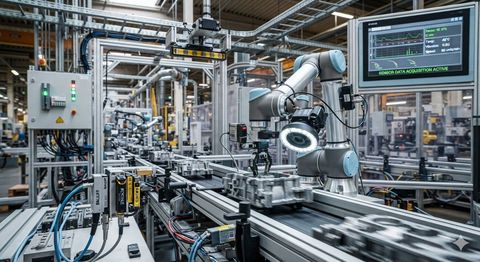
Smart manufacturing expands this concept by connecting sensor information with production equipment and digital systems. Instead of simply detecting whether a machine is running, industrial sensors can continuously provide measurements that help describe operating conditions. This creates a foundation for equipment monitoring, process control, quality management, and production analysis.
How Industrial Sensors Work
Most industrial sensors have three basic functions. First, a sensing element detects a physical or environmental condition. Second, the sensor converts that condition into an electrical or digital signal. Third, a control or monitoring system interprets the signal.
For example, a temperature sensor may detect heat inside an industrial process and transmit a corresponding signal to a controller. If the measured value moves outside a defined operating range, the control system can respond according to its programmed settings.
Industrial sensors can use different technologies, including:
- Resistive and capacitive sensing
- Optical detection
- Magnetic sensing
- Ultrasonic measurement
- Radar-based detection
- Piezoelectric sensing
- Semiconductor-based measurement
- Electromagnetic flow measurement
The appropriate technology depends on the material, environment, measurement range, accuracy requirements, and operating conditions.
Common Industrial Sensor Types
Different manufacturing processes require different forms of measurement. A production line may use several sensor categories at the same time.
| Sensor Type | Common Measurement | Typical Industrial Use |
|---|---|---|
| Temperature Sensor | Heat | Furnaces, motors, processing equipment |
| Pressure Sensor | Pressure | Pumps, hydraulic systems, pipelines |
| Proximity Sensor | Object presence | Assembly and material handling |
| Photoelectric Sensor | Light interruption | Product detection and counting |
| Flow Sensor | Liquid or gas flow | Process and fluid systems |
| Vibration Sensor | Machine vibration | Equipment condition monitoring |
| Position Sensor | Location or movement | Robotics and automated machinery |
| Humidity Sensor | Moisture in air | Controlled production environments |
| Level Sensor | Material level | Tanks, silos, and containers |
Importance
Industrial sensors matter because automated equipment depends on information. Without measurement data, a controller cannot accurately determine many machine conditions or process changes. Sensors therefore form a connection between the physical production environment and digital control systems.
Problems Sensors Help Address
Manufacturing processes can experience temperature changes, pressure variations, mechanical movement, material shortages, vibration, alignment issues, and other conditions that may not be immediately visible to an operator. Industrial sensors technologies can detect these changes and transmit information for monitoring or control.
Common applications include:
- Detecting products on conveyor systems
- Measuring temperatures during processing
- Monitoring hydraulic pressure
- Measuring liquid movement through pipes
- Detecting machine vibration
- Confirming the position of mechanical components
- Checking material levels in containers
- Monitoring environmental conditions
- Supporting automated inspection processes
These applications affect manufacturers, machine operators, engineers, maintenance teams, quality personnel, and workers who interact with automated equipment. The information can also contribute to safer and more consistent production when systems are correctly designed and maintained.
Role in Smart Manufacturing
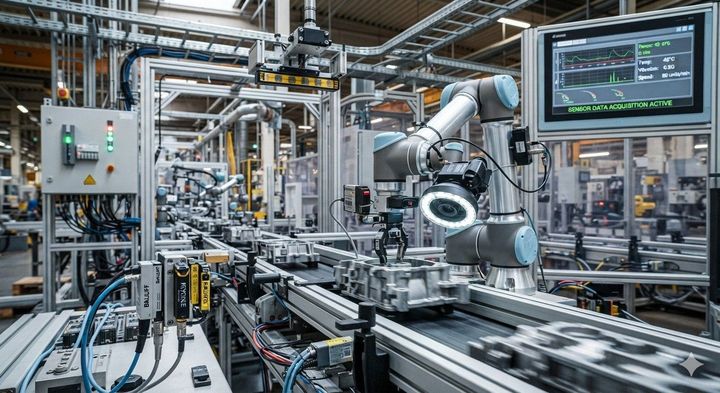
Smart manufacturing uses connected equipment, digital communication, software, and data analysis to create a more observable production environment. Sensors provide much of the raw information used by these systems.
For example, vibration sensors can continuously record machine movement. Software can analyze the data for unusual patterns, while maintenance personnel can investigate the equipment when readings change significantly.
This approach is different from relying only on periodic manual inspections. Continuous measurements can provide additional information about how equipment behaves between inspections, although sensor data still requires appropriate interpretation.
Sensor Selection Factors
Choosing an industrial sensor involves more than selecting a measurement category. The surrounding environment can strongly affect sensor operation.
Important considerations include:
- Measurement range
- Accuracy and repeatability
- Response time
- Operating temperature
- Exposure to dust, moisture, chemicals, or vibration
- Electrical compatibility
- Communication protocol
- Installation requirements
- Maintenance requirements
- Data security considerations
A sensor designed for a clean indoor environment may not be suitable for a location exposed to high temperatures, liquids, or heavy mechanical vibration.
Recent Updates
From 2024 through 2026, industrial sensors have increasingly been associated with connected manufacturing, edge computing, industrial Internet of Things systems, artificial intelligence, and digital production platforms. The general direction has been toward collecting more machine information while processing some data closer to the equipment.
Growth of Connected Sensors
Modern industrial sensors can communicate through various wired and wireless technologies. Ethernet-based industrial networks, fieldbus systems, IO-Link, wireless industrial networks, and other communication methods can connect sensors with controllers and software platforms.
Connected sensors can make measurements easier to integrate into broader manufacturing systems. Instead of treating every sensor as an isolated device, facilities can organize information across machines and production areas.
Edge Processing and Data Analysis
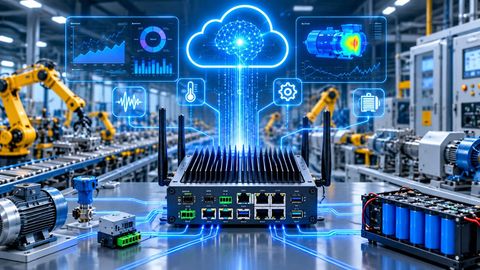
Edge computing is another important development. In this approach, some data processing occurs near the machine rather than sending every measurement to a distant computing environment.
This can reduce communication requirements and support rapid responses where timing matters. It can also allow facilities to filter or organize sensor data before transferring larger datasets to centralized systems.
Artificial Intelligence and Predictive Monitoring
Artificial intelligence and machine learning are increasingly being explored for industrial condition monitoring. Sensor readings such as vibration, temperature, pressure, and electrical characteristics can provide datasets for identifying unusual operating patterns.
These technologies do not automatically determine the physical cause of every abnormal reading. Their usefulness depends on sensor quality, data history, system configuration, and appropriate human interpretation.
More Integrated Sensor Platforms
Industrial automation increasingly combines sensing, communication, diagnostics, and configuration capabilities. Smart sensors may provide additional information about their own operating condition or measurement quality.
This trend supports more detailed monitoring while also increasing the importance of cybersecurity, data management, system compatibility, and technical configuration.
Laws or Policies
Industrial sensors are affected by different rules depending on the country, industry, equipment type, and intended application. There is no single worldwide regulation covering every industrial sensor.
Product and Electrical Requirements
Many industrial environments use electrical and electronic equipment that must meet applicable safety, electromagnetic compatibility, environmental, or product requirements. Standards organizations and national authorities establish requirements that can influence sensor design and installation.
Industrial facilities may also need to follow workplace safety rules governing machinery, electrical installations, hazardous environments, and operator protection.
Industrial Data and Cybersecurity
Connected industrial sensors can generate operational data that moves through networks and digital platforms. As industrial systems become more connected, cybersecurity policies and organizational controls have become increasingly relevant.
Facilities may use network segmentation, access controls, authentication, software updates, monitoring, and secure communication practices. Specific requirements vary by jurisdiction and industry.
Environmental Considerations
Certain industrial environments involve chemicals, gases, dust, high temperatures, or other potentially hazardous conditions. Sensors installed in these areas may need specific equipment classifications or protective designs.
Organizations should verify applicable national regulations, industry standards, equipment certifications, and workplace requirements before deploying sensors in regulated environments.
Tools and Resources
Several categories of tools can help readers understand, select, configure, or analyze industrial sensors.
Sensor Configuration Tools
Manufacturer configuration software and engineering platforms can be used to set measurement ranges, communication parameters, diagnostic functions, and device settings. These tools vary according to sensor technology and communication architecture.
Industrial Automation Platforms
Programmable logic controller software, human-machine interface platforms, supervisory control systems, and industrial data platforms can display and process sensor measurements. They can also connect sensor information with machine controls and production records.
Measurement and Analysis Tools
Digital multimeters, signal analyzers, calibration equipment, vibration analyzers, temperature measurement instruments, and data logging platforms are commonly used when checking industrial sensor performance.
Standards and Technical Documentation
Technical manuals, installation instructions, engineering specifications, sensor datasheets, and applicable standards are important resources for understanding measurement limitations and operating requirements. These materials can help users compare technical characteristics without relying on promotional claims.
FAQs
What are industrial sensors technologies?
Industrial sensors technologies include devices and methods used to detect physical conditions such as temperature, pressure, motion, vibration, flow, position, and humidity. The information can be transmitted to industrial control or monitoring systems.
How do industrial sensors support smart manufacturing?
Industrial sensors provide measurements that can be collected by automation and digital systems. In smart manufacturing, this information can support process monitoring, machine analysis, quality control, and data-driven production management.
What types of industrial sensors are commonly used?
Common types include temperature sensors, pressure sensors, proximity sensors, photoelectric sensors, flow sensors, vibration sensors, level sensors, position sensors, and humidity sensors. A production system may use several types simultaneously.
What should be considered when selecting an industrial sensor?
Users generally consider the measurement range, accuracy, response time, environmental conditions, electrical characteristics, communication method, installation requirements, and maintenance needs. Compatibility with the existing automation architecture is also important.
Are industrial sensors affected by regulations?
Yes. Depending on their application and location, industrial sensors may be subject to electrical safety, electromagnetic compatibility, hazardous-environment, workplace safety, environmental, and cybersecurity requirements. Applicable rules vary by jurisdiction and industry.
Conclusion
Industrial sensors technologies provide the measurement foundation for many automated and connected manufacturing systems. Temperature, pressure, vibration, motion, flow, position, and other sensors help transform physical conditions into usable information. Recent developments have increased integration with smart manufacturing, edge computing, industrial networks, and data analysis. Regulatory requirements, environmental conditions, cybersecurity, and technical compatibility remain important considerations when industrial sensor systems are designed and deployed.