Automated Packaging Lines Information With Smart Manufacturing and Process Automation
Automated packaging lines are integrated industrial systems designed to handle different stages of product packaging with limited manual involvement. These systems combine machines, sensors, conveyors, control panels, and software to move products through filling, sealing, labeling, inspection, and final packaging processes.
They are commonly used in food processing, pharmaceuticals, cosmetics, beverages, electronics, chemicals, and consumer goods manufacturing.
The development of automated packaging lines comes from the growing need to organize production activities and manage large product volumes. Traditional packaging methods relied heavily on manual handling, which could create inconsistent packaging quality, slower processing, and difficulties in maintaining uniform production standards. As manufacturing expanded, industries began adopting mechanical equipment and electronic controls to coordinate repetitive packaging activities.
Modern automated packaging lines combine mechanical engineering with digital technologies. Programmable logic controllers (PLCs), industrial sensors, robotic systems, and manufacturing software help coordinate different machines within a production facility. These technologies allow manufacturers to monitor operations, identify interruptions, and maintain consistent packaging processes.
Smart manufacturing has also influenced packaging automation. Instead of operating individual machines independently, connected equipment can exchange operational information and coordinate production activities. This approach creates a more organized manufacturing environment while helping businesses understand equipment performance and production requirements.
Main Components of Automated Packaging Lines
An automated packaging line contains several interconnected components. Each component performs a particular task within the overall packaging process.
Product feeding systems: Transfer products from manufacturing equipment to packaging machines.
Conveyor systems: Move products and packaging materials between processing stages.
Filling machines: Dispense liquids, powders, granules, or other materials into containers.
Sealing machines: Close packages using heat sealing, adhesive systems, or mechanical methods.
Labeling equipment: Apply product identification, instructions, and tracking information.
Inspection systems: Examine packages for visible defects, incorrect labels, or filling inconsistencies.
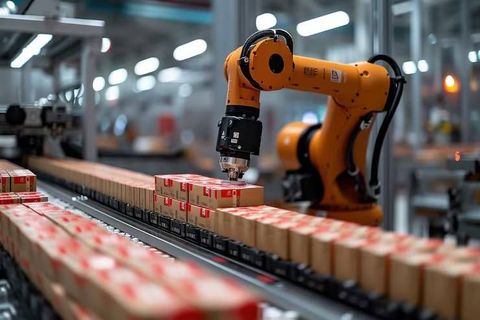
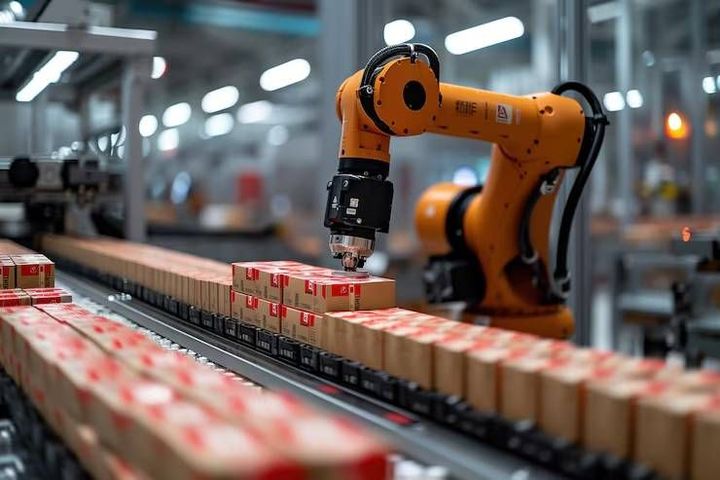
Robotic handling systems: Arrange, pick, and transfer products between different production stages.
The arrangement of these components depends on the product type, packaging material, production capacity, and facility layout.
Common Types of Automated Packaging Systems
Different industries require different packaging technologies. Some systems handle individual products, while others process bulk materials or multiple containers simultaneously.
Packaging System | Main Function | Common Applications |
|---|---|---|
Automatic filling machines | Dispense products into containers | Food, beverages, cosmetics |
Cartoning machines | Place products inside cartons | Pharmaceuticals, consumer goods |
Shrink packaging machines | Wrap products using shrink film | Retail products, electronics |
Case packing systems | Arrange products inside shipping cases | Food, beverages |
Palletizing systems | Stack packaged goods on pallets | Warehousing, manufacturing |
Vacuum packaging machines | Remove air from packaging | Food processing |
Form-fill-seal machines | Form, fill, and close packages | Snacks, powders, liquids |
These systems can operate individually or as part of a complete automated packaging line.
Importance
Automated packaging lines play an important role in modern manufacturing because packaging directly affects product protection, handling, identification, and distribution. As production requirements become more complex, manufacturers need organized processes that can handle different product formats and packaging materials.
The technology also affects consumers and distribution businesses. Proper packaging helps protect products during transportation, provides product information, and supports organized storage. In industries such as food processing and pharmaceuticals, packaging consistency is particularly important because products may require specific handling and identification procedures.
Production Efficiency and Process Consistency
Manual packaging involves repeated physical activities, including filling containers, closing packages, applying labels, and arranging finished products. Automated equipment performs many of these repetitive tasks through coordinated mechanical operations.
Important operational advantages include:
Continuous movement of products between packaging stages.
Consistent application of packaging procedures.
Reduced dependence on repetitive manual handling.
Improved coordination between production equipment.
Easier monitoring of production interruptions.
Better organization of packaging materials.
Automation does not eliminate every production challenge. Machines still require maintenance, calibration, cleaning, and operator supervision.
Product Quality and Packaging Accuracy
Packaging accuracy influences product presentation, identification, and protection. Automated filling systems can use sensors and controlled dispensing mechanisms to maintain specified filling levels.
Vision inspection systems can examine labels, package positions, container conditions, and other visible characteristics. When a packaging defect is detected, the system may separate the affected item for further inspection.
This process helps manufacturers identify inconsistencies before products move into distribution channels.
Workforce Safety and Material Handling
Packaging operations may involve repetitive movements, heavy containers, sharp packaging materials, and moving machinery. Automated conveyors and robotic handling equipment can reduce the need for workers to perform certain physically demanding activities.
However, automated packaging lines introduce their own workplace risks. Moving mechanical parts, electrical equipment, and high-temperature sealing systems require suitable machine guards, emergency stops, training, and operating procedures.
Recent Updates
The development of automated packaging lines increasingly focuses on smart manufacturing, digital monitoring, robotics, and flexible production systems. Manufacturers are integrating technologies that help equipment communicate and provide information about production conditions.
Artificial Intelligence and Machine Vision
Artificial intelligence is becoming more relevant to packaging inspection and production monitoring. Machine vision systems use cameras and image-processing software to examine products and packaging materials.
These systems can identify issues such as:
Incorrect label positioning.
Damaged packaging surfaces.
Missing product components.
Inconsistent package dimensions.
Incorrect printing or identification details.
AI-supported inspection can also help identify patterns in recurring production defects. However, its accuracy depends on camera quality, training data, lighting conditions, and system configuration.
Industrial Internet of Things Integration
Industrial Internet of Things (IIoT) technology connects packaging equipment through communication networks. Sensors collect information about temperature, machine speed, operating conditions, and equipment performance.
Manufacturing teams can use this information to monitor production activities and identify unusual operating conditions. Connected equipment also supports predictive maintenance by helping technical teams recognize potential equipment problems before they cause major interruptions.
Robotics and Flexible Packaging Automation
Robotic systems are increasingly used for product picking, sorting, carton loading, and palletizing. Collaborative robots can also work near human operators when the equipment and workplace have been designed with appropriate safety measures.
Flexible automation is another important development. Modern packaging systems can be configured to handle different container sizes, product formats, and packaging materials. This flexibility is useful for manufacturers managing several product variations within the same facility.
Digital Manufacturing and Automation Trends
Technology | Purpose | Manufacturing Application |
|---|---|---|
Artificial intelligence | Analyze production information | Defect identification |
Machine vision | Inspect product appearance | Label and package inspection |
IIoT sensors | Collect equipment information | Operational monitoring |
Collaborative robots | Support material handling | Product loading |
Digital twins | Simulate equipment operations | Production planning |
Predictive maintenance | Identify potential equipment issues | Maintenance scheduling |
Manufacturing execution systems | Coordinate production activities | Production tracking |
These developments indicate a broader movement toward connected, data-driven packaging operations.
Laws or Policies
Automated packaging lines are influenced by industrial safety requirements, machinery standards, packaging regulations, product labeling rules, and environmental policies. The exact requirements depend on the country, product category, manufacturing environment, and intended distribution market.
In India, industrial packaging operations are influenced by several regulatory frameworks. Businesses operating packaging equipment need to understand the requirements applicable to machinery safety, packaged products, workplace conditions, and environmental management.
Machinery and Workplace Safety
The Occupational Safety, Health and Working Conditions Code, 2020, forms part of India's framework for workplace health and safety. Applicable requirements address occupational safety, worker protection, and working conditions.
Packaging facilities should consider appropriate machine guarding, emergency stopping mechanisms, electrical protection, operator training, and equipment maintenance. Specific obligations depend on the applicable legislation and implementation requirements.
Packaging and Product Labeling
The Legal Metrology Act, 2009, and the Legal Metrology (Packaged Commodities) Rules, 2011, establish requirements concerning packaged commodities in India.
Depending on the product and applicable rules, packaging information may include:
Manufacturer or packer identification.
Product name and description.
Net quantity or declared measurement.
Manufacturing or packaging information.
Maximum retail price where applicable.
Consumer-related declarations.
Automated labeling and printing equipment can help manufacturers apply consistent information to packaging. However, the accuracy and legal compliance of the printed information remain the responsibility of the relevant business.
Food Packaging Requirements
Food manufacturing and packaging activities are governed by the Food Safety and Standards Authority of India (FSSAI). Applicable food safety requirements address packaging materials, hygiene, product handling, labeling, and other relevant manufacturing conditions.
Food packaging equipment must be suitable for its intended application and compatible with the materials being processed.
Environmental and Waste Management Requirements
Packaging manufacturers may also need to consider the Plastic Waste Management Rules, 2016, and subsequent amendments. These rules establish requirements concerning plastic waste management and applicable extended producer responsibility obligations.
Manufacturers should assess packaging material selection, waste segregation, recycling arrangements, and applicable reporting responsibilities.
Tools and Resources
Several digital tools and industrial platforms help manufacturers plan, monitor, and manage automated packaging lines. The appropriate selection depends on production requirements, equipment compatibility, and operational complexity.
Packaging Design and Engineering Software
Computer-aided design (CAD) software helps engineers create equipment layouts, conveyor arrangements, machine components, and packaging configurations.
Common applications include:
3D equipment modeling.
Packaging material design.
Factory layout planning.
Conveyor movement analysis.
Mechanical component development.
Simulation tools can also help engineers examine production layouts before physical installation.
Manufacturing Execution Systems
Manufacturing Execution Systems (MES) coordinate production activities and collect operational information from manufacturing equipment.
Common functions include production scheduling, batch tracking, equipment monitoring, quality records, and production reporting. MES platforms can connect packaging lines with broader enterprise resource planning systems.
Industrial Automation Platforms
Industrial automation platforms support machine control, monitoring, and communication between different equipment.
Examples include:
Siemens SIMATIC automation systems.
Rockwell Automation FactoryTalk platforms.
Schneider Electric EcoStruxure solutions.
ABB industrial automation platforms.
Mitsubishi Electric factory automation systems.
These platforms support different industrial applications, and compatibility depends on equipment specifications and system architecture.
Packaging Performance Measurement
Manufacturers can monitor several indicators to understand automated packaging line performance.
Performance Indicator | What It Measures |
|---|---|
Overall Equipment Effectiveness (OEE) | Availability, performance, and quality |
Production Throughput | Products processed within a period |
Rejection Rate | Percentage of rejected packages |
Downtime | Time equipment remains unavailable |
Changeover Time | Time required to switch product formats |
Packaging Material Usage | Amount of material consumed during production |
Monitoring these indicators provides useful information for production planning, equipment maintenance, and process improvement.
FAQs
What Are Automated Packaging Lines?
Automated packaging lines are connected industrial systems that perform packaging activities such as filling, sealing, labeling, inspection, and palletizing with limited manual involvement.
How Does Smart Manufacturing Improve Packaging Automation?
Smart manufacturing connects packaging equipment through sensors, software, and industrial communication networks. It helps manufacturers monitor machine performance, identify production issues, and coordinate different packaging processes.
Which Industries Use Automatic Packaging Machines?
Food processing, pharmaceuticals, cosmetics, beverages, electronics, chemicals, and consumer goods manufacturing commonly use automatic packaging machines. Equipment selection depends on product characteristics and packaging requirements.
What Is the Role of Robotics in Automated Packaging Lines?
Robotics supports product picking, sorting, carton loading, case packing, and palletizing. Robotic systems can improve handling consistency and reduce repetitive physical activities.
What Factors Affect Industrial Packaging Line Selection?
Important considerations include product type, packaging material, production capacity, container dimensions, factory layout, equipment compatibility, maintenance requirements, and applicable safety regulations.
Conclusion
Automated packaging lines combine mechanical equipment, robotics, sensors, and software to coordinate industrial packaging operations. Smart manufacturing technologies are expanding their capabilities through digital monitoring, machine vision, artificial intelligence, and predictive maintenance. Regulatory requirements concerning machinery safety, product labeling, food packaging, and environmental management also influence packaging operations. Understanding these technologies and requirements provides useful insight into the development of modern manufacturing systems.

You May Also Like