Carbon Steel Tube Mill Machine Guide With Precision Manufacturing and Industrial Engineering Solutions
A Carbon Steel Tube Mill Machine is an industrial production system used to manufacture tubes and pipes from carbon steel strips or coils.
The process generally involves forming flat steel into a cylindrical shape, joining the edges through welding, and completing operations such as sizing, straightening, and cutting. These machines are used in manufacturing environments that require consistent tube dimensions, repeatable production processes, and controlled material properties.
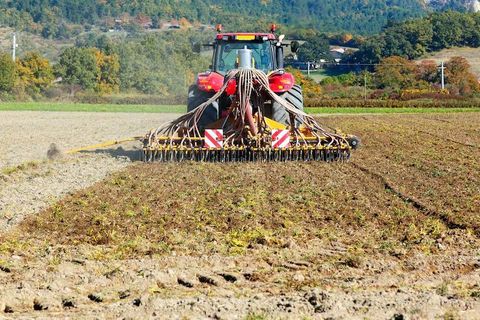
Carbon steel tubes are widely used in construction, transportation, mechanical engineering, agricultural equipment, furniture manufacturing, and industrial infrastructure. Their applications vary according to wall thickness, outside diameter, steel grade, surface condition, and mechanical requirements.
Tube mill technology developed alongside advances in steel production, rolling equipment, welding methods, and industrial automation. Modern systems combine mechanical forming stations, welding equipment, measurement instruments, and electronic controls to maintain production consistency.
How a Carbon Steel Tube Mill Works
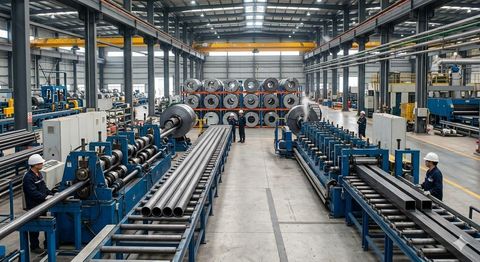
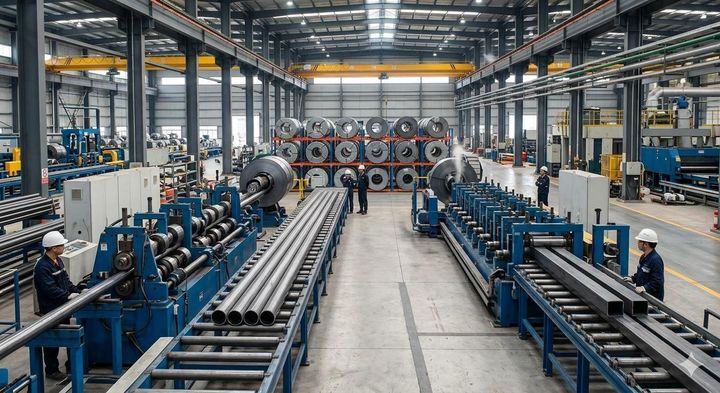
A typical carbon steel tube mill processes steel coil through several connected stages. Each stage contributes to the final tube's shape, dimensional accuracy, and structural quality.
The main production stages include:
Uncoiling: A decoiler releases the steel strip from a coil and feeds it into the production line.
Strip preparation: The strip edges are aligned, and the material is guided toward the forming section.
Roll forming: Multiple roller stands gradually bend the flat strip into a rounded tube shape.
Welding: The adjoining edges are joined, commonly through high-frequency electric resistance welding.
Bead removal: Excess weld material may be removed from the inside or outside, depending on product requirements.
Sizing and straightening: Additional roller stands refine the tube diameter, roundness, and straightness.
Cutting: A cutting system separates the continuous tube into specified lengths.
Inspection: Finished tubes are checked against dimensional, surface, and weld-quality requirements.
Not every production line uses an identical configuration. Equipment selection depends on tube dimensions, production volume, steel grade, welding method, and the intended application.
Common Types of Tube Mill Equipment
Carbon steel tube mill machines can be configured for different manufacturing needs. High-frequency welded tube mills are commonly used for continuous production of round, square, and rectangular hollow sections. Specialized lines may also support particular diameter ranges, wall thicknesses, or profile geometries.
Some systems are designed for rapid size changes, while others prioritize a narrower range of products with stable production settings. The correct configuration depends on the manufacturer's product specifications and the required process capability.
Importance
Precision Manufacturing and Industrial Applications
Dimensional accuracy is important because carbon steel tubes frequently connect with other components. Differences in diameter, wall thickness, straightness, or cut length can complicate assembly and affect the performance of a finished structure.
A precision tube mill helps control these variables through coordinated roller geometry, stable material feeding, welding controls, and measurement systems. However, actual accuracy depends on machine condition, material consistency, tooling setup, and inspection procedures.
Benefits for Manufacturing Operations
A properly configured tube production line can support repeatable manufacturing and reduce avoidable material losses. Automated feeding, cutting, and measurement functions may also reduce manual handling and improve process monitoring.
Important operational considerations include:
Production speed and stable material flow.
Consistency of tube diameter and wall thickness.
Weld integrity and defect detection.
Material utilization and scrap management.
Changeover time between product sizes.
Maintenance requirements and equipment availability.
Operator safety and energy consumption.
These factors influence production planning and the suitability of a tube mill for a particular industrial application.
Industries That Use Carbon Steel Tubes
Industry | Typical tube applications | Important requirements |
|---|---|---|
Construction | Structural frames and supports | Strength, dimensions, traceability |
Automotive | Frames and mechanical components | Dimensional control, material properties |
Furniture | Frames, legs, and supports | Surface finish, shape consistency |
Agriculture | Equipment frames and tubular components | Durability, dimensional suitability |
General engineering | Machine components and enclosures | Tolerances, machinability |
Energy infrastructure | Selected piping and structural applications | Applicable specifications, testing |
The intended application determines whether a standard structural tube is suitable or whether more demanding material, welding, and testing requirements apply.
Recent Updates
Industrial Automation and Digital Monitoring
During 2024–2026, industrial tube manufacturing continued to reflect broader developments in factory automation, connected equipment, and data-based quality management. Modern production systems increasingly incorporate programmable logic controllers, human-machine interfaces, electronic sensors, and automated process monitoring.
These technologies can help operators track production speed, detect process deviations, record machine settings, and coordinate equipment stages. Their practical value depends on sensor quality, system integration, operator training, and the accuracy of collected data.
Improvements in Welding and Quality Control
Welding control remains central to carbon steel tube manufacturing. Changes in material thickness, edge preparation, alignment, and welding conditions can influence the consistency of the joint.
Manufacturers may use automated monitoring, dimensional measurement, visual inspection, and suitable nondestructive testing methods to identify defects. The selection of testing methods depends on the applicable product specification and the consequences of a tube failure.
Energy Efficiency and Production Flexibility
Manufacturing facilities increasingly examine energy consumption, material utilization, and equipment downtime as part of operational planning. Efficient drive systems, preventive maintenance, optimized production settings, and improved scrap handling can support these objectives.
Another continuing development is flexible tooling and faster size adjustment. Such capabilities can help facilities produce multiple tube profiles, although the actual changeover time depends on the machine design and the complexity of each product.
Laws or Policies
Manufacturing Standards and Product Specifications
Carbon steel tube production is influenced by technical standards, workplace safety requirements, environmental rules, and product-specific regulations. Applicable requirements vary by destination market and intended use, so a tube mill manufacturer must distinguish general manufacturing capability from compliance with a particular standard.
Commonly referenced technical frameworks include ASTM, ISO, and EN standards. Different standards address different products, testing procedures, dimensions, material grades, and acceptance criteria; they are not interchangeable in every application.
For example, structural hollow sections, mechanical tubing, and pressure-related piping may require different specifications. A tube's suitability should be assessed against the requirements governing its intended application rather than its appearance alone.
Workplace Safety Requirements
Tube mill equipment contains moving rollers, rotating components, cutting mechanisms, electrical systems, and high-temperature or high-frequency welding equipment. These hazards require suitable engineering controls, operating procedures, and worker training.
Important safety measures may include:
Guards around hazardous moving parts.
Emergency-stop systems and clearly marked controls.
Safe coil loading and material-handling procedures.
Electrical isolation during maintenance.
Appropriate protective equipment.
Documented inspection and maintenance routines.
Lockout and isolation procedures are particularly important when maintenance exposes workers to unexpected machine movement or stored energy.
Environmental and Quality Management
Industrial facilities may need to manage welding-related emissions, metal scrap, lubricants, noise, and electricity consumption under applicable environmental requirements. The precise obligations depend on the location, facility operations, and production processes.
Quality management systems can support traceability, documented inspection, calibration, corrective action, and consistent manufacturing procedures. Compliance should be established through applicable documentation and verification rather than assumed from equipment specifications.
Tools and Resources
Engineering Calculations and Measurement Instruments
Engineering calculations help determine whether a proposed tube specification suits its intended use. Common inputs include outside diameter, wall thickness, tube length, material density, and required mechanical properties.
For a circular tube, the approximate cross-sectional area of the steel can be calculated as:
Here, \(D\) is the outside diameter and \(d\) is the inside diameter. The inside diameter can be estimated as the outside diameter minus twice the wall thickness, assuming a uniform wall.
The theoretical mass per unit length can then be estimated by multiplying the cross-sectional area by the material density. Actual mass may differ because of manufacturing tolerances, weld geometry, and variations in material composition.
Useful inspection instruments include outside micrometers, calipers, wall-thickness gauges, straightness measurement tools, and appropriate weld inspection equipment. Instruments should be selected and calibrated according to the required measurement accuracy.
Tube Mill Selection and Evaluation
When evaluating a carbon steel tube mill machine, engineering teams commonly compare technical specifications rather than relying on a single performance figure.
Evaluation factor | Information to examine | Why it matters |
|---|---|---|
Diameter range | Minimum and maximum tube sizes | Defines product capability |
Wall thickness | Supported thickness range | Affects forming and welding |
Line speed | Rated and practical operating speeds | Influences production planning |
Welding system | Method and control features | Affects weld formation |
Cutting equipment | Length accuracy and cutting method | Supports downstream assembly |
Changeover system | Tooling adjustments and setup needs | Influences production flexibility |
Quality monitoring | Sensors and inspection integration | Supports process control |
Maintenance access | Wear parts and inspection points | Affects equipment availability |
Maintenance and Production Records
A structured maintenance log can record roller condition, bearing temperature, lubrication, weld settings, alignment checks, cutting accuracy, and unplanned stoppages. Reviewing these records helps identify recurring defects and equipment wear.
Production records can also include coil identification, steel grade, material thickness, finished dimensions, inspection results, and rejected quantities. This information supports traceability and helps manufacturers investigate quality issues.
FAQs
What is a Carbon Steel Tube Mill Machine used for?
A Carbon Steel Tube Mill Machine forms steel strips into tubes and joins their edges, commonly through a welding process. The finished products are used in construction, machinery, transportation, furniture, and other industrial applications.
How does a carbon steel tube mill machine work?
The machine typically uncoils steel, forms it through roller stands, welds the edges, sizes the tube, cuts it to length, and checks the finished dimensions. Specific stages vary with the production line configuration.
What factors affect carbon steel tube mill precision?
Precision depends on roller alignment, steel thickness consistency, strip-edge preparation, welding conditions, sizing adjustments, tooling wear, and measurement accuracy. Regular inspection helps identify deviations.
Which standards apply to carbon steel tube manufacturing?
Applicable standards depend on the tube type, intended application, destination market, and required material properties. ASTM, ISO, and EN documents cover different aspects of materials, dimensions, manufacturing, and testing.
What maintenance does a carbon steel tube mill require?
Maintenance commonly includes checking rollers, bearings, drives, lubrication, alignment, welding equipment, sensors, guards, and cutting systems. The required frequency depends on operating conditions and the equipment manufacturer's maintenance instructions.
Conclusion
Carbon steel tube mill machines combine forming, welding, sizing, cutting, and inspection processes to manufacture tubes for a wide range of industrial applications. Precision depends on equipment configuration, material consistency, process control, and systematic quality checks. Automation and digital monitoring are increasingly relevant to production oversight, while safety and applicable technical standards remain essential considerations. Understanding these factors helps explain how tube mill engineering supports reliable manufacturing operations.