Agricultural Machinery Guide With Modern Farming Equipment and Technology Insights
Agricultural machinery refers to the equipment used to prepare land, plant crops, manage fields, harvest produce, and handle materials after harvesting. It developed to reduce physically demanding tasks and improve the timing of agricultural operations.
Early farming relied mainly on hand tools and animal power, while later developments introduced engines, tractors, harvesters, irrigation equipment, and specialized implements.
Modern agricultural machinery includes much more than tractors. Farm equipment can include soil preparation machines, seed drills, planters, sprayers, fertilizer spreaders, irrigation equipment, crop harvesters, balers, grain handling systems, and post-harvest equipment. Digital technologies can connect machines with positioning systems, sensors, cameras, software, and field data.
The main idea behind agricultural mechanization is matching equipment with the farming task, crop, terrain, and scale of operation. Sustainable mechanization also considers resource use, environmental effects, and operator safety.
Main Types of Agricultural Machinery
Agricultural equipment can be grouped according to the stage of crop production. Common categories include:
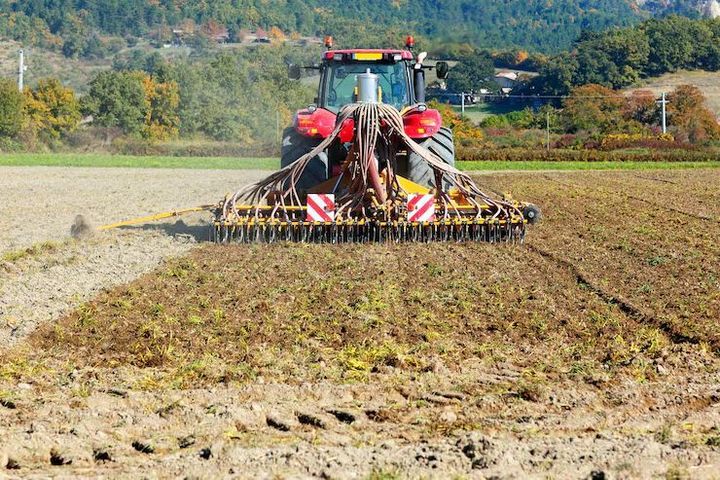
- Land preparation equipment such as plows, harrows, cultivators, and rotary tillers.
- Planting equipment such as seed drills, planters, transplanters, and precision seeders.
- Crop management equipment such as fertilizer spreaders, sprayers, weed control machines, and irrigation systems.
- Harvesting equipment such as combine harvesters, forage harvesters, potato harvesters, and specialized crop machines.
- Post-harvest equipment such as grain dryers, cleaners, conveyors, storage systems, and sorting equipment.
Tractors remain a central power source because different implements can be attached to one platform. Smaller machines and specialized equipment can support farms where field size or crop type makes large machinery unsuitable.
Importance
Agricultural machinery matters because farming requires many operations to be completed within limited seasonal windows. Delayed soil preparation, planting, irrigation, weed control, or harvesting can affect crop quality and field productivity. Mechanization can help reduce physical workload and improve the timing and consistency of repeated operations. FAO identifies reduced hard labour, improved timeliness, resource efficiency, and greater productivity among important reasons for sustainable mechanization.
Problems Addressed by Farm Equipment
Modern farm equipment addresses several practical challenges:
- Labour intensity: Machines can perform repetitive or physically demanding tasks that would otherwise require substantial manual effort.
- Timing: Equipment can help complete planting and harvesting activities within narrow agricultural windows.
- Field accuracy: Guidance systems and precision equipment can improve the consistency of planting, application, and field movement.
- Resource management: Variable-rate equipment, sensors, and automated controls can support more targeted use of water, seed, fertilizer, and crop protection inputs.
- Post-harvest handling: Cleaning, drying, sorting, and transport equipment can help protect harvested materials during handling.
Results vary with machine design, operator skill, field conditions, maintenance, and infrastructure. Mechanization is therefore not simply a matter of using larger equipment; appropriate technology depends on local conditions.
Equipment and Typical Uses
| Equipment | Main agricultural use | Common technology features |
|---|---|---|
| Tractor | Pulling and powering implements | GPS guidance, telematics, electronic controls |
| Planter | Placing seed in prepared soil | Row control, seed monitoring, precision placement |
| Cultivator | Soil and weed management | Adjustable working depth, field monitoring |
| Sprayer | Applying crop protection materials | Section control, sensors, variable application |
| Combine harvester | Harvesting and separating grain crops | Yield monitoring, automated settings |
| Irrigation system | Delivering water to crops | Sensors, timers, flow monitoring |
| Drone | Field observation and mapping | Cameras, positioning systems, image analysis |
| Grain dryer | Reducing moisture after harvest | Temperature and airflow controls |
Recent Updates
From 2024 through 2026, agricultural machinery development has increasingly connected mechanical equipment with digital agriculture, automation, artificial intelligence, and precision farming. This trend includes automated guidance, field sensors, machine data, robotics, and equipment that can support more precise field operations. FAO has highlighted digital tools, artificial intelligence, precision agriculture, and sustainable mechanization as areas of continuing development.
Precision Agriculture
Precision agriculture uses location data, field measurements, sensors, imagery, and software to support decisions at a more detailed field level. GPS or satellite positioning can guide machinery along planned paths, while sensors can monitor soil, crop conditions, machine performance, or application rates.
Precision farming connects field information with specific agricultural actions, including section control, automated steering, variable-rate application, yield mapping, and sensor-based irrigation management.
Automation and Autonomous Equipment
Automation is also expanding. Some agricultural machines can perform specific functions with limited operator input, while more advanced systems combine cameras, positioning, sensors, machine controls, and software to manage field movement or individual tasks.
International safety standards have also developed alongside these technologies. ISO 18497-1:2024 addresses design principles and vocabulary for partially automated, semi-autonomous, and autonomous agricultural machinery, while related parts address autonomous operating zones and verification methods.
Connected Farm Equipment
Connected agricultural machinery can collect operational information and transfer data for monitoring and analysis. Telematics may record machine location, operating hours, fuel or energy use, field activity, and selected equipment conditions. This can support maintenance planning, fleet coordination, field records, and equipment utilization analysis.
Digital agriculture also requires connectivity, data management, cybersecurity, operator training, and system compatibility.
Laws or Policies
Rules affecting agricultural machinery vary by country, machine type, operating environment, and intended use. Regulations can cover machinery safety, electrical systems, emissions, noise, road movement, operator protection, chemical application equipment, and environmental practices.
Machinery Safety
Safety requirements generally address hazards such as moving parts, power transmission systems, braking, steering, rollover risks, guarding, emergency controls, and safe operating procedures. Automated machinery introduces additional concerns involving sensors, perception systems, autonomous operating areas, and human-machine interaction.
International standards can provide technical frameworks, but they do not automatically replace national laws. Farmers, equipment operators, manufacturers, and other users may need to follow the rules applicable in their jurisdiction.
Environmental and Agricultural Rules
Some jurisdictions regulate fuel emissions, noise, water use, chemical application, soil protection, and waste handling. Agricultural equipment used on public roads may also be subject to separate requirements involving registration, lighting, dimensions, braking, speed, and operator licensing.
Government agricultural programs can also influence mechanization through equipment standards, training initiatives, rural development programs, digital agriculture strategies, or support for sustainable farming practices. Because these programs differ by location, current local rules should be checked before equipment is operated or modified.
Tools and Resources
Farm machinery decisions increasingly rely on a combination of physical equipment and digital resources. Equipment manuals, maintenance schedules, field maps, weather platforms, soil databases, crop monitoring applications, and machinery management software can support routine planning.
Digital Farming Tools
Common resources include GPS field mapping tools, farm management platforms, yield-monitoring systems, irrigation controllers, soil sensors, weather applications, and drone-based imaging systems. These tools can help organize field information and identify changes that may not be visible from ground level.
Agricultural machinery databases and equipment catalogs can also help users compare machine categories, technical specifications, power requirements, attachment compatibility, and operating characteristics. FAO maintains an equipment and manufacturers database as part of its sustainable mechanization resources.
Maintenance and Planning Resources
Maintenance records are another important resource. A basic machinery record can include operating hours, inspection dates, lubricant changes, filter replacement, component checks, calibration activities, and repairs.
Planning templates can track equipment, field locations, machine availability, energy use, storage needs, and seasonal schedules. Keeping these records can make it easier to identify recurring equipment issues and plan agricultural operations.
FAQs
What is agricultural machinery?
Agricultural machinery is equipment designed to support farming activities such as land preparation, planting, crop management, harvesting, transportation, and post-harvest handling. It ranges from simple powered tools to tractors, harvesters, automated machines, and digitally connected equipment.
What are the main types of agricultural machinery?
Major categories include tractors, plows, cultivators, planters, seed drills, sprayers, fertilizer spreaders, irrigation equipment, harvesters, balers, grain handling equipment, and post-harvest processing machines. The appropriate equipment depends on crop type, field conditions, farm scale, and the specific operation.
How does precision agriculture use modern farming equipment?
Precision agriculture combines positioning systems, sensors, field maps, imagery, and software with modern farming equipment. These technologies can support accurate guidance, variable-rate application, crop monitoring, yield mapping, and more controlled use of agricultural inputs.
What is autonomous agricultural machinery?
Autonomous agricultural machinery uses sensors, software, positioning technologies, and machine controls to perform selected agricultural tasks with reduced direct operator input. Safety systems and defined operating conditions are important parts of autonomous equipment design.
Why is agricultural mechanization important?
Agricultural mechanization can reduce physical workload, improve the timing of field operations, support more consistent work, and help manage resources. Its practical results depend on equipment suitability, operator skills, infrastructure, maintenance, and local farming conditions.
Conclusion
Agricultural machinery has developed from basic mechanical tools into integrated systems that can combine engines, implements, sensors, positioning technology, automation, and data analysis. Modern farming equipment supports activities across land preparation, planting, crop management, harvesting, and post-harvest handling. Recent developments emphasize precision agriculture, connected equipment, artificial intelligence, automation, and safety frameworks for advanced machinery. The role of mechanization continues to vary according to farm scale, crop requirements, environmental conditions, infrastructure, and applicable rules.