Industrial Metal Cutting Machines Guide With Precision Engineering and Metalworking Solutions
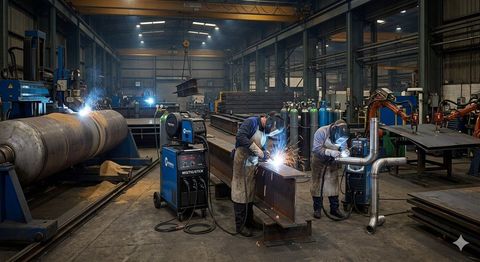
Industrial metal cutting machines are mechanical and automated systems designed to divide metal materials into controlled shapes and dimensions. They are used with materials such as steel, aluminum, copper, brass, and various metal alloys across manufacturing, construction, automotive, energy, fabrication, and engineering operations.
The development of metal cutting technology comes from the need to create repeatable dimensions while reducing unnecessary material removal and manual effort. Early metalworking relied heavily on hand tools and basic mechanical saws. Modern equipment combines motors, cutting tools, computerized controls, sensors, and precision mechanisms to handle increasingly complex production requirements.
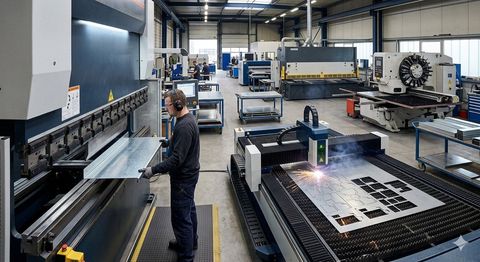
Industrial metal cutting machines include several equipment categories. Band saws use a continuous toothed blade, circular saw machines use rotating blades, abrasive cutting machines remove material through abrasive wheels, and CNC cutting systems use programmed movements to create controlled cutting paths.
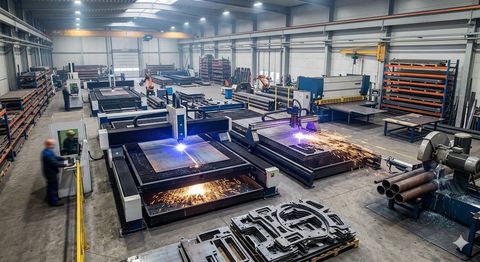
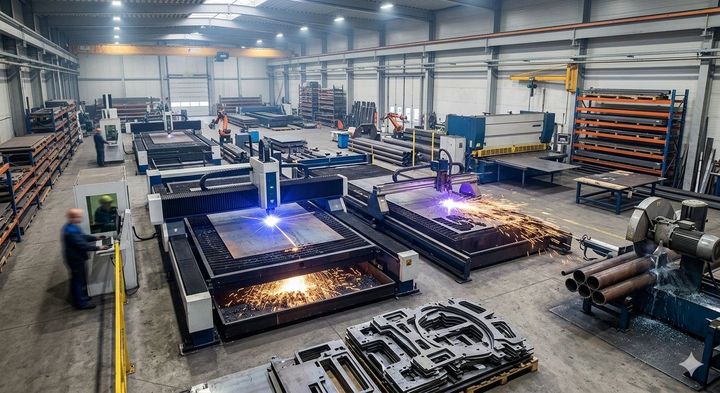
Other technologies include laser cutting machines, plasma cutting machines, waterjet cutting machines, shearing machines, and oxy-fuel systems. Each technology operates differently and is suited to particular material thicknesses, shapes, tolerances, and production environments.
How Metal Cutting Works
The basic process involves securing a workpiece, positioning a cutting tool, applying controlled cutting force or energy, and separating the material along a defined path. Depending on the machine, the cutting action can involve mechanical teeth, abrasive particles, thermal energy, or high-pressure water.
Machine selection depends on several factors:
- Material type and hardness
- Material thickness
- Required dimensional accuracy
- Cutting speed
- Shape and size of the workpiece
- Production volume
- Surface-finish requirements
- Available floor space
Main Types of Industrial Metal Cutting Machines
Different machines address different manufacturing requirements.
| Machine Type | Primary Cutting Method | Common Applications |
|---|---|---|
| Band Saw | Continuous toothed blade | Bars, pipes, profiles |
| Circular Saw | Rotating blade | Tubes, sheets, sections |
| Laser Cutter | Focused laser energy | Sheet and plate cutting |
| Plasma Cutter | Ionized gas arc | Conductive metal plates |
| Waterjet Cutter | High-pressure water stream | Heat-sensitive materials |
| Shearing Machine | Mechanical blade force | Sheet metal |
| Abrasive Cutter | Abrasive wheel | Bars and metal sections |
| Oxy-Fuel Cutter | Thermal flame | Thick steel plates |
| CNC Cutting System | Computer-controlled movement | Repeated precision profiles |
Importance
Industrial metal cutting machines play an important role in modern manufacturing because accurate material preparation affects many later production stages. Poorly controlled cutting can create dimensional variations, excess material waste, rough edges, and additional processing requirements.
Precision engineering has also increased the importance of controlled cutting. Components used in machinery, transportation equipment, structural assemblies, and industrial systems may need dimensions that remain within defined tolerances.
Who Uses Metal Cutting Equipment
Metal cutting technology affects manufacturers, fabricators, engineers, maintenance teams, construction operations, and other industrial users. The equipment also indirectly affects consumers because accurately manufactured metal components are incorporated into vehicles, buildings, appliances, machinery, and infrastructure.
For smaller workshops, machine size, operating complexity, and material flexibility can be important considerations. Large manufacturing environments may additionally require automated loading, material handling, CNC programming, inspection systems, and production monitoring.
Precision and Productivity Factors
Precision does not depend only on the cutting machine. Blade condition, machine alignment, material stability, cutting parameters, vibration, temperature, and operator setup can all influence results.
Computer numerical control systems can improve repeatability by following programmed cutting paths. Sensors and automated positioning systems can further reduce variations between production cycles.
A typical metal cutting workflow may include:
- Material inspection and measurement
- Workpiece positioning
- Machine setup
- Cutting parameter selection
- Cutting operation
- Edge or surface inspection
- Dimensional verification
- Secondary processing when required
Material Efficiency
Efficient cutting can help manufacturers use raw material more effectively. CNC nesting software, for example, can arrange multiple profiles on a sheet to reduce unused areas.
Material efficiency is particularly relevant when processing expensive alloys or large metal plates. However, actual material utilization depends on part geometry, cutting technology, kerf width, nesting strategy, and production requirements.
Recent Updates
From 2024 through 2026, industrial metal cutting has continued moving toward automation, digital control, energy management, and connected manufacturing. These developments build on established CNC and automated cutting technologies rather than replacing traditional equipment entirely.
Automation and Smart Manufacturing
Modern metal cutting machines increasingly integrate programmable controls, sensors, automatic positioning, and production monitoring. Connected equipment can collect information about machine operation, cutting cycles, tool condition, and production performance.
Artificial intelligence and machine-learning techniques are also being explored for process monitoring, quality inspection, predictive maintenance, and parameter optimization. Their practical use varies according to machine architecture and manufacturing requirements.
Fiber Laser Technology
Fiber laser systems have become an important technology for processing sheet and plate materials. Improvements in laser sources, motion systems, cutting heads, and control software have expanded the range of applications.
Modern systems can incorporate automatic focusing, nozzle monitoring, piercing controls, and material-recognition functions. These features can reduce setup complexity and support repeatable processing.
Digital Integration
Industrial equipment is increasingly connected with manufacturing software. CAD files can be converted into machine instructions, while production-management systems can track material usage and machine activity.
Digital twins, industrial Internet of Things platforms, and automated inspection systems are also becoming part of broader smart manufacturing environments. These technologies can help connect design, production, measurement, and maintenance information.
Energy and Environmental Considerations
Manufacturers are paying greater attention to energy consumption, consumable usage, material efficiency, and waste generation. Electric drive systems, improved laser sources, efficient motors, and automated process control can influence overall energy requirements.
Environmental performance depends on the complete manufacturing process rather than one machine specification. Cutting gases, lubricants, metal scrap, dust, fumes, and electricity consumption may all need consideration.
Laws or Policies
Metal cutting operations are generally influenced by workplace safety, machinery protection, electrical safety, environmental controls, and worker exposure requirements. The exact rules vary by country, industry, machine type, and workplace conditions.
Machine Safety Requirements
Industrial cutting equipment commonly requires safeguards around moving components, cutting zones, electrical systems, and emergency stopping mechanisms. Risk assessments can identify hazards associated with blades, lasers, plasma arcs, hot surfaces, flying particles, and automated movements.
Manufacturers and operators may need to follow applicable machinery safety standards, technical documentation requirements, guarding practices, and inspection procedures.
Workplace Exposure Controls
Some cutting processes generate metal dust, fumes, smoke, noise, or heat. Appropriate ventilation, extraction systems, protective equipment, and workplace controls may be required depending on the process and local regulations.
Laser and plasma equipment can also introduce optical and thermal hazards. Controlled operating areas, protective enclosures, warning systems, and suitable protective equipment may be part of a compliant workplace arrangement.
Environmental Rules
Environmental requirements can apply to metal scrap, hazardous process residues, emissions, wastewater, and other manufacturing outputs. Because regulatory requirements differ between jurisdictions, operators should consult the rules applicable to their specific location and process.
Tools and Resources
Several digital and physical tools help people understand, plan, and manage industrial metal cutting operations.
CAD and CAM Software
Computer-aided design software can create component drawings, while computer-aided manufacturing software can convert designs into machine instructions. These tools are commonly used with CNC cutting systems.
Cutting Parameter Calculators
Online and software-based calculators can assist with estimating cutting parameters such as feed rates, cutting speeds, kerf allowances, and material requirements. Results should be treated as starting points because actual parameters depend on machine configuration and material conditions.
Material Databases
Technical material databases provide information about alloy composition, hardness, thickness ranges, thermal properties, and machining characteristics. Such information can help engineers understand how different metals may behave during cutting.
Measurement Equipment
Common inspection tools include digital calipers, micrometers, height gauges, measuring tapes, optical inspection equipment, and coordinate measurement systems. The appropriate tool depends on the required dimensional tolerance.
Maintenance and Production Templates
Machine inspection checklists, preventive maintenance schedules, cutting parameter records, material tracking sheets, and production logs can help organize manufacturing information. Digital manufacturing platforms can combine some of these functions within a connected production environment.
FAQs
What are industrial metal cutting machines?
Industrial metal cutting machines are equipment systems used to separate metal materials into specified dimensions or shapes. They include band saws, circular saws, laser cutters, plasma cutters, waterjet systems, shearing machines, and CNC cutting equipment.
How do CNC metal cutting machines improve precision?
CNC metal cutting machines use programmed movements to control the cutting path. Consistent positioning and repeatable instructions can reduce variation between repeated cutting cycles, although machine condition, setup, tooling, and material properties still affect accuracy.
Which metal cutting machine is used for thick metal?
The appropriate machine depends on the metal type, thickness, geometry, and required edge characteristics. Plasma, oxy-fuel, abrasive, band saw, and certain laser systems can process thick materials under different operating conditions.
What is the difference between laser and plasma cutting machines?
Laser cutting machines use a concentrated beam of light to process material, while plasma systems use a high-temperature ionized gas arc. Laser systems are commonly associated with detailed and narrow cuts, while plasma systems can process many electrically conductive metals across a range of thicknesses.
What factors affect metal cutting accuracy?
Machine alignment, cutting tool condition, material movement, vibration, thermal effects, programmed parameters, workholding, and measurement methods can all influence cutting accuracy.
Conclusion
Industrial metal cutting machines provide controlled methods for preparing metal components across manufacturing and engineering applications. Technologies such as CNC cutting, laser processing, plasma cutting, band sawing, waterjet cutting, and shearing address different material and production requirements. Recent developments have emphasized automation, digital integration, process monitoring, energy efficiency, and improved machine control. Safety, environmental management, accurate measurement, and appropriate operating parameters remain important parts of responsible metalworking.