Fruit Juice Evaporators Information With Industrial Equipment and Juice Concentration Methods
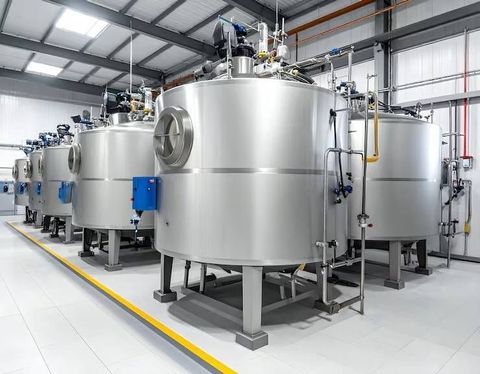
Fruit juice evaporators are industrial processing machines used to remove water from fruit juice and increase its concentration. The process reduces the liquid volume while retaining much of the juice's natural soluble content, including sugars, acids, and other dissolved compounds.
Fruit juice evaporators are widely used in food processing facilities that handle apple, orange, grape, mango, pineapple, and other fruit juices.
Fruit juice concentration developed as food manufacturers looked for practical ways to manage seasonal harvests, transport liquid ingredients, and maintain a consistent supply of juice throughout the year. Fresh fruit contains a large proportion of water, which increases the volume and weight of the juice extracted from it. Evaporation helps reduce this water content, making concentrated juice easier to store, transport, and use in further manufacturing.
Industrial juice concentration equipment works by applying heat under controlled conditions or by combining evaporation with other processing technologies. The selected method depends on the fruit variety, desired concentration, production capacity, and sensitivity of the juice to temperature.
What Is an Industrial Fruit Juice Evaporator?
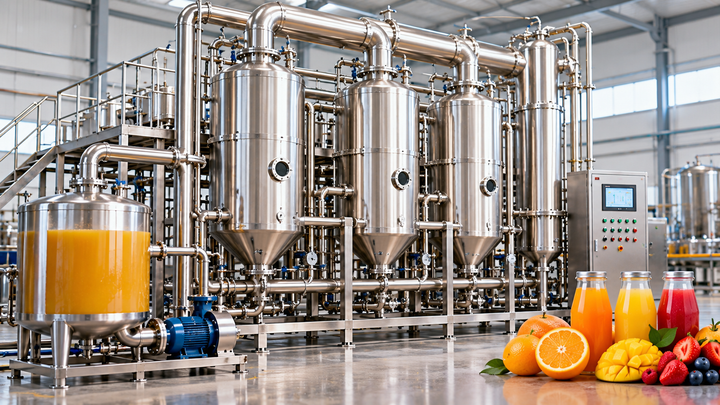
An industrial fruit juice evaporator is a machine that separates water from juice through vaporization. The juice is heated, allowing some of its water to turn into vapor while the remaining liquid becomes more concentrated. The concentrated product may later be blended with water to produce juice at a required strength or used as an ingredient in other food products.
Modern equipment includes temperature controls, pressure monitoring systems, pumps, heat exchangers, and vapor separation components. These parts work together to maintain consistent processing conditions and reduce unnecessary exposure to heat.
How Fruit Juice Concentration Works
The concentration process usually begins with fruit washing, crushing, pressing, and juice extraction. Depending on the product, the extracted juice may undergo clarification or filtration before entering the evaporator.
Inside the equipment, heat transfers to the juice and causes water to evaporate. The remaining liquid contains a higher proportion of soluble solids. Operators monitor parameters such as temperature, pressure, flow rate, and soluble solids concentration to achieve the required product characteristics.
Importance
Fruit juice evaporators play an important role in the food and beverage industry because they help manage large quantities of perishable agricultural products. Fruit availability often changes with seasons, and processing plants need methods that allow extracted juice to remain useful beyond the immediate harvest period. Concentration supports this requirement by reducing the amount of water in the processed product.
The technology also affects transportation, storage, production planning, and packaging. Concentrated juice occupies less volume than an equivalent quantity of single-strength juice, although the actual reduction depends on the fruit and concentration level.
Who Uses Fruit Juice Evaporators?
Several groups depend on industrial juice concentration equipment:
Fruit processing plants: Process large volumes of harvested fruit into juice and concentrated ingredients.
Beverage manufacturers: Use concentrates to prepare drinks with consistent flavor and soluble solids levels.
Food ingredient producers: Supply concentrated juice for sauces, confectionery, bakery products, and other food applications.
Agricultural cooperatives: Process fruit during harvest periods and support the use of seasonal crops.
Food research laboratories: Evaluate concentration methods, product stability, and processing conditions.
Problems Addressed by Juice Concentration
Fresh juice contains substantial water, which increases the space required for storage and transportation. Evaporators help reduce this volume and support more efficient handling of concentrated ingredients.
Another challenge is maintaining flavor, color, aroma, and nutritional characteristics during processing. Excessive heat can damage heat-sensitive compounds and create undesirable cooked flavors. Industrial systems therefore use controlled temperatures, appropriate residence times, and suitable pressure conditions to manage product quality.
Energy consumption is another important consideration. Evaporating water requires considerable thermal energy, so equipment design and heat recovery can influence overall plant efficiency. Cleaning requirements, product fouling, and the handling of different juice varieties also affect day-to-day operations.
Recent Updates
Recent developments in fruit juice evaporation emphasize energy efficiency, automation, product quality, and improved process monitoring. Rather than relying only on traditional heating arrangements, processing facilities increasingly evaluate integrated systems that recover heat, regulate operating conditions, and limit unnecessary thermal exposure.
Energy-Efficient Evaporation Systems
Multiple-effect evaporators use vapor generated in one stage to provide heat for another stage operating at a lower pressure. This arrangement reduces the amount of fresh heating energy required compared with a single-effect system under comparable conditions.
Mechanical vapor recompression and thermal vapor recompression are additional technologies used in suitable installations. They reuse vapor energy to support evaporation, although their suitability depends on the process, equipment configuration, energy prices, and operating requirements.
Automation and Process Monitoring
Modern industrial equipment can incorporate automated controls that monitor temperature, vacuum pressure, juice flow, and concentration. Sensors and programmable control systems help operators identify deviations and adjust processing conditions.
Digital monitoring can also support maintenance planning and production records. However, reliable results still depend on sensor calibration, equipment maintenance, appropriate operating procedures, and accurate measurements.
Gentle Processing and Product Quality
Manufacturers continue to evaluate methods that limit heat exposure while achieving the required concentration. Vacuum evaporation lowers the boiling temperature of water, helping reduce thermal stress on sensitive juice components.
Some facilities also consider membrane concentration before evaporation. Membrane systems can remove part of the water without boiling the entire liquid stream, but they have limitations involving membrane fouling, achievable concentration, and the characteristics of individual juices.
Comparison of Industrial Juice Concentration Methods
Method | Operating principle | Main consideration |
|---|---|---|
Single-effect evaporation | Water evaporates through heating in one stage | Relatively straightforward equipment arrangement |
Multiple-effect evaporation | Vapor heats juice in successive stages | Improved thermal energy utilization |
Vacuum evaporation | Reduced pressure lowers the boiling temperature | Helps limit heat exposure |
Mechanical vapor recompression | Vapor is compressed and reused as a heat source | Requires suitable equipment and electrical energy |
Membrane concentration | Water passes through a selective membrane | Limited by membrane performance and juice composition |
The appropriate method depends on production volume, juice characteristics, energy availability, maintenance requirements, and the required final concentration.
Laws or Policies
Fruit juice evaporators are influenced by food safety requirements, equipment safety rules, environmental controls, and manufacturing standards. The applicable requirements depend on the country where the equipment operates and where the resulting juice is distributed.
Food Safety and Processing Requirements
Food processing facilities generally need procedures that protect ingredients from contamination throughout extraction, concentration, storage, and packaging. These procedures may cover equipment hygiene, water quality, cleaning, traceability, temperature monitoring, and personnel practices.
In India, food businesses are subject to the applicable requirements of the Food Safety and Standards Authority of India (FSSAI). Relevant provisions can include food manufacturing hygiene, licensing, product standards, and labeling requirements. The precise obligations depend on the type of facility and the product being manufactured.
Internationally, food safety management systems commonly use hazard analysis and preventive controls to identify risks associated with processing operations. Evaporator design should support hygienic cleaning and help prevent contamination between production batches.
Equipment and Environmental Considerations
Industrial evaporation systems may be subject to workplace safety requirements involving pressure vessels, steam systems, electrical installations, and hot surfaces. Applicable machinery and pressure equipment standards vary by jurisdiction and installation type.
Environmental requirements may address wastewater discharge, boiler emissions, energy use, and cleaning chemical management. Facilities may also need procedures for handling condensate and managing waste generated during juice clarification and equipment cleaning.
Compliance is therefore not determined by the evaporator alone. It also depends on the complete processing line, the facility's operating practices, the product category, and applicable local requirements.
Tools and Resources
Several technical tools help processing facilities evaluate fruit juice evaporators, calculate concentration requirements, and monitor production performance. These tools are useful for preliminary planning, although equipment selection generally requires process-specific engineering assessment.
Concentration and Production Calculators
A soluble solids balance calculator helps estimate the amount of concentrated juice produced from a given quantity of feed juice. Juice concentration is commonly measured in degrees Brix, which approximates the percentage of soluble solids in a solution.
For an initial estimate, assuming negligible solids loss:
Final concentrate mass = Initial juice mass × Initial Brix ÷ Final Brix
For example, concentrating 1,000 kilograms of juice from 12° Brix to 60° Brix gives:
1,000 × 12 ÷ 60 = 200 kilograms of concentrate.
This simplified calculation assumes that soluble solids remain constant and that Brix measurements are suitable for the juice being processed. Actual results can differ because of clarification losses, suspended solids, sampling, and measurement conditions.
Equipment Selection and Monitoring Tools
Useful resources include:
Heat duty calculators: Estimate the thermal energy required to heat juice and evaporate water.
Evaporation capacity worksheets: Help estimate water removal per hour and compare equipment capacities.
Temperature and pressure sensors: Monitor operating conditions throughout the concentration process.
Refractometers: Measure refractive index and estimate soluble solids concentration.
Cleaning and maintenance records: Document cleaning cycles, inspections, calibration, and equipment performance.
Food safety management documentation: Support hygiene procedures, hazard analysis, and traceability.
Equipment technical manuals and food processing engineering references can help explain the operating principles, limitations, and maintenance requirements of different evaporation systems.
FAQs
What Is a Fruit Juice Evaporator Used For?
A fruit juice evaporator removes water from extracted juice to produce a more concentrated liquid. The resulting concentrate is used in beverage production, food ingredient manufacturing, and other processing applications.
How Does an Industrial Fruit Juice Evaporator Work?
An industrial fruit juice evaporator transfers heat to juice, causing water to vaporize. The remaining liquid contains a higher concentration of soluble solids. Pressure, temperature, and processing time influence the final product characteristics.
What Is the Difference Between Single-Effect and Multiple-Effect Evaporators?
A single-effect evaporator performs evaporation in one main heating stage. A multiple-effect evaporator reuses vapor from one stage to heat another stage, reducing the requirement for fresh thermal energy under suitable operating conditions.
Why Is Vacuum Evaporation Used for Fruit Juice Concentration?
Vacuum evaporation reduces the pressure inside the processing system, allowing water to boil at a lower temperature. This can help preserve heat-sensitive flavor and aroma compounds, depending on the juice and operating conditions.
How Is Fruit Juice Concentration Measured?
Concentration is commonly monitored using degrees Brix, a measure related to soluble solids content. Refractometers and other suitable instruments help operators assess whether the juice has reached its intended concentration.
Conclusion
Fruit juice evaporators are important components of industrial food processing because they reduce water content and produce concentrated juice for storage, transportation, and further manufacturing. Single-effect, multiple-effect, vacuum, and vapor recompression systems differ in energy use, operating principles, and processing requirements. Automation, heat recovery, and careful temperature control are central considerations in modern evaporation systems. Food safety, equipment protection, environmental requirements, and product quality all influence how these machines are designed and operated.