UV Curing System Guide With Curing Technology and Industrial Applications
A UV curing system uses ultraviolet light to rapidly harden or solidify specially formulated materials such as coatings, inks, adhesives, and resins. Instead of relying mainly on heat or long air-drying periods, UV curing technology activates photoinitiators within a material.
UV curing has developed alongside advances in industrial coating, printing, electronics, optical manufacturing, and adhesive technologies. Early systems commonly relied on ultraviolet lamps, while modern equipment increasingly uses light-emitting diode (LED) sources. The development of UV LED technology has expanded the range of applications while providing manufacturers with greater control over wavelength, energy delivery, and operating conditions.
How UV Curing Technology Works
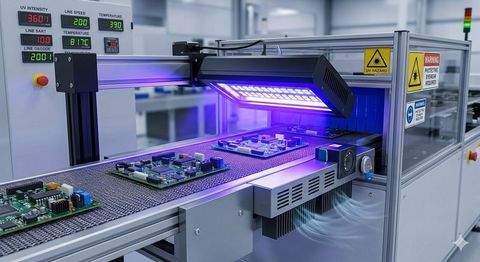
A typical UV curing process involves three basic elements: a UV light source, a UV-reactive material, and controlled exposure. The material contains components designed to react when exposed to a suitable wavelength of ultraviolet radiation.
The UV curing system directs light toward the material. When sufficient energy reaches the reactive layer, polymerization begins. The material gradually develops the physical properties required for its intended application.
Common components include:
- UV lamps or UV LED modules
- Reflectors and optical components
- Power supplies or LED drivers
- Cooling systems
- Exposure controls
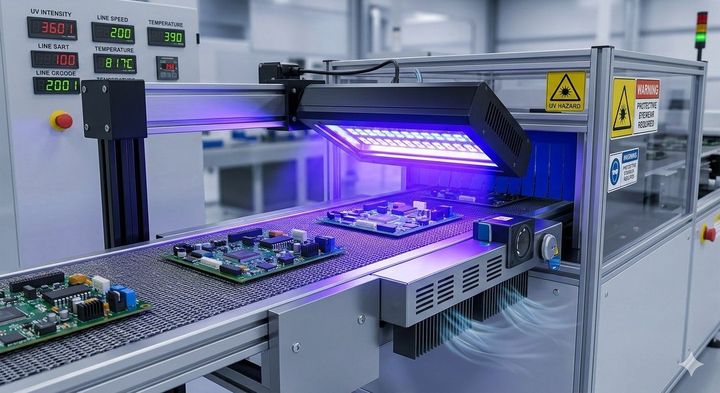
- Conveyor or positioning mechanisms
- Sensors and control interfaces
Different materials require different wavelengths and exposure conditions. A system designed for one coating or adhesive may not provide the same results with another formulation.
Main Types of UV Curing Systems
UV curing equipment can be divided into several categories according to the light source and application.
Mercury-vapor and other arc-lamp systems have traditionally been used in printing, coating, and industrial processing. They can provide strong UV output across a broad range of wavelengths but may generate considerable heat.
UV LED curing systems use arrays of LEDs that produce specific ultraviolet wavelengths. They generally provide precise light delivery and can be integrated into compact equipment. Their operating characteristics make them suitable for applications requiring controlled exposure.
Spot curing systems direct UV energy toward a relatively small area. They are frequently used for electronics assembly, optical components, and precision adhesive applications.
Conveyor curing systems expose continuously moving products to UV radiation. These systems are commonly associated with printing, coating, and high-throughput manufacturing processes.
Importance
Why UV Curing Matters
UV curing technology matters because many manufacturing processes require materials to become stable within a controlled production sequence. Traditional drying methods can require extended periods, elevated temperatures, or additional processing space. UV curing can reduce the time between material application and subsequent production stages when the formulation and equipment are properly matched.
The technology also supports applications where excessive heat could affect sensitive substrates. This is particularly relevant to electronics, plastics, films, labels, optical components, and other products that may not tolerate conventional high-temperature processes.
Industries Using UV Curing
UV curing systems are used across several industrial fields. Printing is a major application, where UV-reactive inks can be cured directly after printing. Coating applications include wood finishes, plastics, metal components, flooring materials, and specialty surfaces.
Adhesive curing is another important area. UV-curable adhesives are used in electronics, optics, medical-device manufacturing, and assembly processes where light can reach the adhesive layer.
Other applications include:
- Electronics and circuit assembly
- Optical component manufacturing
- Automotive component processing
- Packaging and label printing
- Furniture and wood finishing
- Plastic component coating
- Industrial marking and printing
- Resin-based manufacturing
- Fiber-optic assembly
- Three-dimensional printing processes
Practical Problems Addressed
UV curing can address several manufacturing challenges, including long drying intervals, inconsistent exposure, limited production space, and heat-sensitive substrates. However, successful curing depends on factors such as material chemistry, UV wavelength, exposure intensity, distance, and exposure time.
A material that appears hardened on its surface may not be fully cured underneath. For this reason, process validation is important, particularly when coatings or adhesives are relatively thick or when UV light cannot reach all parts of a component.
Recent Updates
Growth of UV LED Technology
One of the most significant developments in UV curing has been the wider use of UV LED systems. LED-based equipment can be designed around specific wavelengths, allowing manufacturers to match light output more closely with the photoinitiator system used in a formulation.
Modern systems can also incorporate electronic controls for monitoring exposure conditions. These controls can help operators maintain consistent operating parameters across production cycles.
Greater Process Monitoring
Industrial UV curing increasingly incorporates sensors and digital controls. Monitoring may include UV intensity, operating temperature, exposure duration, conveyor speed, and equipment status.
Data collection can help identify changes in curing conditions before they create significant process variation. Automated control systems can also integrate curing equipment with broader manufacturing lines.
More Efficient Equipment Design
Equipment development has focused on compact UV LED modules, improved thermal management, optimized optical systems, and more precise energy control. These developments can help manufacturers design curing stations around specific production requirements rather than relying on one general-purpose configuration.
Current industry trends also include hybrid curing systems, automated exposure controls, modular LED configurations, and equipment designed for integration with digital manufacturing environments.
Laws or Policies
Workplace UV Exposure
UV curing systems are subject to workplace safety requirements because ultraviolet radiation can cause injury to skin and eyes. Industrial facilities generally need appropriate engineering controls, shielding, interlocks, warning systems, and operating procedures based on the equipment and applicable occupational safety rules.
Requirements vary by jurisdiction and by the type of UV source. Facilities should follow applicable workplace exposure limits and equipment safety requirements rather than assuming that one standard applies globally.
Electrical and Equipment Safety
UV curing equipment also involves electrical power, heat, moving components, and potentially pressurized or cooled systems. Applicable electrical and machinery safety requirements may therefore influence equipment design, installation, maintenance, and operator procedures.
Manufacturers and facility operators may need to consider electromagnetic compatibility, electrical protection, machine guarding, emergency controls, and documentation according to the jurisdiction where equipment is installed.
Environmental Considerations
Environmental requirements can also influence UV-curable formulations and manufacturing processes. Some UV-curable materials contain chemical components that require controlled handling, storage, ventilation, and disposal procedures.
The applicable requirements depend on the material composition and local environmental framework. Safety data sheets and manufacturer documentation are important sources for understanding handling requirements.
Tools and Resources
UV Measurement Equipment
A UV radiometer can measure ultraviolet intensity at the curing surface. This helps determine whether the system is delivering the expected amount of radiation during operation.
Radiometers are available for different wavelength ranges, so the measurement device needs to correspond with the curing system and material requirements.
Curing Calculators and Process Tools
Engineering teams may use exposure calculations to estimate UV energy based on irradiance and exposure time. A simplified relationship is:
UV Energy = UV Intensity × Exposure Time
For example, if intensity is measured in milliwatts per square centimeter and time is measured in seconds, the resulting energy can be expressed in millijoules per square centimeter.
Other useful resources include:
- UV wavelength charts
- Material technical data sheets
- Equipment operating manuals
- UV intensity measurement instruments
- Process-control software
- Maintenance checklists
- Safety documentation
- Production quality records
Comparing UV Curing System Parameters
The following table shows common parameters that influence curing performance.
| Parameter | What It Affects | Typical Consideration |
|---|---|---|
| UV Wavelength | Photoinitiator response | Match the material formulation |
| UV Intensity | Energy delivered to surface | Monitor during operation |
| Exposure Time | Total radiation received | Depends on line speed and application |
| Working Distance | Light distribution | Maintain consistent positioning |
| Material Thickness | Light penetration | Thick layers may require special evaluation |
| Cooling | Equipment temperature | Important for LEDs and lamp systems |
| Conveyor Speed | Exposure duration | Coordinate with process requirements |
Technical Documentation
Technical documentation remains an important resource when selecting or operating UV curing equipment. Material manufacturers typically provide information about recommended wavelengths, curing conditions, substrate compatibility, and handling requirements.
Equipment documentation can explain lamp or LED replacement procedures, optical alignment, cooling requirements, maintenance intervals, and safety controls. Combining these documents with actual process measurements provides a clearer understanding of curing conditions.
FAQs
What is a UV curing system?
A UV curing system is equipment that uses ultraviolet radiation to initiate a chemical reaction in UV-reactive materials. It is commonly used to harden coatings, inks, adhesives, and resins.
How does UV curing technology work?
UV curing technology exposes a reactive material to a suitable wavelength of ultraviolet light. Photoinitiators absorb the radiation and initiate polymerization, changing the material from a liquid or soft state into a more stable solid.
What are UV LED curing systems used for?
UV LED curing systems are used for applications such as adhesive curing, printing, coatings, electronics assembly, optical manufacturing, and specialized resin processing. Their wavelength-specific output allows them to be matched with suitable formulations.
What factors affect UV curing performance?
Important factors include wavelength, UV intensity, exposure time, working distance, material composition, layer thickness, substrate characteristics, and temperature. Changes in any of these conditions can affect the curing process.
Are UV curing systems safe to operate?
UV radiation can harm eyes and skin, so appropriate shielding, interlocks, protective procedures, and workplace controls are important. Operators should follow the equipment documentation and applicable occupational safety requirements.
Conclusion
UV curing systems use controlled ultraviolet radiation to harden reactive coatings, inks, adhesives, and resins across a range of industrial applications. UV curing technology has expanded from traditional lamp-based equipment toward increasingly precise UV LED systems, digital controls, and automated process monitoring. Proper wavelength selection, exposure control, material compatibility, and workplace protection are important parts of the curing process. Understanding these factors helps explain how UV curing equipment fits into modern industrial production.