Rubber Profile Cutting Machines Guide With Precision Cutting and Manufacturing Insights
Rubber profile cutting machines are industrial systems designed to cut continuous rubber profiles into precise lengths or shapes for manufacturing and assembly. These machines are used with materials such as EPDM, silicone, neoprene, natural rubber, and other elastomeric compounds.
Rubber profiles appear in many everyday products, including seals, gaskets, window channels, door sections, vibration-control components, protective strips, and industrial sealing elements. As production becomes more automated, rubber profile cutting machines are increasingly connected with digital controls, automatic measurement systems, and production monitoring technologies. Understanding how these systems operate helps explain their role in modern rubber processing and precision manufacturing.
Context
What Are Rubber Profiles?
A rubber profile is a continuous length of rubber manufactured with a particular cross-sectional shape. Instead of being produced as a flat sheet, the material is formed through processes such as extrusion, creating a consistent profile along its length.
Common profile shapes include:
- Round and tubular sections
- U-shaped channels
- Square and rectangular strips
- D-shaped seals
- Complex custom cross-sections
- Multi-material profiles
The shape and material determine how the profile behaves during cutting, installation, compression, and repeated use.
Why Cutting Is Necessary
Rubber extrusion can produce profiles in continuous lengths, while many finished components require individual sections. Cutting converts the continuous material into pieces with specified dimensions.
Manual cutting can be suitable for limited production, but repeated industrial operations require greater consistency. Rubber profile cutting machines automate the measurement and cutting sequence so that each section can follow the programmed specifications.
How the Machines Work
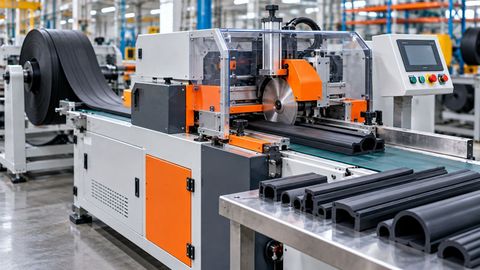
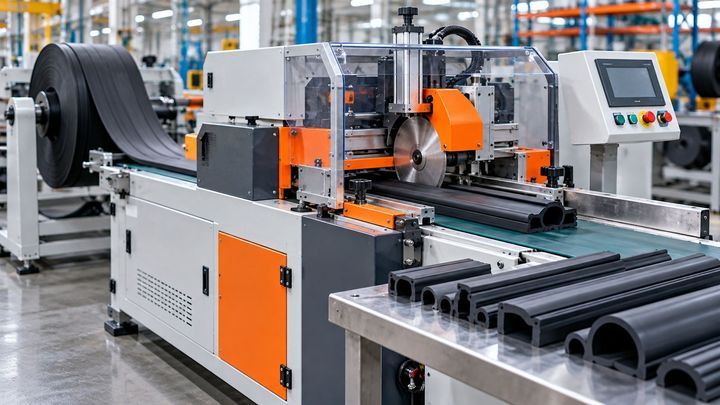
A typical system begins with a feeding mechanism that moves the rubber profile toward the cutting area. Measuring equipment determines how much material has passed through the system, while a controller coordinates movement and cutting.
Depending on the machine design, cutting can involve blades, rotary knives, guillotine-style mechanisms, or other specialized tooling. The selected method depends on profile geometry, material hardness, required tolerance, and production requirements.
Main Machine Components
A rubber profile cutting machine can contain several coordinated components:
- Feeding rollers for controlled material movement
- Measuring systems for determining profile length
- Cutting mechanisms for separating sections
- Sensors for detecting material position
- Programmable controllers for operating sequences
- Operator interfaces for setting parameters
- Collection systems for finished sections
- Safety guards and emergency stopping equipment
The combination varies according to the application and level of automation.
Importance
Consistent Profile Dimensions
Dimensional consistency is important when rubber sections must fit into predefined channels, frames, housings, or assemblies. Differences in length can affect installation and the final fit of the component.
Automated measuring and cutting can reduce variation associated with repetitive manual measurement. However, actual accuracy depends on machine design, calibration, material behavior, tooling condition, and operating conditions.
Reduced Material Handling
Continuous profile cutting can involve repeated measuring, positioning, and cutting. Automation combines these steps into a controlled sequence, reducing the amount of repetitive handling required during production.
This is particularly relevant for manufacturing environments processing large quantities of similar profiles.
Production Planning
Rubber profile cutting machines can be integrated into broader production lines. A cutting system may receive material directly from an extrusion process or operate with profiles supplied in coils, rolls, or long sections.
Production planning can include factors such as:
- Profile length
- Required quantity
- Material characteristics
- Cutting pattern
- Waste allowance
- Changeover requirements
- Inspection procedures
Applications Across Industries
Rubber profiles are used in numerous manufacturing sectors. Applications include automotive components, building products, industrial equipment, appliances, transportation systems, and general engineering.
For example, a long rubber extrusion may be divided into predetermined sections for sealing assemblies. In another application, complex profiles may require angled or programmed cuts so that individual pieces can form a frame or continuous seal.
Key Selection Factors
Choosing an appropriate rubber profile cutting machine involves understanding the production requirements rather than focusing on one specification alone.
Important considerations include:
| Factor | What It Determines |
|---|---|
| Profile geometry | Suitable feeding and cutting method |
| Rubber hardness | Required cutting force and tooling |
| Profile dimensions | Machine capacity and material guidance |
| Cutting length | Measurement and positioning requirements |
| Tolerance | Required control and inspection capability |
| Production volume | Appropriate automation level |
| Cutting angle | Tooling and programming requirements |
| Material condition | Feeding consistency and handling method |
These factors influence how a cutting system performs with a particular rubber profile.
Recent Updates
Greater Automation
From 2024 through 2026, the general direction of rubber processing equipment has continued toward greater automation. Machines increasingly use programmable controls, sensors, digital displays, and automated material positioning.
These technologies can help operators manage cutting parameters more consistently while reducing manual adjustments during repetitive processes.
Digital Measurement Systems
Modern rubber profile cutting equipment may use electronic measurement systems instead of relying entirely on mechanical measuring arrangements. Encoders and sensors can track material movement and provide information to the machine controller.
Digital measurement can also support programmable cutting sequences where different lengths are processed within the same production run.
Computer-Controlled Cutting
Programmable controllers allow operators to define cutting lengths, quantities, sequences, and other machine parameters. Some systems can store multiple production configurations for different profile types.
This approach is particularly useful when manufacturing involves frequent changes between profile dimensions or product configurations.
Integration With Production Lines
Another continuing trend is integration. Rubber profile cutting machines can be positioned between extrusion, inspection, marking, packaging, and other manufacturing stages.
Connected production systems may exchange information through industrial communication protocols, allowing equipment to become part of a broader automated manufacturing environment.
Improved Process Monitoring
Sensors can monitor conditions such as material presence, feeding position, machine status, and cutting cycles. Monitoring functions can help identify interruptions or abnormal operating conditions.
The exact capabilities vary considerably between machine designs, so manufacturers generally specify monitoring features according to their production requirements.
Laws or Policies
Workplace Machinery Requirements
Rubber profile cutting machines are subject to workplace safety requirements in the jurisdictions where they operate. Regulations commonly address moving parts, cutting mechanisms, electrical systems, emergency stopping arrangements, machine guarding, and operator safety.
Because regulations differ between countries and regions, businesses must follow the requirements applicable to their operating location.
Machine Guarding
Cutting equipment normally requires protection around hazardous moving or cutting areas. Guards, interlocks, emergency stop controls, warning systems, and safe access procedures can form part of the machine's safety arrangement.
Operators should follow the manufacturer's operating instructions and workplace safety procedures.
Electrical and Equipment Compliance
Electrical components and industrial machinery may also be subject to applicable technical standards. Depending on the jurisdiction and machine configuration, compliance requirements can involve electrical safety, electromagnetic compatibility, documentation, and conformity assessment.
These requirements should be checked against the rules applicable to the specific installation.
Environmental Considerations
Rubber processing can generate offcuts and production waste. Environmental policies may address industrial waste handling, recycling, emissions, and disposal practices.
Rubber profile cutting itself generally produces solid offcuts rather than chemical waste, but the handling of those materials remains part of responsible manufacturing management.
Tools and Resources
Measurement and Calculation Tools
Production teams can use length calculators, unit converters, tolerance calculators, and material utilization worksheets when planning rubber profile cutting operations.
A basic production worksheet can record:
- Profile dimensions
- Required cutting lengths
- Quantity
- Cutting angle
- Expected material usage
- Offcut quantity
- Inspection results
Machine Control Software
Programmable machine interfaces allow operators to enter cutting parameters and production sequences. More advanced systems may maintain production recipes, monitor machine conditions, or communicate with factory management systems.
Inspection Equipment
Measurement tools are important for verifying finished profile sections. Depending on the required tolerance, manufacturers may use rulers, digital calipers, gauges, optical measurement equipment, or automated inspection systems.
Maintenance Resources
Maintenance documentation can help operators understand blade replacement intervals, lubrication requirements, sensor positioning, cleaning procedures, and calibration routines. Keeping measurement systems properly adjusted is particularly important when dimensional accuracy is a central production requirement.
FAQs
What are rubber profile cutting machines used for?
Rubber profile cutting machines divide continuous rubber extrusions into predetermined lengths or shapes. They are commonly used for seals, gaskets, channels, strips, and other rubber components.
How does a rubber profile cutting machine measure cutting length?
Many systems use mechanical or electronic measuring mechanisms, such as rollers and encoders. The controller uses the measured material movement to determine when the cutting operation should occur.
Can rubber profile cutting machines handle different rubber materials?
Many machines can process several elastomer types, but compatibility depends on material hardness, profile geometry, thickness, temperature, and cutting mechanism. Machine specifications should be matched with the intended material.
What affects precision in rubber profile cutting?
Precision can be affected by measurement accuracy, material stretching, feeding stability, blade condition, profile geometry, machine calibration, and environmental conditions. Rubber's flexibility makes controlled feeding particularly important.
Are rubber profile cutting machines automated?
Automation levels vary. Basic systems may require considerable operator involvement, while advanced rubber profile cutting machines can integrate automatic feeding, measurement, programmable cutting sequences, sensors, and production monitoring.
Conclusion
Rubber profile cutting machines convert continuous rubber extrusions into accurately measured sections used across many manufacturing applications. Their operation combines material feeding, measurement, cutting, control systems, and inspection processes. Recent developments have emphasized automation, digital measurement, programmable controls, monitoring, and integration with wider production systems. Applicable machinery, workplace safety, electrical, and environmental requirements depend on the jurisdiction and specific installation.