Industrial Water Purification Facts: Filtration Methods and Treatment Stages
Industrial water purification helps manufacturing facilities manage water quality through filtration, treatment, and purification technologies.
Understanding available systems, equipment types, and treatment processes helps explain how industries manage water resources effectively.
Understanding Industrial Water Purification
Industrial water purification refers to processes that remove unwanted substances from water before it is used in manufacturing, processing, cooling, cleaning, or other industrial activities.
The required water quality depends on the application. Some operations need water with fewer suspended particles, while others require reduced mineral content, dissolved salts, or microorganisms.
Why Industrial Facilities Need Purification
Water quality can influence production equipment, product consistency, and operational performance. Untreated water may contain sediment, minerals, organic materials, and other substances that affect industrial processes.
Industrial water purification systems help manage these conditions by applying suitable treatment methods according to the incoming water composition and intended application.
Importance of Industrial Water Treatment Equipment
Industrial water treatment equipment plays an important role in managing water quality across different manufacturing environments.
Proper treatment can help address several operational challenges:
Equipment protection: Reducing mineral deposits and suspended particles can help limit scaling and clogging.
Process consistency: Controlled water quality supports more consistent manufacturing conditions.
Water management: Treatment processes can support water reuse and reduce unnecessary freshwater consumption.
Operational efficiency: Appropriate filtration can help maintain suitable conditions for industrial equipment.
The actual results depend on system design, water characteristics, operating conditions, and maintenance practices.
Common Industrial Water Purification Technologies
Different technologies are used depending on the contaminants present and the required treatment level.
1. Industrial Water Filtration Systems
Filtration removes suspended particles such as sand, sediment, rust, and other solid materials. Common equipment includes sand filters, multimedia filters, cartridge filters, and activated carbon filters.
These systems are often used as preliminary treatment stages before more advanced purification processes.
2. Industrial Reverse Osmosis Plant
Reverse osmosis uses a semi-permeable membrane to reduce dissolved salts and other impurities in water. Pressure moves water through the membrane while many dissolved substances remain in the concentrated wastewater stream.
An industrial reverse osmosis plant is commonly used in manufacturing, food processing, electronics production, and other applications requiring controlled dissolved mineral levels.
3. Water Softening Systems
Water softeners reduce hardness caused primarily by calcium and magnesium ions. They commonly use ion-exchange technology to replace hardness ions with sodium or potassium ions.
This treatment can help reduce scale formation in boilers, pipelines, and heat exchangers.
4. Ultraviolet Water Treatment
Ultraviolet treatment uses UV light to inactivate microorganisms in water. It is generally applied after suitable filtration because suspended particles can interfere with UV exposure.
Industrial Water Purification Equipment Comparison
Different equipment types perform different treatment functions. The following table provides a basic comparison.
| Equipment | Main Function | Common Application |
|---|---|---|
| Sand filter | Removes suspended particles | Preliminary filtration |
| Carbon filter | Reduces chlorine and certain organic compounds | Process water |
| RO system | Reduces dissolved salts | Purified process water |
| Water softener | Reduces water hardness | Boiler feedwater |
| UV system | Inactivates microorganisms | Microbial control |
| Ultrafiltration | Removes fine particles and microorganisms | Advanced filtration |
An industrial water purification plant may combine several technologies to achieve the required water quality.
Factors to Consider When Selecting an Industrial Water Purification Plant
Selecting appropriate equipment requires an understanding of the water source, treatment objectives, and operational requirements.
Water Quality Analysis
Testing the incoming water helps identify hardness, dissolved solids, pH, turbidity, and other relevant characteristics. These results provide a foundation for choosing appropriate treatment technologies.
Production Capacity
System capacity should match the facility's daily water demand and peak consumption requirements. An undersized system may struggle to maintain production needs, while an oversized installation may increase energy and maintenance requirements.
Equipment Design and Maintenance
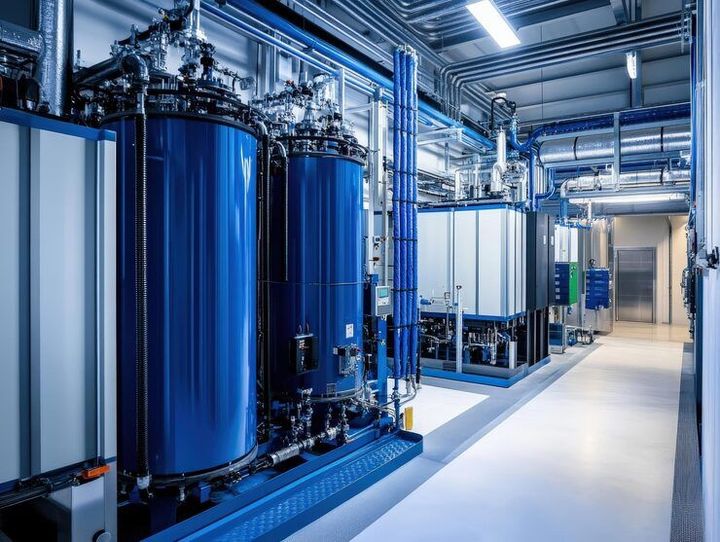
Industrial water treatment systems include pumps, membranes, filters, storage tanks, valves, and monitoring instruments. Their specifications should match operating pressure, flow requirements, and water chemistry.
Maintenance planning should also consider filter replacement, membrane cleaning, equipment inspection, and routine water testing.
Industrial Applications of Water Purification
Industrial water purification technologies are used across several sectors:
Food and beverage: Managing process water quality and supporting production requirements.
Pharmaceutical manufacturing: Preparing water that meets specific application standards.
Textile processing: Controlling water characteristics during dyeing and finishing.
Power generation: Treating boiler feedwater to manage dissolved minerals.
Electronics manufacturing: Producing highly purified water for specialized processes.
Chemical manufacturing: Managing water quality for different production operations.
Each industry follows different water quality specifications based on its processes and applicable standards.
Frequently Asked Questions
What is an industrial water purification system?
It is an equipment arrangement designed to remove unwanted substances from water for industrial applications using filtration, membrane separation, or other treatment technologies.
What is the difference between filtration and reverse osmosis?
Filtration generally removes suspended particles, while reverse osmosis reduces dissolved salts and various other dissolved substances through a membrane.
How much does an industrial RO water treatment plant cost?
Pricing varies according to treatment capacity, membrane specifications, automation, water quality, installation requirements, and equipment configuration. A technical assessment is generally needed to establish project requirements.
How often should industrial water purification equipment be maintained?
Maintenance frequency depends on water quality, equipment design, operating hours, and manufacturer instructions. Regular inspections and water quality testing help identify maintenance requirements.
Conclusion
Industrial water purification is an important part of modern manufacturing and water management. Different technologies, including filtration, reverse osmosis, softening, and ultraviolet treatment, address specific water quality requirements.
Understanding treatment processes, equipment specifications, production capacity, and maintenance considerations helps industrial facilities evaluate suitable purification arrangements for their operational needs.