Industrial Predictive Maintenance Guide With Smart Monitoring and Automation Insights
Industrial predictive maintenance is an approach that uses equipment data, sensors, software, and analytical methods to identify developing machine problems before they cause major operational disruption. Instead of relying only on fixed maintenance schedules or waiting for a machine to fail, predictive maintenance examines equipment condition continuously or at planned intervals.
The concept developed from traditional maintenance practices used in manufacturing, energy, transportation, construction, processing, and other industrial environments. Earlier approaches often depended on routine inspections, operator observations, and calendar-based maintenance. Modern systems add connected sensors, machine learning, automated alerts, and data analysis to provide a more detailed view of equipment condition.
Industrial predictive maintenance can monitor assets such as motors, pumps, compressors, turbines, conveyors, gearboxes, hydraulic systems, production machines, and electrical equipment. Common measurements include vibration, temperature, pressure, current, speed, acoustic signals, lubrication condition, and operating hours.
How predictive maintenance works
A typical predictive maintenance system follows several connected stages:
- Data collection uses sensors or existing machine controls to gather operating information.
- Data transmission moves measurements to a local controller, industrial network, or cloud platform.
- Data analysis identifies unusual patterns or changes from normal operating conditions.
- Condition assessment determines whether an asset is operating normally or showing signs of deterioration.
- Automated alerts notify appropriate personnel when predefined conditions or analytical thresholds are reached.
- Maintenance planning uses the available information to determine when inspection, adjustment, component replacement, or other work may be appropriate.
This approach does not eliminate conventional maintenance. Instead, it adds condition-based information that can support maintenance planning and equipment monitoring.
Predictive maintenance compared with other approaches
Industrial maintenance can involve several methods, and each has a different purpose.
| Maintenance approach | Main principle | Typical trigger |
|---|---|---|
| Reactive maintenance | Action follows equipment failure | Breakdown or malfunction |
| Preventive maintenance | Work follows a planned schedule | Time, cycles, or operating hours |
| Condition-based maintenance | Work follows measured equipment condition | Sensor or inspection findings |
| Predictive maintenance | Analytics identify developing conditions | Pattern, trend, or anomaly |
| Prescriptive maintenance | Analysis evaluates possible responses | Predicted condition and operating context |
Predictive maintenance commonly combines condition monitoring with historical information. This creates a more detailed understanding of how equipment behaves under different operating conditions.
Importance
Industrial equipment can affect production continuity, workplace safety, energy consumption, product quality, and operational planning. A malfunctioning motor, pump, bearing, compressor, or gearbox can influence several connected processes rather than only one machine.
Predictive maintenance addresses this challenge by focusing on equipment condition. For example, increasing vibration in a rotating machine can indicate changes involving bearings, alignment, balance, mounting, or other mechanical conditions. A temperature trend may reveal abnormal friction, cooling problems, electrical loading, or another developing issue.
Who uses industrial predictive maintenance
Predictive maintenance is relevant across many industrial environments, including:
- Manufacturing plants
- Power generation facilities
- Oil and gas operations
- Mining and material processing
- Food and beverage production
- Chemical processing
- Automotive manufacturing
- Warehousing and logistics
- Water treatment facilities
- Large commercial and infrastructure operations
The approach is particularly relevant where equipment operates continuously, contains many interconnected components, or requires regular monitoring.
Problems addressed by smart monitoring
Smart monitoring can help organizations identify changes that may be difficult to notice through occasional manual inspection. It can also create historical records that allow equipment behavior to be compared over time.
Common challenges include unexpected equipment downtime, repeated component failures, inefficient inspection routines, incomplete maintenance records, and difficulty identifying gradual degradation.
However, sensor data does not automatically explain every equipment problem. Measurements need appropriate context, accurate sensor placement, suitable thresholds, and qualified interpretation.
Industrial predictive maintenance data
Different equipment types require different measurements. A rotating machine may require vibration and temperature monitoring, while an electrical system may place greater emphasis on current, voltage, harmonics, or thermal behavior.
The following examples illustrate common relationships:
| Equipment | Common measurements | Potential condition indicators |
|---|---|---|
| Electric motor | Vibration, temperature, current | Bearing or electrical abnormalities |
| Pump | Pressure, vibration, flow, temperature | Cavitation or mechanical changes |
| Compressor | Pressure, temperature, vibration | Performance or mechanical changes |
| Gearbox | Vibration, temperature, acoustic signals | Gear or bearing changes |
| Conveyor | Motor current, vibration, speed | Drive or mechanical abnormalities |
| Hydraulic system | Pressure, temperature, flow | Leakage or component changes |
These indicators should be interpreted according to the machine design, operating environment, manufacturer specifications, and historical behavior.
Recent Updates
Industrial predictive maintenance has increasingly moved toward connected monitoring, edge computing, artificial intelligence, and integrated automation. Modern industrial environments can combine sensor networks with programmable controllers, industrial gateways, manufacturing execution systems, and analytics platforms.
Edge and cloud monitoring
Edge computing allows some equipment data to be processed close to the machine rather than sending every measurement to a remote platform. This can support faster local analysis and reduce the amount of information that needs to travel across a network.
Cloud-based platforms can provide broader data storage and analysis across multiple facilities or equipment groups. Many industrial architectures now combine local processing with centralized analytics.
Artificial intelligence and machine learning
Machine learning is increasingly used to identify patterns that may not be obvious through fixed thresholds alone. Algorithms can examine historical equipment data and compare current behavior with previous operating patterns.
Industrial artificial intelligence can support anomaly detection, remaining useful life estimation, pattern recognition, and maintenance planning. These systems still depend on data quality and appropriate validation because unusual readings can result from sensor faults, changes in production conditions, or legitimate operating variations.
Digital twins and asset models
Digital twin technology is also becoming more connected with industrial monitoring. A digital representation of an asset or process can combine equipment information, operating conditions, historical data, and analytical models.
When integrated appropriately, this approach can help engineers examine how equipment behaves under different operating conditions without relying exclusively on physical inspection.
Automation integration
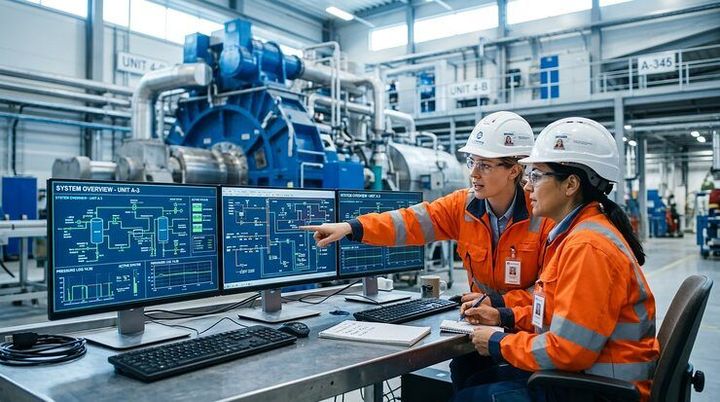
Modern predictive maintenance systems can connect monitoring data with industrial automation platforms. Alerts may be integrated with control systems, maintenance management platforms, dashboards, or notification systems.
The broader trend is toward a connected maintenance environment where equipment condition, operational data, maintenance history, and automation information can be viewed together.
Laws or Policies
Industrial predictive maintenance is influenced by workplace safety requirements, machinery regulations, electrical standards, environmental rules, data protection requirements, and industrial cybersecurity frameworks. The exact legal requirements depend on the country, industry, equipment category, and operating environment.
Equipment and workplace safety
Organizations generally need to maintain industrial equipment in a condition that supports safe operation. Predictive monitoring can contribute useful information, but it does not replace required inspections, safety procedures, testing, or competent technical assessment.
Pressure equipment, electrical installations, lifting equipment, boilers, rotating machinery, and other regulated assets may have specific inspection requirements. These requirements can apply regardless of whether predictive monitoring is installed.
Data and cybersecurity
Connected industrial monitoring creates another policy consideration: cybersecurity. Sensors, gateways, controllers, and cloud platforms can become part of an industrial digital network.
Organizations may therefore apply access controls, authentication, network segmentation, software update procedures, data protection measures, and incident response processes. Industrial cybersecurity frameworks can help structure these activities.
Environmental considerations
Some industries also need to monitor environmental factors such as emissions, energy use, wastewater, leaks, or resource consumption. Predictive monitoring can provide supporting operational information, but environmental compliance remains governed by applicable regulations and measurement requirements.
Tools and Resources
Several categories of tools can support an industrial predictive maintenance program. The appropriate combination depends on equipment type, plant structure, data availability, and monitoring requirements.
Condition monitoring tools
Common technologies include:
- Vibration sensors and analyzers
- Thermal cameras
- Temperature sensors
- Pressure and flow sensors
- Motor current monitoring
- Acoustic monitoring equipment
- Lubricant condition analysis
- Portable inspection instruments
These tools can collect measurements used to establish equipment condition and identify changes over time.
Maintenance management platforms
Computerized maintenance management systems can store equipment records, inspection history, maintenance schedules, component information, and work records. Connecting these systems with predictive analytics can provide greater context when an abnormal condition is detected.
Industrial analytics platforms
Analytics platforms can combine sensor measurements with production data and historical records. Typical capabilities include trend analysis, anomaly detection, dashboards, alarm management, equipment health indicators, and automated reporting.
Data quality and monitoring templates
Useful resources can include asset registers, sensor-location diagrams, equipment history templates, inspection checklists, alarm matrices, condition-monitoring records, and maintenance history databases.
Data quality is important because inaccurate measurements, missing records, incorrect timestamps, and poorly positioned sensors can affect analytical results.
FAQs
What is industrial predictive maintenance?
Industrial predictive maintenance uses equipment condition data and analytical methods to identify changes that may indicate developing equipment problems. It supports maintenance planning through information gathered from sensors, inspections, and operational systems.
How does smart monitoring support predictive maintenance?
Smart monitoring continuously or periodically collects measurements such as vibration, temperature, pressure, current, and flow. Analytical software can examine these measurements for unusual patterns and generate alerts when defined conditions are detected.
What equipment can use industrial predictive maintenance?
Motors, pumps, compressors, gearboxes, turbines, conveyors, hydraulic systems, production machines, and electrical equipment can use predictive monitoring when suitable measurements are available.
Is artificial intelligence required for predictive maintenance?
No. Predictive maintenance can use statistical analysis, engineering thresholds, trend monitoring, vibration analysis, and other techniques. Artificial intelligence and machine learning can add pattern-recognition capabilities when sufficient and reliable data is available.
What are the main limitations of predictive maintenance?
Predictive maintenance depends on reliable measurements, suitable sensors, accurate equipment information, appropriate analytical methods, and qualified interpretation. Sensor faults, changing operating conditions, limited historical data, and incorrect thresholds can affect results.
Conclusion
Industrial predictive maintenance combines condition monitoring, equipment data, analytics, and automation to provide information about changing machine conditions. Smart sensors, edge computing, artificial intelligence, digital twins, and connected maintenance platforms are expanding the capabilities of modern industrial monitoring. Safety requirements, cybersecurity practices, environmental rules, and equipment-specific regulations remain important considerations. The overall approach focuses on using equipment information to understand operating conditions and support structured maintenance planning.