Explore Industrial Heat Exchangers With Cooling Systems, Heating Processes, and Technical Details
Industrial heat exchangers are important components used in manufacturing facilities, power generation plants, chemical processing units, food production facilities, and commercial heating and cooling systems.
These devices transfer thermal energy between two or more fluids without necessarily allowing them to mix. The fluids may include water, steam, oil, refrigerants, gases, or specialized industrial liquids.
The development of heat exchanger technology came from the growing need to manage temperatures during industrial production. As factories expanded and manufacturing processes became more complex, controlling heat became essential for maintaining equipment performance, product quality, and operational stability. Early designs gradually developed into advanced industrial heat transfer systems with improved materials, compact structures, and automated temperature controls.
An industrial heat exchanger generally works through a heat transfer surface that separates hot and cold fluids. Energy moves from the hotter fluid toward the cooler fluid, allowing one process stream to release heat while another absorbs it. This principle supports both industrial heating and cooling applications.
Modern heat exchanger systems are available in different configurations depending on temperature requirements, pressure conditions, fluid characteristics, and installation space. Understanding their construction, operation, and applications helps explain their role in modern industrial infrastructure.
How Industrial Heat Exchangers Work
The basic operating principle involves transferring thermal energy between fluids at different temperatures. Depending on the equipment design, heat transfer occurs through metal plates, tubes, coils, or other conductive surfaces.
Three common flow arrangements are used:
Parallel flow: Hot and cold fluids move in the same direction.
Counterflow: Fluids move in opposite directions, supporting effective temperature exchange.
Crossflow: Fluids move perpendicular to one another, commonly used in air cooling and ventilation equipment.
The selection of a flow arrangement depends on thermal requirements, available space, and process conditions.
Main Types of Industrial Heat Exchangers
Different industries use specific heat exchanger designs according to their operating environments.
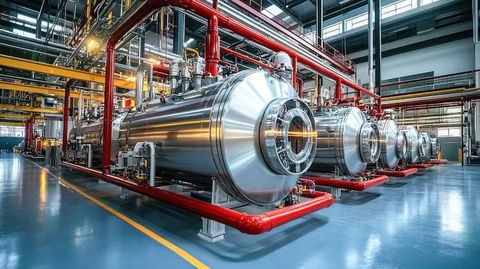
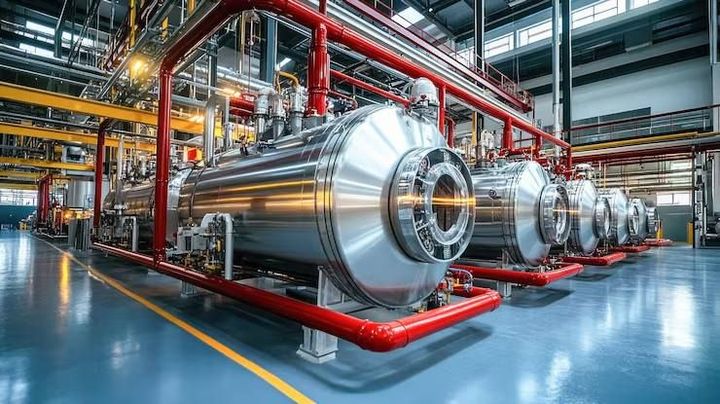
Shell and tube heat exchangers: Consist of multiple tubes enclosed within a cylindrical shell. They are widely used in chemical processing, refineries, power generation, and industrial heating.
Plate heat exchangers: Use thin metal plates to create separate channels for hot and cold fluids. Their compact construction makes them suitable for HVAC systems, food processing, and water heating.
Air-cooled heat exchangers: Transfer heat from process fluids into surrounding air, often using fans and finned surfaces.
Double-pipe heat exchangers: Contain one pipe inside another, allowing two fluids to exchange thermal energy through the pipe wall.
Spiral heat exchangers: Use spiral-shaped flow passages and are applied in certain processes involving viscous or contaminated fluids.
Importance
Industrial heat exchangers play an important role in managing thermal conditions across manufacturing and infrastructure systems. Industrial processes frequently generate excessive heat or require controlled heating before materials can be processed, stored, or transported.
Without suitable thermal management, equipment may experience overheating, inconsistent operating temperatures, material degradation, or interruptions in production. Heat exchangers help address these challenges by controlling the movement and distribution of thermal energy.
Industrial Applications and Everyday Importance
Heat exchanger technology affects several industries and indirectly supports everyday activities.
Manufacturing: Controls temperatures in machinery, production lines, metal processing, and industrial equipment.
Power generation: Transfers heat within steam systems, cooling circuits, and energy production equipment.
Food processing: Supports pasteurization, product cooling, liquid heating, and temperature-controlled production.
Chemical processing: Maintains suitable temperatures during chemical reactions, separation, and material processing.
HVAC systems: Supports heating, ventilation, air conditioning, and building temperature management.
Automotive manufacturing: Helps manage thermal conditions in engine testing, battery production, and industrial cooling operations.
Pharmaceutical production: Supports controlled heating and cooling environments during manufacturing processes.
Benefits of Industrial Heat Transfer Systems
Industrial heat exchangers provide several operational advantages.
Temperature regulation: Maintain suitable thermal conditions across different production stages.
Energy recovery: Transfer heat from hot process streams to other fluids that require heating.
Equipment protection: Help control excessive temperatures in industrial machinery.
Process consistency: Support stable operating conditions during manufacturing.
Heat distribution: Transfer thermal energy between different production circuits.
Cooling management: Remove unwanted heat from equipment and industrial liquids.
Common Industrial Heat Exchanger Specifications
The technical characteristics of a heat exchanger influence its suitability for different applications.
Specification | Description |
|---|---|
Heat transfer area | Surface available for transferring thermal energy |
Operating temperature | Temperature range supported by the equipment |
Operating pressure | Pressure conditions within the fluid circuits |
Flow rate | Volume of fluid passing through the system |
Heat transfer material | Metal or alloy used in the heat transfer surfaces |
Thermal capacity | Amount of heat transferred under operating conditions |
Fouling resistance | Ability of the design to manage material accumulation |
Pressure drop | Reduction in fluid pressure as it passes through the equipment |
These specifications are considered together when selecting industrial heat transfer equipment.
Recent Updates
Industrial heat exchanger technology continues to develop through improvements in thermal engineering, materials, digital monitoring, and energy management. Recent industry trends emphasize improved thermal performance, reduced energy consumption, and compatibility with increasingly automated manufacturing environments.
Advanced Materials and Equipment Design
Manufacturers are developing heat exchanger designs using corrosion-resistant alloys, stainless steel, titanium, and specialized surface coatings. Material selection depends on fluid composition, temperature, pressure, and exposure to chemicals.
Compact plate heat exchangers and advanced tube configurations are also receiving attention because they can provide substantial heat transfer surfaces within limited installation spaces.
Digital Monitoring and Automation
Industrial heat exchanger systems increasingly incorporate digital sensors and automated controls. These technologies monitor operating temperatures, pressure differences, flow rates, and other important parameters.
Connected monitoring systems can help operators identify unusual operating conditions. Predictive maintenance software can also analyze equipment data to identify possible performance changes before they develop into significant operational problems.
Energy Recovery and Sustainable Heating
Industrial facilities are increasingly examining opportunities to recover waste heat from production processes. Instead of releasing all excess thermal energy into the environment, heat recovery systems can transfer some of it into incoming water, air, or other process fluids.
Important developments include:
Industrial waste heat recovery systems.
Heat pump integration with industrial processes.
Improved insulation and thermal management.
High-efficiency cooling technologies.
Automated temperature regulation.
Heat exchanger designs compatible with alternative energy systems.
These developments reflect broader efforts to improve industrial energy management.
Laws or Policies
Industrial heat exchangers are influenced by national and international requirements covering equipment safety, pressure systems, environmental protection, workplace conditions, and energy efficiency. The applicable rules depend on the installation location, industry, equipment classification, and operating pressure.
Equipment Safety and Pressure Regulations
Heat exchangers operating under pressure must meet applicable engineering and safety requirements. Pressure vessels and related components may require appropriate design calculations, material documentation, inspection procedures, and pressure testing.
International standards such as ASME Boiler and Pressure Vessel Code and relevant ISO standards provide technical frameworks for equipment design, manufacturing, inspection, and quality management.
Environmental and Energy Efficiency Requirements
Environmental policies can influence the selection and operation of industrial cooling and heating systems. Facilities may need to consider water consumption, wastewater management, refrigerant handling, energy efficiency, and industrial emissions.
In India, industrial installations may be subject to requirements administered by relevant authorities, including the Central Pollution Control Board and State Pollution Control Boards. The applicable requirements depend on the industrial activity and environmental impact.
Workplace and Operational Safety
Industrial facilities generally need procedures for safe equipment operation and maintenance. Important considerations include:
Pressure monitoring and protective devices.
Temperature controls and emergency shutdown arrangements.
Appropriate insulation around hot surfaces.
Safe access for inspection and maintenance.
Leak detection and fluid containment.
Employee training for equipment handling.
Applicable requirements should be assessed according to the equipment type and operating environment.
Tools and Resources
Several technical tools help engineers, facility managers, and industrial operators understand heat exchanger performance. These resources support equipment evaluation, thermal calculations, monitoring, and maintenance planning.
Heat Exchanger Design Calculators
Thermal engineering calculators help estimate heat transfer requirements using fluid temperatures, flow rates, and thermal properties.
A commonly used relationship is:
Where:
Q represents heat transfer rate.
\(\dot{m}\) represents mass flow rate.
\(C_p\) represents specific heat capacity.
\(\Delta T\) represents temperature change.
This equation helps estimate the thermal energy transferred through a fluid.
Engineering Simulation Software
Computer-based simulation platforms help engineers evaluate heat exchanger configurations and operating conditions.
Common technical platforms include:
ANSYS: Used for thermal analysis and computational fluid dynamics.
COMSOL Multiphysics: Supports heat transfer and fluid flow simulations.
Aspen HYSYS: Used for process simulation and industrial thermal calculations.
MATLAB: Supports engineering calculations, thermal modeling, and data analysis.
Maintenance and Monitoring Resources
Industrial monitoring tools help track equipment performance and identify changes in operating conditions.
Useful resources include:
Temperature sensors and pressure gauges.
Flow meters for monitoring fluid movement.
Thermal imaging equipment for identifying temperature variations.
Vibration monitoring instruments for associated rotating equipment.
Maintenance management software for inspection records.
Technical datasheets for comparing heat exchanger specifications.
These resources support systematic equipment evaluation and operational monitoring.
FAQs
What Is an Industrial Heat Exchanger?
An industrial heat exchanger is equipment designed to transfer thermal energy between two or more fluids. It is used in manufacturing, chemical processing, power generation, HVAC systems, and other industrial applications.
What Are the Main Types of Industrial Heat Exchangers?
The main types include shell and tube heat exchangers, plate heat exchangers, air-cooled heat exchangers, double-pipe heat exchangers, and spiral heat exchangers. Each design supports different temperature, pressure, and fluid requirements.
How Does an Industrial Cooling System Work?
An industrial cooling system removes unwanted heat from machinery, process fluids, or production equipment. It may use water, air, refrigerants, cooling towers, or heat exchangers to transfer thermal energy away from the equipment.
Which Materials Are Used in Heat Exchanger Manufacturing?
Common materials include stainless steel, carbon steel, copper, titanium, and specialized corrosion-resistant alloys. Material selection depends on fluid properties, operating temperature, pressure, and chemical exposure.
How Can Industrial Heat Exchanger Efficiency Be Monitored?
Efficiency can be evaluated by monitoring inlet and outlet temperatures, fluid flow rates, pressure drops, and heat transfer performance. Regular inspection also helps identify fouling, corrosion, leakage, and other conditions that may affect operation.
Conclusion
Industrial heat exchangers are essential components of modern heating, cooling, and thermal management systems. Their different designs support applications across manufacturing, power generation, chemical processing, food production, and building infrastructure. Developments in automation, advanced materials, and waste heat recovery continue to influence industrial heat transfer technology. Understanding their operating principles, technical specifications, and safety requirements provides useful insight into their role in industrial operations.