Discover Vision-Guided Robots for Precision Manufacturing and Automated Inspection
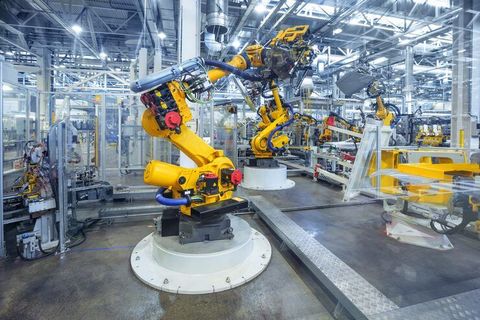
Vision-guided robots combine robotic movement with cameras, lighting, image-processing software, and control systems. Instead of repeating a fixed movement without checking the work area, the robot can use visual information to identify objects, determine their position, inspect surfaces, and adjust its actions.
Vision-guided robots are increasingly associated with precision manufacturing because modern production environments often handle different shapes, sizes, orientations, and product variations. A camera can capture an image, software can interpret important features, and the robot controller can use that information to perform a programmed operation.
The technology developed from the combination of industrial robotics and machine vision. Earlier robotic systems generally depended on carefully positioned components and predefined coordinates. Modern vision systems can provide additional information about the location and condition of components before the robot acts.
Main Components
A typical vision-guided robotic cell contains several connected elements. The exact configuration depends on the manufacturing task, product characteristics, inspection requirements, and environmental conditions.
Common components include:
- Industrial robot for movement and handling
- Industrial camera for capturing visual information
- Lighting system for creating consistent images
- Vision software for image processing
- Robot controller for movement coordination
- Sensors for detecting position or process conditions
- End effector for gripping, placing, assembling, or manipulating components
- Communication system for exchanging information with other production equipment
Together, these elements create a feedback-based automation system. The camera provides information, the software interprets it, and the robot uses the resulting data within its programmed operating limits.
How Vision Guidance Works
A typical sequence begins when a camera captures an image of a component or work area. Image-processing software identifies relevant characteristics, such as edges, shapes, patterns, dimensions, or surface conditions.
The system then compares the detected information with programmed criteria. If the component is located differently from the expected position, the robot can calculate an adjusted movement. During automated inspection, the system can also classify an item according to predefined visual criteria.
This process can be useful when components do not arrive in exactly the same orientation. Rather than requiring every item to be positioned identically, vision guidance can provide information that helps the robot respond to variations.
Importance
Why Precision Manufacturing Uses Vision
Precision manufacturing requires consistent positioning, measurement, assembly, and inspection. Small differences in component location can affect downstream operations, particularly when parts must fit together or pass through multiple production stages.
Vision-guided robots can help address these challenges by combining physical movement with visual information. They can locate components, identify orientation, inspect features, and support automated handling within a defined production process.
The technology can also reduce reliance on manual visual checks for repetitive inspection tasks. Human inspection remains important for many applications, especially where complex judgment is required, but automated inspection can process predefined visual criteria consistently.
Industries Using Vision-Guided Systems
Vision-guided robotics can be found across several manufacturing environments. Applications include:
- Automotive component assembly
- Electronics and circuit-board production
- Packaging and material handling
- Metal component manufacturing
- Food and consumer-product processing
- Pharmaceutical manufacturing equipment
- Plastics and injection-molded component production
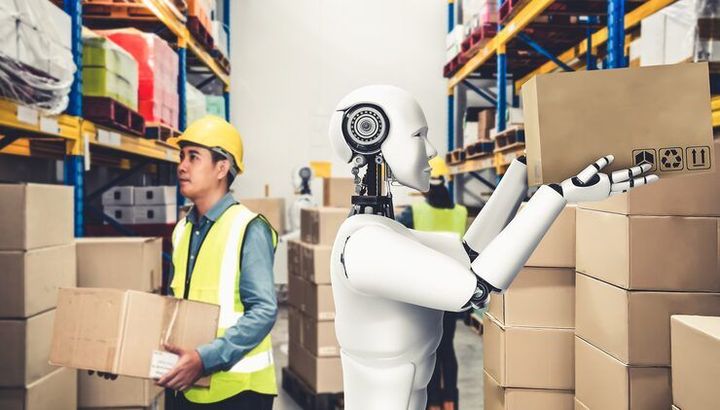
- Warehouse and production-line handling
The requirements differ between sectors. Electronics applications may focus on small components and precise positioning, while automotive applications can involve larger parts and complex assembly sequences.
Common Manufacturing Tasks
Vision-guided robots can support several types of work. Pick-and-place operations are a common application because cameras can determine where components are located before the robot moves toward them.
Automated inspection is another major application. A camera can examine dimensions, alignment, surface characteristics, labels, holes, edges, or assembly conditions according to defined inspection rules.
Other applications include robotic sorting, bin picking, assembly assistance, machine tending, quality verification, and orientation correction.
Comparison of Conventional and Vision-Guided Robotics
| Feature | Conventional Robotic System | Vision-Guided Robotic System |
|---|---|---|
| Position information | Usually predefined | Can be obtained from camera data |
| Component orientation | Often fixed | Can identify varying orientation |
| Visual inspection | Usually separate | Can be integrated |
| Product variation | More limited | Can accommodate defined variations |
| Programming | Coordinate-focused | Coordinates plus visual information |
| Inspection capability | Requires additional equipment | Can integrate machine vision |
| Adaptability | Depends on system design | Greater visual feedback capability |
The table describes general system characteristics. Actual performance depends on camera selection, lighting, software, robot mechanics, calibration, programming, and the manufacturing environment.
Recent Updates
Developments in Robotics and Machine Vision
Recent developments have focused on combining industrial robots with more capable machine vision and data-processing technologies. Improvements in cameras, computing hardware, three-dimensional imaging, and software have expanded the types of objects that robotic systems can identify.
Artificial intelligence is also being incorporated into some machine vision applications. Instead of relying only on traditional image-processing rules, certain systems can use trained models to identify patterns or classify visual conditions. The practical suitability of such systems depends on the available training data, inspection criteria, lighting conditions, and validation process.
Another trend is greater integration between robots, cameras, sensors, programmable controllers, and manufacturing software. This can allow inspection results to become part of a broader production-data system.
New Robot Safety Standards
A significant development was the publication of revised industrial robot safety standards in 2025. ISO 10218-1:2025 addresses safety requirements for industrial robots, while ISO 10218-2:2025 addresses industrial robot applications and robot cells, including integration, commissioning, operation, maintenance, and decommissioning.
These standards are relevant when designing robotic systems because safety considerations extend beyond the robot itself. The surrounding cell, equipment, controls, protective measures, and operating procedures must also be considered.
Greater Use of Three-Dimensional Vision
Two-dimensional cameras remain widely used, but three-dimensional vision is increasingly relevant for applications involving irregular objects, depth measurement, and flexible positioning. Three-dimensional information can help a robot understand an object's spatial location rather than relying only on a flat image.
This is particularly relevant to bin picking and complex component handling, where objects may overlap or appear in different orientations.
Laws or Policies
Industrial Robot Safety Requirements
Vision-guided robots are generally subject to workplace safety, machinery, electrical, and industrial equipment requirements applicable in the jurisdiction where the system operates. Requirements can vary according to the industry, robot application, machine configuration, and national regulatory framework.
International standards can provide technical guidance, but they do not automatically replace applicable laws. Organizations normally need to evaluate the complete robotic cell rather than considering only the robot arm.
ISO 10218-1:2025 covers the robot itself, while ISO 10218-2:2025 focuses on robot applications and robot cells. The second standard addresses areas such as integration, commissioning, operation, maintenance, and decommissioning.
Machinery Rules and Regional Requirements
Regulatory frameworks can also change as machinery technology develops. In the European Union, Regulation (EU) 2023/1230 establishes a new machinery framework and is scheduled to apply generally from January 2027, with certain provisions applying earlier.
Manufacturers and system integrators working across borders may therefore need to consider both international standards and regional machinery requirements. Additional rules may apply to electrical equipment, workplace protection, data systems, or particular industrial processes.
Tools and Resources
Vision and Robot Programming Tools
Several categories of tools can help engineers and operators understand or configure vision-guided robotics:
- Machine vision software for image acquisition and analysis
- Camera calibration tools for improving measurement accuracy
- Robot programming environments for movement and sequence control
- Simulation platforms for testing robot paths before physical operation
- Three-dimensional vision software for depth-based applications
- Programmable logic controllers for coordinating equipment
- Manufacturing execution systems for production information
- Digital twin platforms for system modelling and process analysis
Calibration and Testing Resources
Calibration is an important part of precision manufacturing. The camera, robot, work surface, lighting, and coordinate systems need to operate consistently with one another.
Testing can include camera calibration, robot positioning checks, inspection repeatability tests, lighting evaluation, and verification of detection criteria. Environmental factors such as vibration, dust, changing illumination, reflective surfaces, and component variation can influence vision results.
Standards databases, manufacturer documentation, robotics training materials, technical manuals, simulation environments, and machine vision reference guides can provide additional background information for readers studying the technology.
FAQs
What are vision-guided robots?
Vision-guided robots are robotic systems that use cameras and image-processing technology to obtain information about objects or work areas. The visual information can help the robot locate, orient, handle, assemble, or inspect components.
How do vision-guided robots support precision manufacturing?
Vision-guided robots can identify component positions, detect orientation, and provide visual information for robotic operations. This can support precise handling and repeatable processes when the system has been properly calibrated and configured.
What is automated inspection in manufacturing?
Automated inspection uses cameras, sensors, software, or other measurement technologies to evaluate products according to predefined criteria. Vision-based automated inspection can examine features such as shape, alignment, dimensions, surface characteristics, or assembly conditions.
Can vision-guided robots inspect products?
Yes. A vision-guided robot can work with cameras and inspection software to examine components or products. Depending on the system design, the robot may also separate items according to predefined inspection results or move them to different process stages.
What safety standards apply to industrial robots?
ISO 10218-1:2025 addresses safety requirements for industrial robots, while ISO 10218-2:2025 addresses industrial robot applications and robot cells. Local machinery and workplace safety requirements may also apply depending on the jurisdiction and application.
Conclusion
Vision-guided robots combine industrial robotics with machine vision to support precision manufacturing, component handling, and automated inspection. Their capabilities depend on cameras, lighting, software, calibration, robot control, and the conditions of the production environment. Recent developments include improved vision technologies, three-dimensional imaging, artificial intelligence methods, and updated industrial robot safety standards. As manufacturing systems become more connected, vision-guided robotics continues to form part of broader automation and inspection systems.