Discover Industrial RO Systems for Water Treatment, Filtration, and Process Applications
Industrial RO systems are engineered water treatment systems that use reverse osmosis membranes to reduce dissolved salts, minerals, and selected contaminants from water. The technology has become an important part of industrial water filtration because many manufacturing and process operations require water with controlled quality.
Reverse osmosis works by applying pressure to water so that it passes through a semipermeable membrane while many dissolved substances are retained. The treated stream is commonly called permeate, while the concentrated stream is known as reject or concentrate. The exact treatment performance depends on feed-water quality, membrane characteristics, operating pressure, temperature, and pretreatment.
Context
What Is an Industrial RO System
An industrial RO system is a larger-scale reverse osmosis arrangement designed for commercial facilities, manufacturing plants, institutions, and process applications. Unlike small point-of-use units, these systems are configured around a required water flow, feed-water composition, operating schedule, and desired treated-water quality.
A typical industrial RO system may contain several stages:
- Feed-water tank and transfer pump
- Multimedia or cartridge filtration
- Activated carbon treatment where appropriate
- Chemical dosing equipment when required
- High-pressure pump
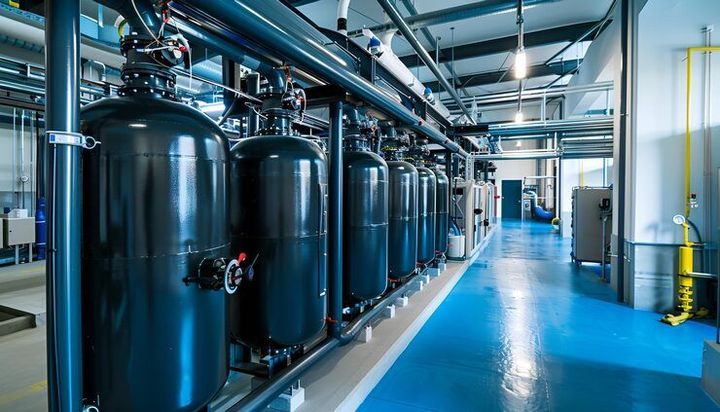
- RO membrane vessels
- Flow, pressure, conductivity, and other monitoring instruments
- Permeate and reject collection arrangements
The purpose of each stage is different. Pretreatment protects the membranes from suspended particles, scaling, fouling, and other conditions that can reduce performance.
How Reverse Osmosis Works
Reverse osmosis is based on membrane separation. Pressure is applied to feed water at a level sufficient to overcome the natural movement of water across the membrane.
The membrane allows water molecules to pass while restricting many dissolved substances. However, RO should not be treated as a universal solution for every contaminant. Water analysis is normally required to determine which pretreatment and polishing stages are appropriate.
BIS describes RO as a process in which pressure forces water through a semipermeable membrane, and its Indian standard for RO-based drinking-water systems also discusses combinations with sediment and carbon filtration.
Main Industrial RO Components
The performance of an industrial RO plant depends on how its individual components work together. Important components include the membrane assembly, pressure pump, pretreatment equipment, control system, valves, instrumentation, and storage tanks.
A basic configuration can be summarized as follows:
| Stage | Main Function | Typical Purpose |
|---|---|---|
| Feed treatment | Removes larger particles and problem substances | Protects downstream equipment |
| Cartridge filtration | Captures fine suspended particles | Reduces membrane fouling |
| High-pressure pumping | Provides membrane operating pressure | Drives water through membranes |
| RO membrane | Separates dissolved substances | Produces treated permeate |
| Monitoring | Measures operating conditions | Supports process control |
| Storage | Holds treated water | Provides a controlled supply |
| Reject management | Handles concentrated stream | Supports responsible disposal or reuse |
Importance
Why Industrial Water Filtration Matters
Water quality can directly influence industrial processes. Dissolved minerals, suspended solids, hardness, silica, microorganisms, and other substances may interfere with equipment or affect process consistency.
Industrial RO systems are therefore used in applications where controlled water quality is important. Examples include manufacturing, food and beverage processing, electronics-related processes, laboratories, boiler-feed preparation, cooling-water treatment, and various utility operations.
The actual treatment requirement differs between industries. Water intended for a production process may have different specifications from water used for equipment washing or boiler makeup.
Problems Addressed by RO Treatment
Industrial water filtration can address several common challenges:
- High total dissolved solids
- Excess mineral content
- Hardness-related problems
- Certain inorganic contaminants
- Variable feed-water quality
- Requirements for consistent process water
- Reduced dependence on untreated water sources
However, RO does not eliminate the need for water-quality testing. A system designed without understanding the incoming water may experience scaling, membrane fouling, pressure problems, or inconsistent output.
Applications Across Industries
Industrial RO systems can be integrated into many process environments.
In manufacturing facilities, RO water may be used for process preparation, equipment cleaning, or other controlled applications. In boiler systems, RO-treated water can form part of the feed-water treatment sequence, depending on the boiler and water-quality requirements.
Food and beverage operations may use multiple water-treatment stages where water quality is relevant to production. Laboratories and technical facilities can also combine RO with additional purification technologies when their processes require lower concentrations of specific substances.
Recent Updates
Greater Attention to Water Efficiency
Recent developments in water treatment increasingly focus on improving recovery, reducing unnecessary water consumption, monitoring membrane performance, and managing concentrated reject streams.
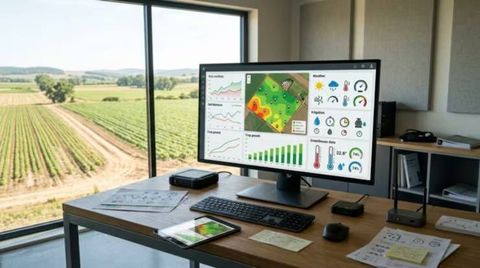
Modern industrial RO systems commonly incorporate sensors and automated controls that track pressure, flow, conductivity, and other operating parameters. These measurements can help operators identify changes in membrane performance and treatment conditions.
Digital Monitoring and Automation
Industrial water treatment is also becoming more data-driven. Digital controllers can record operating information and provide alarms when pressure, conductivity, flow, or other parameters move outside configured ranges.
This trend is particularly relevant to larger plants where water treatment operates continuously. Better monitoring can make it easier to identify membrane fouling, changes in feed-water quality, or abnormal operating conditions.
Developments in RO Standards
India has also seen updates related to RO-based water-treatment standards. BIS published an amendment to IS 16240:2023 concerning RO-based point-of-use drinking-water treatment systems, with implementation guidance issued in 2025. While that standard concerns point-of-use systems rather than every industrial RO plant, it reflects continuing attention to RO equipment specifications and performance requirements.
At the broader water-management level, government programs continue to emphasize water-quality monitoring, treatment technologies, source sustainability, and improved water management. Jal Jeevan Mission materials include drinking-water quality frameworks and handbooks covering water-treatment technologies.
Membrane Efficiency and Process Integration
Another important direction is greater integration between RO and other treatment processes. Instead of treating RO as an isolated machine, facilities increasingly consider pretreatment, membrane operation, polishing, water reuse, and reject management as connected stages.
This approach is particularly relevant where water availability is limited or where industrial operations generate substantial volumes of treated and concentrated water streams.
Laws or Policies
Environmental Protection Requirements
In India, industrial water treatment is influenced by environmental legislation and pollution-control requirements. The Environment (Protection) Rules establish standards for emissions and discharges of environmental pollutants, and the applicable requirements can vary according to the industry and discharge route.
Industrial facilities therefore need to consider more than the quality of RO permeate. The management of reject water, process wastewater, sludge, and other residual streams may also be subject to applicable requirements.
Water Pollution Controls
Water-pollution controls can involve central and state-level authorities. Specific industries may have sector-specific discharge standards, while authorities can impose requirements based on the receiving environment and the nature of the operation.
This means an industrial RO system should be considered within the facility's overall water and wastewater management plan rather than as an isolated filtration unit.
Groundwater Extraction
Groundwater use is another relevant consideration for facilities that obtain their feed water from underground sources. Central Ground Water Authority guidelines regulate groundwater abstraction in applicable areas and provide for No Objection Certificate requirements for various industrial and infrastructure activities, subject to stated exemptions and state-level provisions.
The regulatory position can depend on location, groundwater conditions, industry category, and the authority responsible for water-resource management.
Tools and Resources
Water Quality Testing
Laboratory analysis is one of the most useful resources when evaluating an industrial RO system. Common parameters may include pH, conductivity, total dissolved solids, hardness, alkalinity, silica, iron, manganese, chloride, sulfate, and microbiological indicators, depending on the application.
Testing helps establish the characteristics of the feed water before system design and can also be used for routine performance monitoring.
RO Design Calculators
RO design calculators can help estimate membrane recovery, permeate flow, reject flow, membrane area, and related operating parameters. These tools should be used with actual water-analysis data rather than generic assumptions.
Monitoring Instruments
Common instruments include:
- Conductivity or TDS meters
- Pressure gauges and transmitters
- Flow meters
- pH meters
- Water-quality testing equipment
- Data logging and control systems
These tools provide operational information that can be compared over time.
Standards and Technical Documents
BIS publications, environmental rules, groundwater guidelines, and water-treatment manuals can help users understand applicable technical and regulatory considerations. BIS identifies IS 10500 as the specification for drinking water, while its water-treatment publications provide additional information about drinking-water quality and treatment systems.
FAQs
What is an industrial RO system?
An industrial RO system is a water-treatment system that uses pressure and semipermeable membranes to reduce dissolved substances in water. It is designed for larger water flows and process applications.
How does industrial RO water filtration work?
Industrial RO water filtration applies pressure to feed water and passes it through membranes. Many dissolved substances are retained in the concentrated stream while treated water passes through as permeate.
What is the difference between RO and conventional water filtration?
Conventional filtration generally targets suspended particles and some specific substances, depending on the filter. RO uses a semipermeable membrane and pressure to reduce many dissolved substances, making it a different treatment stage.
What affects industrial RO system performance?
Feed-water quality, membrane condition, pressure, temperature, pretreatment, recovery, scaling, fouling, and operating controls can all affect performance.
Is RO suitable for every industrial water application?
No. The appropriate treatment depends on the water source, contaminant profile, required water quality, process requirements, and wastewater-management conditions. Water analysis is important before selecting a treatment configuration.
Conclusion
Industrial RO systems are an important technology for producing controlled-quality water for manufacturing and process applications. Their operation depends on membranes, pressure, pretreatment, monitoring, and appropriate management of the concentrated stream. Recent developments increasingly emphasize automation, water efficiency, membrane monitoring, and integrated treatment. In India, industrial RO applications are also shaped by environmental discharge requirements, drinking-water standards where applicable, and groundwater regulations.