Battery Tab Welding Systems Guide With Advanced Battery Assembly and Industrial Technology
Battery tab welding systems are industrial machines used to join thin metal tabs to battery cells, terminals, or conductive components. They are part of the battery assembly process and are commonly associated with rechargeable battery packs used in electronics, energy storage equipment, electric mobility, industrial devices, and other electrical applications.
The technology developed from the broader field of resistance welding and other precision joining methods. As battery designs became smaller, more powerful, and more densely assembled, manufacturers needed welding equipment capable of handling thin conductive materials without unnecessarily affecting the battery cell. This created demand for specialized battery welding equipment designed around controlled energy delivery, precise positioning, and repeatable joining.
A typical battery tab welding system can include a welding power source, electrodes or a laser source, positioning mechanisms, fixtures, sensors, control software, and safety equipment. Depending on the design, the system may use resistance welding, laser welding, ultrasonic welding, or another joining technique.
Battery tab welding systems are particularly relevant to lithium-ion battery assembly, although similar joining principles can apply to other rechargeable battery technologies. The equipment is used at different stages of battery pack production, from individual cell connections to module and pack assembly.
What Battery Tab Welding Systems Do
The primary purpose of a battery tab welding system is to create a conductive connection between a battery cell and another electrical component. A tab may connect a cell to a busbar, conductor, terminal, or circuit component.
The welding process needs to balance several factors:
- Electrical conductivity of the finished connection
- Mechanical strength of the joint
- Controlled heat generation
- Accurate positioning of the tab
- Consistency between individual welds
- Compatibility with the materials being joined
These factors make battery tab welding different from ordinary metal joining. Battery cells can contain sensitive internal materials, so excessive heat, pressure, or energy can damage components.
Importance
Battery assembly has become increasingly important as rechargeable energy systems are used in consumer electronics, transportation, industrial equipment, and stationary energy storage. The electrical connection between cells is a fundamental part of a battery pack because poor connections can increase electrical resistance and affect overall pack performance.
Battery tab welding systems address the practical challenge of joining thin conductive materials repeatedly in a controlled production environment. Manual joining can be difficult when a battery assembly contains many cells and connections. Automated or semi-automated equipment can provide consistent positioning and process control.
Who Uses Battery Tab Welding Equipment
Different organizations and technical teams can interact with this equipment depending on their role in battery production.
Manufacturing engineers may use battery tab welding systems to establish production processes and determine suitable welding parameters. Quality teams examine weld appearance, mechanical integrity, electrical characteristics, and process records.
Equipment operators work with fixtures, cell positioning systems, controls, and inspection procedures. Research and development laboratories may also use smaller battery tab welding machines when developing new cell configurations or battery pack designs.
Problems Addressed by Precision Welding
Battery assembly can involve hundreds or thousands of individual electrical connections in larger systems. Each connection introduces an opportunity for misalignment, inadequate bonding, excessive heating, or contamination.
A controlled battery welding process can address several manufacturing challenges:
- Repeatable tab positioning
- Controlled welding energy
- Reduced variation between connections
- Automated process monitoring
- Traceability of production parameters
- Integration with battery assembly lines
The exact results depend on the welding method, materials, equipment configuration, and production conditions.
Common Welding Methods
Battery tab welding technology includes several joining approaches. Resistance welding uses electrical current and controlled pressure to generate heat at the contact area. It is widely associated with cylindrical and other battery cell assemblies.
Laser welding uses a focused beam to create localized heating. It can be useful when precise, narrow weld areas are required. Ultrasonic welding uses mechanical vibrations to join compatible materials and can be applied to certain battery and conductive-material assemblies.
| Welding method | Basic principle | Common consideration |
|---|---|---|
| Resistance welding | Electrical current creates localized heat | Electrode pressure and current control |
| Laser welding | Focused light produces localized heating | Beam alignment and material response |
| Ultrasonic welding | High-frequency mechanical vibration joins materials | Material compatibility and vibration control |
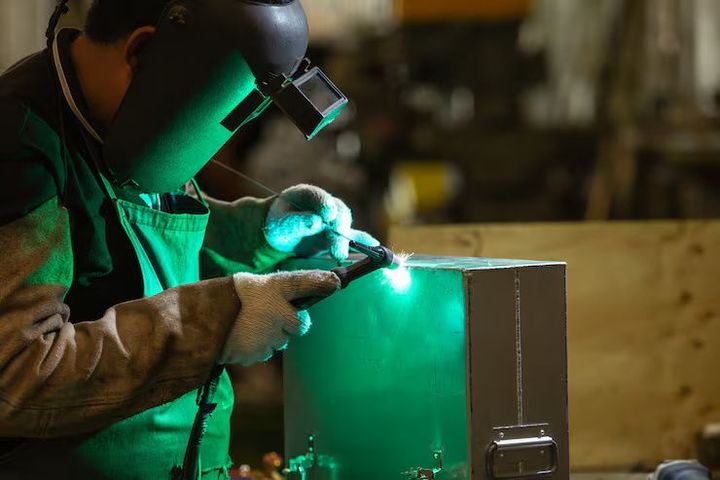
| Manual welding equipment | Operator controls the joining process | Operator consistency and inspection |
No single method applies to every battery design. Cell construction, tab material, thickness, required connection geometry, production volume, and thermal sensitivity all influence equipment selection.
Recent Updates
Battery manufacturing technology has continued to develop as battery packs become more compact and production systems become increasingly automated. From 2024 through 2026, the broader battery assembly industry has placed continued emphasis on automation, process monitoring, traceability, precision joining, and integration with manufacturing control systems.
Automation and Process Monitoring
Modern battery tab welding systems increasingly incorporate sensors and digital controls. These systems can monitor process parameters such as welding current, voltage, pressure, displacement, energy, or laser characteristics depending on the welding method.
Data collection can help production teams identify process variation. When a welding parameter moves outside a defined range, an integrated control system may flag the process for inspection.
Machine vision is another area of development. Cameras can inspect tab positioning, weld locations, component presence, and certain visible characteristics of completed connections.
Battery Assembly Integration
Battery tab welding machines are increasingly designed to work as part of broader automated battery assembly lines. Equipment can communicate with programmable controllers, manufacturing execution systems, inspection equipment, and material-handling systems.
This type of integration can support production traceability. For example, a manufacturing system may associate a battery pack or module with process information generated during assembly.
Precision and New Battery Designs
Changes in cell formats and battery architectures have also influenced welding equipment. Cylindrical, prismatic, and pouch cells can require different connection arrangements and joining techniques.
Battery tab welding systems therefore increasingly emphasize flexible tooling, programmable parameters, accurate positioning, and compatibility with different component geometries. These features are particularly relevant in production environments where battery designs can change over time.
Laws or Policies
Battery tab welding systems are affected by several categories of workplace, electrical, machinery, environmental, and battery-related requirements. The exact rules depend on the country or region where equipment is manufactured, installed, or operated.
Machinery and Workplace Requirements
Industrial welding equipment generally needs appropriate safeguards against electrical hazards, moving machinery, heat, optical radiation where applicable, and other operational risks. Equipment may need guarding, emergency controls, warning systems, protective enclosures, or documented operating procedures.
Laser-based battery welding systems can have additional requirements related to laser radiation. Appropriate enclosure design, interlocks, warning indicators, and controlled access may be required under applicable workplace safety frameworks.
Battery Transportation and Environmental Rules
Battery manufacturing also intersects with rules concerning hazardous materials, battery transportation, recycling, waste handling, and environmental protection. These requirements generally apply to batteries and production activities rather than to the welding machine alone.
Policies in many regions increasingly emphasize battery lifecycle management. Recycling, material recovery, producer responsibilities, and safe handling can influence how battery manufacturing facilities organize production and end-of-life processes.
Organizations operating battery tab welding equipment should consult the regulations applicable to their specific location, equipment type, workplace, and battery chemistry. This article provides general information rather than regulatory or professional advice.
Tools and Resources
Several tools can help people understand or manage battery tab welding processes. The appropriate resources depend on whether the reader is studying battery technology, designing equipment, operating a production line, or evaluating manufacturing data.
Engineering and Process Tools
Useful resources may include:
- Welding parameter calculators for estimating electrical or process relationships
- Battery pack design software
- CAD tools for fixtures and tab positioning
- Machine vision inspection systems
- Electrical resistance measurement equipment
- Weld force measurement instruments
- Data logging and manufacturing traceability platforms
- Equipment manuals and technical documentation
- Battery assembly process templates
- Industrial safety assessment tools
Inspection and Measurement
Inspection is an important part of battery assembly because the visible appearance of a weld does not always reveal its complete electrical or mechanical condition.
Electrical testing can measure resistance across a connection. Mechanical testing can evaluate joint strength in controlled laboratory or production-quality environments. Microscopic examination and cross-sectional analysis may also be used when detailed weld evaluation is required.
Process data can provide another layer of information. Monitoring current, voltage, force, displacement, energy, or other relevant variables can help production teams understand whether the process is operating within its defined parameters.
Selecting a System Configuration
When evaluating battery tab welding systems, technical teams commonly consider factors such as:
- Battery cell format
- Tab material and thickness
- Required weld geometry
- Production volume
- Welding method
- Automation level
- Inspection requirements
- Data collection needs
- Fixture design
- Electrical and workplace safety requirements
The correct configuration depends on the specific battery assembly and manufacturing process.
FAQs
What are battery tab welding systems?
Battery tab welding systems are machines designed to join conductive battery tabs with cells, terminals, busbars, or other electrical components. They can use methods such as resistance, laser, or ultrasonic welding.
How does a battery tab welding machine work?
A battery tab welding machine positions the components and applies controlled welding energy according to programmed process parameters. Sensors and controls may monitor variables such as current, pressure, energy, displacement, or other process conditions.
What welding methods are used in battery assembly?
Resistance welding, laser welding, and ultrasonic welding are among the methods used in battery assembly. The appropriate method depends on cell design, material properties, tab thickness, connection geometry, and manufacturing requirements.
Why are battery tab welding systems important for battery manufacturing?
Battery tab welding systems help create electrical connections between battery components with controlled positioning and repeatable process conditions. This is important when battery packs contain many interconnected cells.
What should be monitored during battery tab welding?
Depending on the equipment and welding method, important parameters may include welding current, voltage, pressure, energy, weld duration, electrode position, laser characteristics, and component alignment. Inspection and electrical testing can provide additional information about connection quality.
Conclusion
Battery tab welding systems are an important part of modern battery assembly because they create controlled electrical and mechanical connections between cells and conductive components. Resistance, laser, and ultrasonic welding technologies each use different principles and can be applied to different battery designs. Recent developments have emphasized automation, process monitoring, machine vision, data traceability, and integration with wider manufacturing systems. Workplace safety, machinery requirements, battery handling rules, and environmental policies also influence how battery welding equipment is designed and operated.