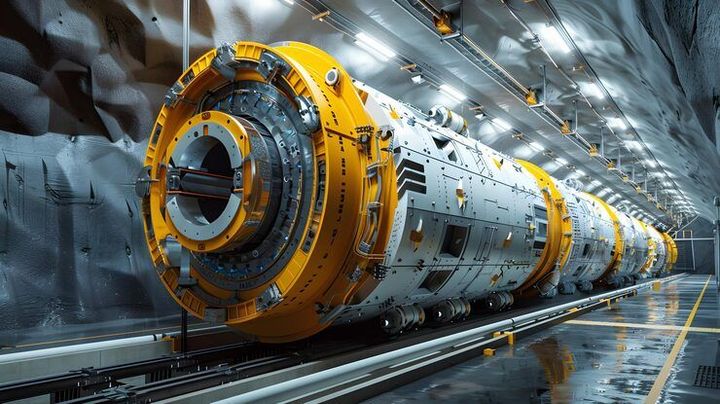
Tunnel Boring Machines Guide With Underground Construction and Engineering Insights
Tunnel boring machines (TBMs) are large underground construction systems designed to excavate soil or rock while creating a controlled tunnel behind the cutting face. A modern tunnel boring machine combines excavation, ground support, material removal, guidance, monitoring, and tunnel lining operations into one coordinated process.
The idea behind mechanized tunneling is to make underground excavation more controlled and repeatable than conventional excavation methods in suitable ground conditions. A TBM does not work in the same way in every location. Machine selection depends on geology, groundwater, tunnel diameter, depth, alignment, pressure conditions, and the required tunnel lining system.
Main types of TBMs
Tunnel boring machines are selected according to the ground they must cross. Common categories include hard-rock TBMs, shield TBMs, earth pressure balance machines, slurry TBMs, and multi-mode machines.
| TBM Type | Typical Ground Condition | Main Operating Feature |
|---|---|---|
| Hard-rock TBM | Strong rock | Rotating cutters break rock |
| Gripper TBM | Competent rock | Uses grippers against tunnel walls |
| Shield TBM | Soft or mixed ground | Shield protects the excavation area |
| EPB TBM | Soft cohesive ground | Excavated soil helps balance pressure |
| Slurry TBM | Water-bearing or unstable ground | Slurry supports the excavation face |
| Multi-mode TBM | Changing geology | Can operate in different modes |
No single machine is suitable for every geological environment. Detailed ground investigation is therefore an important part of underground construction planning.
Key components
A typical TBM includes a cutting head, main drive, shield or supporting structure, hydraulic thrust system, steering equipment, spoil removal equipment, segment erector, grout system, electrical systems, and monitoring instruments.
The cutting head contains tools selected for the expected ground. In hard rock, disc cutters are common, while different cutter arrangements can be used for softer or mixed materials. Behind the cutting area, the machine contains systems supporting excavation, lining installation, ventilation, power distribution, and material transport.
Importance
Why underground construction matters
Underground construction can create transport and utility corridors without occupying the full surface area required by open excavation. This is particularly useful where roads, buildings, rivers, railways, or other infrastructure already occupy the surface.
Metro tunnels can connect dense urban areas, while water tunnels can move water through difficult terrain. Utility tunnels can also carry cables, pipelines, and other infrastructure below ground.
Problems TBMs help address
A tunnel boring machine can reduce surface disruption associated with some tunneling methods. It can also provide continuous excavation and controlled ground support when the selected technology matches site conditions.
Important challenges remain. Ground settlement, groundwater pressure, unexpected rock formations, cutter wear, machine alignment, ventilation, spoil handling, and equipment maintenance all require careful planning.
Safety and monitoring
Underground construction requires continuous observation because conditions can change as the machine advances. Monitoring may include ground movement, groundwater levels, tunnel pressure, machine thrust, cutter performance, lining position, and structural behavior.
Modern TBM projects commonly combine machine data with surveying and geotechnical information. This creates a more detailed picture of conditions inside the machine and around the tunnel.
Recent Updates
Digital monitoring and automation
From 2024 through 2026, the general direction of TBM development has continued toward greater automation, digital monitoring, remote diagnostics, and data-based decision support. Sensors can record large volumes of operating information, while software can organize these readings for engineers and machine operators.
Digital models and digital twin approaches are also being used in parts of the tunneling sector to connect design information with construction data. These systems can help teams compare planned and actual machine behavior and identify unusual operating patterns.
Machines for complex environments
Modern tunnel boring machine development increasingly focuses on difficult combinations of soil, rock, groundwater, and changing geology. Multi-mode TBMs are designed to switch between operating configurations when ground conditions vary along a route.
Mechanized tunneling is also being applied to demanding environments such as deep urban corridors, river crossings, and underwater sections. These projects require careful pressure control, navigation, ground assessment, and emergency planning.
Energy and resource efficiency
Another continuing trend is attention to energy use, cutter performance, component life, spoil handling, and material efficiency. Better monitoring can help identify unnecessary machine loading and support more controlled maintenance planning.
Laws or Policies
Indian regulatory framework
In India, tunnel projects are shaped by engineering standards, environmental requirements, land and forest rules where applicable, and project-specific approvals. Indian engineering standards include guidance covering mechanized tunneling, geological investigation, tunnel construction, structural considerations, and related safety requirements.
Geological investigation is an important part of the planning process. Engineers need information about soil layers, rock strength, groundwater, faults, and other underground features before selecting excavation methods and machine configurations.
For road and infrastructure projects, requirements can also involve standards and guidelines issued by relevant transport authorities and professional bodies. Safety provisions, tunnel geometry, ventilation, emergency access, structural design, and monitoring may vary according to the project type.
Environmental requirements can include assessment of impacts on water, land, vegetation, nearby communities, and other environmental resources. Projects within applicable categories may require environmental clearance and additional permissions before construction activities proceed.
The exact approval pathway depends on the tunnel's purpose, location, geology, environmental setting, and project authority. A TBM project therefore needs to be assessed according to the rules applicable to its particular site rather than treated as one regulatory category.
Tools and Resources
Engineering and planning tools
Several technical tools support TBM planning and operation. Geological models help represent soil and rock conditions along the alignment. Surveying equipment and tunnel guidance systems help control machine position and direction.
Geotechnical calculators can be used for pressure, ground behavior, and basic excavation-related assessments. Structural analysis software can help engineers examine tunnel linings, loads, and deformation.
Digital resources
Useful resources include standards databases, engineering manuals, geological maps, tunnel design references, project specifications, monitoring dashboards, and equipment documentation. Public engineering portals and standards libraries can help readers understand terminology and technical requirements.
Helpful resources can include:
- Tunnel alignment and surveying references
- Geological and geotechnical investigation guides
- TBM operating manuals
- Tunnel lining design references
- Ground monitoring templates
- Risk assessment frameworks
- Project planning and progress-tracking tools
These resources are most useful when their information is interpreted according to the conditions of a specific tunnel project.
FAQs
What is a tunnel boring machine?
A tunnel boring machine is a large mechanical system used to excavate tunnels through soil or rock. It combines cutting, ground support, material removal, guidance, and, in many designs, tunnel lining installation.
How does a tunnel boring machine work?
The cutting head rotates against the ground while hydraulic systems push the machine forward. Excavated material is removed from the tunnel, and lining segments can be installed behind the cutting area as the machine advances.
What types of tunnel boring machines are used in underground construction?
Common types include hard-rock TBMs, shield TBMs, earth pressure balance TBMs, slurry TBMs, and multi-mode machines. The appropriate design depends on geology, groundwater, tunnel dimensions, and pressure requirements.
Why is geological investigation important before using a TBM?
Geological investigation helps identify soil layers, rock strength, groundwater conditions, faults, and other underground features. This information influences machine selection, cutter design, pressure control, tunnel alignment, and risk planning.
Are tunnel boring machines used for underwater tunnels?
Yes. Specialized TBMs can be used for tunnels beneath rivers, channels, and other water bodies. Such projects require careful control of groundwater pressure, ground stability, lining, navigation, and environmental conditions.
Conclusion
Tunnel boring machines are complex underground construction systems that combine excavation, support, material handling, guidance, and monitoring. Their selection depends strongly on geology, groundwater, tunnel dimensions, and project requirements. Recent development has placed greater attention on automation, digital monitoring, multi-mode operation, and resource efficiency. Engineering standards, environmental requirements, and project-specific approvals also play important roles in controlled tunnel construction.