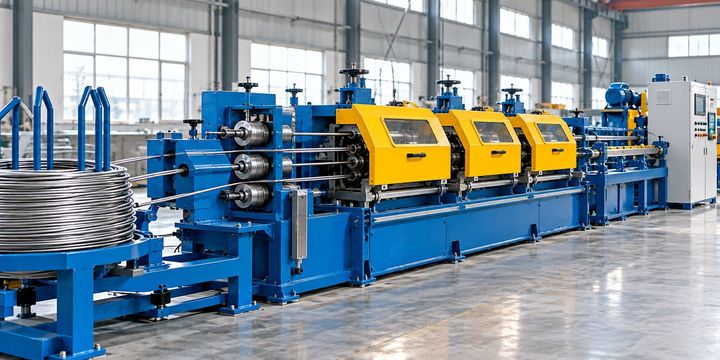
Three-Line Cold Drawing Machine Information With Production Efficiency and Quality Control
A Three-Line Cold Drawing Machine is an industrial metal-processing system designed to reduce the diameter or adjust the cross-sectional dimensions of metal rods, wires, or tubes by pulling the material through a specially shaped die.
The term “three-line” generally refers to a machine arrangement with three drawing lines or processing paths, although the exact configuration depends on the manufacturer and production design. These systems are used in metalworking facilities where dimensional accuracy, consistent output, and controlled material properties are important.
Cold drawing differs from hot forming because the metal is processed below its recrystallization temperature. The material passes through a die that gradually reduces its dimensions while increasing its length. This process can improve surface finish and dimensional consistency while also changing mechanical properties, including strength and ductility.
How the Machine Developed
Cold drawing evolved from traditional wire and rod manufacturing methods that relied on mechanical force to pull metal through dies. As industrial production expanded, manufacturers developed powered drawing equipment with improved tension control, material handling, and process monitoring.
A three-line arrangement can help organize production across multiple processing paths. Depending on its design, the equipment may process three material strands simultaneously, operate through separate drawing stations, or support coordinated production stages. Understanding the specific machine configuration is necessary before comparing output capacity or operating methods.
Main Components and Their Functions
A typical Three-Line Cold Drawing Machine may include several interconnected components:
Pay-off units: Hold and release incoming coils, rods, or wire.
Straightening equipment: Reduces unwanted bends before drawing.
Drawing dies: Shape the material by reducing its cross-sectional dimensions.
Drawing capstans or pulling mechanisms: Apply the force needed to move material through the dies.
Drive systems: Control movement, speed, and coordination between processing lines.
Lubrication systems: Reduce friction, heat generation, and die wear.
Take-up or collection units: Gather the finished material into coils or other suitable forms.
Control panels and sensors: Monitor operating conditions and support process adjustments.
The exact component arrangement depends on whether the machine is designed for wire, rods, tubes, or a particular metal grade.
Importance
Production Efficiency and Throughput
Production efficiency is an important consideration when evaluating a Three-Line Cold Drawing Machine. Processing multiple lines within one coordinated arrangement may increase throughput compared with a single-line configuration, provided that the equipment, material supply, and downstream operations can support the additional output.
Actual production performance depends on drawing speed, material dimensions, die changes, setup time, equipment downtime, and the number of processing stages. A machine running three lines does not automatically produce three times the output of a single-line machine because each line may have different operating conditions or limitations.
Dimensional Accuracy and Surface Quality
Cold drawing is commonly used when metal products require controlled dimensions and a consistent surface. Die condition, incoming material quality, lubrication, and drawing force all influence the finished product.
Poor process control can lead to dimensional variation, surface scratches, cracks, excessive heating, or material breakage. These defects can increase rejected output and interrupt production, making routine inspection and preventive maintenance important parts of manufacturing operations.
Material Properties and Applications
Cold drawing can increase tensile strength and hardness through work hardening. However, this change may reduce ductility, depending on the material and amount of deformation. Some applications therefore require intermediate heat treatment or a carefully planned sequence of drawing passes.
Three-line drawing systems may be used in the production of:
Steel wire for industrial manufacturing.
Metal rods used in engineering components.
Precision wire for electrical and mechanical applications.
Stainless steel products requiring controlled dimensions.
Certain nonferrous metal wires and profiles.
Specialized feedstock for further forming processes.
The suitability of a machine depends on its rated capacity, compatible material grades, drawing range, and required product tolerances.
Production Factors at a Glance
Production factor | Effect on operations | Control method |
|---|---|---|
Drawing speed | Influences throughput and heat generation | Speed monitoring |
Die condition | Affects dimensions and surface finish | Inspection and replacement |
Lubrication | Influences friction and tool wear | Lubricant monitoring |
Material quality | Affects breakage and consistency | Incoming inspection |
Line synchronization | Influences continuous operation | Drive and tension control |
Maintenance | Influences downtime and reliability | Planned maintenance |
Final inspection | Identifies dimensional and surface defects | Measurement and testing |
Recent Updates
Automation and Process Monitoring
During 2024–2026, industrial metalworking has continued to incorporate automation, digital monitoring, and data-based process management. In cold drawing operations, these approaches can help monitor motor loads, line speeds, production counts, temperatures, and selected tension measurements.
A modern control system may use sensors and programmable logic controllers to coordinate drives and detect operating abnormalities. The available functions vary by equipment model, and some machines require additional instrumentation to measure particular process variables.
Energy and Material Efficiency
Manufacturers continue to examine electricity consumption, lubricant use, die life, and material waste when assessing production efficiency. More consistent speed control and suitable maintenance schedules can help reduce avoidable interruptions and unnecessary energy use.
Material efficiency also depends on controlling defects at an early stage. Detecting a dimensional problem before a large batch is processed can reduce the amount of material that requires rework or rejection.
Digital Quality Records
Electronic production records can connect inspection results with machine settings, material batches, and maintenance activities. This information helps operators identify recurring problems and compare performance between production runs.
Data collection alone does not improve quality unless the information is reviewed and used to adjust the process. Reliable measurement methods, suitable sensor calibration, and clear inspection procedures remain essential.
Laws or Policies
Machinery Safety Requirements
Three-Line Cold Drawing Machines contain moving components, powerful drives, pulling mechanisms, and areas where metal can break under tension. Applicable workplace safety rules may require machine guarding, emergency-stop arrangements, suitable electrical protection, and documented operating procedures.
Requirements vary by country and installation. Manufacturers and facility operators must determine which machinery safety, electrical, occupational health, and equipment conformity rules apply to their particular location and machine configuration.
Worker Protection and Training
Operators need appropriate instruction in machine controls, material loading, die changes, emergency procedures, and routine inspection. Access to moving parts should be restricted during operation, and maintenance should follow suitable isolation procedures to prevent unexpected movement or electrical activation.
Personal protective equipment may include safety footwear, eye protection, and other items selected through a workplace risk assessment. Loose clothing and unsuitable gloves can create entanglement hazards around rotating machinery, so protective equipment must be chosen for the specific task.
Environmental and Product Quality Considerations
Industrial facilities may also need to manage used lubricants, metal waste, noise, and other environmental impacts under applicable rules. Handling and disposal procedures depend on the substances involved and local environmental requirements.
Product quality may be governed by customer specifications, industry standards, or material-specific requirements. These can define dimensional tolerances, tensile properties, surface conditions, testing methods, and documentation expectations. Compliance should be assessed against the standards relevant to the intended application rather than assumed from the machine type alone.
Tools and Resources
Measurement and Quality Control Equipment
Quality control for a Three-Line Cold Drawing Machine commonly uses measuring instruments and testing equipment to verify product dimensions and material properties.
Micrometers: Measure wire or rod diameters with suitable precision.
Laser diameter gauges: Support continuous dimensional monitoring where compatible with the production line.
Tensile testing machines: Measure tensile strength and related mechanical properties.
Surface inspection equipment: Helps identify scratches, cracks, and other visible or measurable defects.
Hardness testers: Assess resistance to indentation using an appropriate test method.
Temperature sensors: Monitor selected equipment or material temperatures.
Tension measurement devices: Help evaluate material pulling conditions when incorporated into the system.
Instrument selection should match the product dimensions, required tolerance, material, and inspection procedure.
Production Efficiency Calculations
Manufacturing teams can use simple calculations to compare planned output with actual production. One useful measure is equipment availability, which compares the time the machine was operating with the planned production time.
A basic production efficiency calculation is:
Production efficiency (%) = (Actual output ÷ Planned output) × 100
For example, if a line produces 900 kilograms during a period when its planned output is 1,000 kilograms, the production efficiency against that plan is 90%. This figure does not independently measure product quality, energy consumption, or overall equipment effectiveness.
Quality and Maintenance Records
A structured production record can help connect operating conditions with finished-product results. Useful fields include material batch, die identification, drawing speed, lubricant condition, measured diameter, inspection results, downtime, and maintenance activity.
Regular review of these records can help identify recurring causes of defects. Records should use consistent measurement units and clearly defined acceptance criteria so results can be compared across lines and production shifts.
FAQs
What is a Three-Line Cold Drawing Machine used for?
A Three-Line Cold Drawing Machine processes metal through drawing dies to reduce dimensions and improve dimensional consistency. Depending on its configuration, it can support the production of wire, rods, or other compatible metal products across multiple processing lines.
How does a Three-Line Cold Drawing Machine improve production efficiency?
It may increase throughput by allowing multiple processing paths to operate within one coordinated arrangement. Actual performance depends on drawing speed, material supply, downtime, tooling condition, and synchronization between lines.
How is quality control maintained in cold drawing?
Quality control involves checking dimensions, surface condition, and relevant mechanical properties. Suitable lubrication, die inspection, process monitoring, calibrated instruments, and documented inspection procedures help maintain consistent output.
Which materials can be processed using a Three-Line Cold Drawing Machine?
Compatible materials may include carbon steel, stainless steel, and certain nonferrous metals. The permitted material grades and dimensional ranges depend on the machine design, tooling, and process specifications.
What maintenance does a Three-Line Cold Drawing Machine require?
Maintenance commonly includes inspecting dies, checking lubrication, examining drive components, verifying sensors, and inspecting guards and emergency stops. The maintenance schedule should follow the equipment manufacturer's instructions and the facility's operating conditions.
Conclusion
A Three-Line Cold Drawing Machine supports metal processing through controlled deformation across multiple production paths. Its output and product quality depend on machine configuration, material properties, drawing speed, lubrication, tooling condition, and process monitoring. Automation and digital records can help operators identify variations, while inspection and maintenance remain important for consistent production. Safe operation requires suitable training, machine protection, and compliance with applicable industrial requirements.