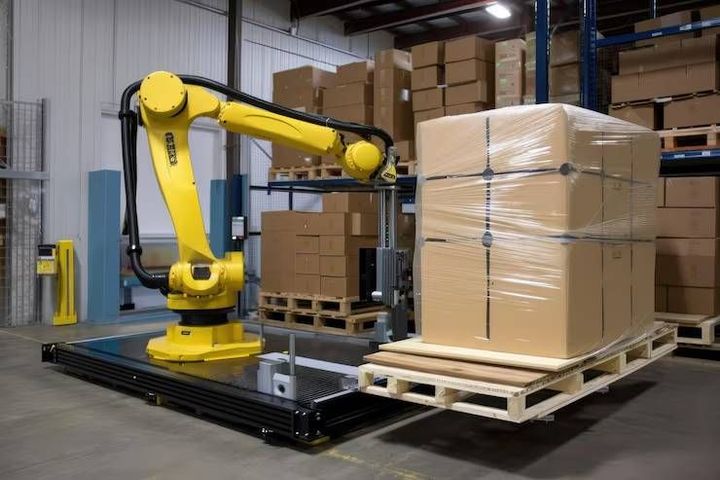
Pallet Wrapping Robots Guide With Automated Packaging and Warehouse Insights
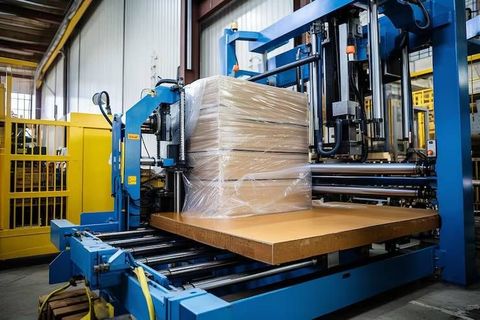
Pallet wrapping robots are automated machines designed to wrap stretch film around palletized products. They are used in warehouses, manufacturing plants, distribution facilities, food processing environments, and other operations where packaged goods need to be stabilized before storage or transportation.
A pallet wrapping robot typically moves around a stationary pallet while applying stretch film in controlled layers.
Traditional pallet wrapping can involve a worker manually moving around a pallet with a film roll or operating a basic wrapping machine. As material-handling operations became more automated, robotic wrapping systems developed as another way to connect pallet preparation with warehouse handling processes.
A pallet wrapping robot generally includes a mobile base, wrapping mast, film carriage, sensors, battery or electrical system, and control software. The robot can travel around a pallet while maintaining a programmed distance from the load. Depending on its design, it can adjust wrapping speed, film tension, wrapping height, and the number of film layers.
Automated packaging systems can place pallet wrapping within a larger material-handling workflow. Products may first arrive from a palletizer, then move through inspection or labeling before being wrapped and transferred to a storage area.
Main Components of Pallet Wrapping Robots
A typical robotic pallet wrapping system may contain:
Mobile robot base for movement around the pallet
Film carriage for holding and dispensing stretch film
Mast or vertical lifting mechanism
Sensors for detecting pallet and load dimensions
Control panel or user interface
Battery and charging system
Drive motors for movement
Film tension controls
Safety sensors and emergency controls
The configuration varies according to pallet dimensions, load shape, wrapping requirements, floor conditions, and the wider warehouse layout.
How Automated Pallet Wrapping Works
The process normally begins when a completed pallet is positioned within the wrapping area. Sensors can identify the load and provide information about its approximate height or position.
The robot moves around the pallet while the film carriage travels vertically. Stretch film is applied around the load in overlapping layers, with the wrapping pattern controlled by the programmed operating sequence.
After the wrapping cycle is completed, the robot can move away from the pallet. The wrapped pallet can then be transferred by a forklift, pallet truck, automated guided vehicle, or another warehouse handling system.
Importance
Pallet wrapping robots are important because wrapped loads need to remain reasonably stable during internal movement, storage, and transportation. Properly applied stretch film can help hold individual packages together and reduce unwanted movement within a pallet load.
Automated wrapping also addresses repetitive packaging activities. Instead of requiring a person to repeatedly walk around pallets while handling film, a robotic system can perform a programmed wrapping sequence.
Warehouse Applications
Pallet wrapping robots can be used in many environments, including:
Manufacturing warehouses
Food and beverage facilities
Consumer product distribution
Agricultural processing
Paper and packaging operations
Industrial material storage
Retail distribution centers
E-commerce fulfillment facilities
The appropriate configuration depends on the pallet dimensions, product characteristics, floor surface, traffic patterns, and required wrapping process.
Load Stability
Pallet stability depends on several factors, including product arrangement, pallet condition, packaging characteristics, film properties, and wrapping pattern. A wrapping robot controls only part of this overall process.
Loads with irregular shapes can require different wrapping approaches from uniform cartons. Lightweight products may also behave differently from dense or rigid packages.
The wrapping process can include adjustments to film tension, vertical movement, overlap, and the number of revolutions. These parameters need to be matched to the load and packaging conditions.
Warehouse Movement
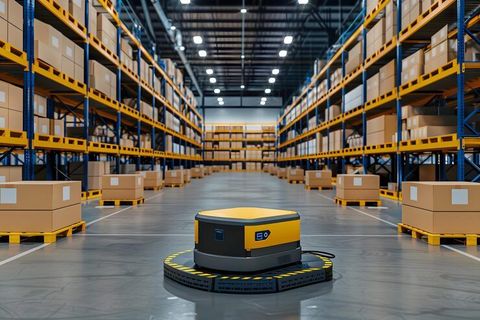
A mobile pallet wrapping robot needs enough space to travel around pallets safely. Warehouse planning therefore needs to account for aisles, racks, workers, forklifts, pallet trucks, doors, columns, and other equipment.
Floor conditions are also relevant. Uneven surfaces, debris, narrow passages, slopes, or frequent traffic can influence robotic movement. Charging locations and temporary parking areas also need to be considered.
Automation and Human Interaction
Pallet wrapping robots are designed to work within environments where people and other equipment may also be present. Sensors can detect certain obstacles or unexpected objects and trigger programmed responses.
Safety does not depend on sensors alone. Physical separation, operating procedures, warning systems, emergency controls, traffic management, and risk assessment can all be part of the overall warehouse safety arrangement.
Recent Updates
From 2024 through 2026, pallet wrapping automation has continued to develop through improvements in mobile robotics, sensors, battery systems, film-control technology, digital monitoring, and warehouse integration. The broader trend is toward connecting packaging equipment with automated material-handling systems.
Mobile Robotic Wrapping
Unlike fixed turntable or rotary-arm wrapping machines, mobile wrapping robots can travel to different pallet locations. This can provide greater flexibility in facilities where pallets are prepared at multiple points.
The robot's navigation system can use sensors to maintain its position around a load. Some systems can work within defined routes or areas, while others use more advanced navigation technologies.
Improved Film Management
Film carriage technology has continued to develop around controlled tension and consistent application. Sensors and electronic controls can regulate film movement according to programmed settings.
Some systems can monitor film usage and detect conditions such as film breaks. Automatic film cutting and attachment mechanisms may also be incorporated into certain configurations.
Battery and Charging Technology
Mobile wrapping robots depend on onboard power systems. Developments in battery technology and automated charging arrangements are supporting longer operating periods and more flexible warehouse workflows.
Charging strategies can vary. Some facilities use designated charging areas, while others may incorporate automatic charging stations into the warehouse environment.
Warehouse Integration
Modern pallet wrapping robots can potentially operate alongside conveyors, palletizers, automated guided vehicles, warehouse management systems, and manufacturing execution platforms.
Data integration can provide information about completed wrapping cycles, pallet identification, equipment status, and production activity. Communication between systems requires compatible interfaces and carefully planned control architecture.
Sensors and Digital Monitoring
Sensors can provide information about pallet position, load height, obstacles, film movement, and machine status. Digital interfaces can display operating information and selected alarms.
Collected data may also support maintenance planning. Information such as cycle counts, battery status, movement patterns, and recurring alarms can help maintenance teams understand equipment usage.
Laws or Policies
Pallet wrapping robots are affected by machinery safety, workplace protection, electrical safety, battery-handling requirements, and warehouse traffic rules. Specific regulations vary according to the country, facility, equipment design, and working environment.
Machinery Safety
Robotic wrapping systems contain moving wheels, motors, film carriages, vertical mechanisms, and control systems. Safety measures may include emergency-stop controls, protective sensors, warning indicators, controlled access, and safe operating modes.
A risk assessment can examine potential hazards involving robot movement, unexpected starts, film mechanisms, nearby people, pallet movement, and interaction with other machinery.
Warehouse Traffic
A mobile pallet wrapping robot operates on the same floor area used by people and other material-handling equipment in many facilities. Warehouse traffic planning may therefore define operating zones, travel paths, crossings, restricted areas, and pedestrian routes.
Where forklifts or automated vehicles are present, their movements may need to be coordinated with robotic wrapping operations.
Electrical and Battery Safety
Battery-powered robots require appropriate charging arrangements and electrical protection. Depending on the battery technology, facilities may also need procedures covering charging locations, inspection, ventilation, storage, and damaged battery handling.
Electrical requirements can apply to chargers, control panels, motors, sensors, and other connected equipment.
Workplace Protection
Operators and maintenance personnel may need training concerning normal operation, emergency procedures, inspection, cleaning, battery charging, and equipment isolation.
Maintenance activities may involve mechanical, electrical, or stored energy. Appropriate isolation procedures can help control these hazards when personnel need to access equipment.
Tools and Resources
Planning a pallet wrapping robot involves several types of technical and operational information. Load-dimension worksheets can record pallet length, width, height, weight, product arrangement, and packaging characteristics.
Warehouse-layout software can help planners examine robot travel paths, pallet locations, aisle widths, charging areas, pedestrian routes, and interactions with other equipment.
Useful resources include:
Pallet dimension calculators
Film usage worksheets
Warehouse layout software
Robot simulation platforms
Battery monitoring systems
Equipment inspection checklists
Maintenance schedules
Risk assessment templates
Warehouse management platforms
Manufacturing execution systems
Pallet identification systems
Production monitoring dashboards
A simplified comparison of wrapping approaches is shown below:
| Wrapping System | Movement Method | Main Planning Factor |
|---|---|---|
| Mobile Wrapping Robot | Robot travels around pallet | Floor navigation |
| Turntable Wrapper | Pallet rotates on platform | Pallet positioning |
| Rotary Arm Wrapper | Arm moves around stationary load | Clearance |
| Fixed Robotic Wrapper | Automated wrapping cell | Cell footprint |
| Integrated Wrapping Line | Connected conveyor system | System coordination |
Film selection is another important planning consideration. Film thickness, stretch characteristics, load weight, product shape, and environmental conditions can influence wrapping behavior.
Digital warehouse systems can also associate pallet identification information with wrapping records. This can provide traceability within a broader material-handling process when compatible systems are connected.
FAQs
What are pallet wrapping robots?
Pallet wrapping robots are mobile or fixed automated machines that apply stretch film around palletized loads. They can use sensors, programmed movement, film-control mechanisms, and automated controls to complete wrapping cycles.
How do automated pallet wrapping robots work?
A robot identifies or receives information about a pallet and moves around the load while applying stretch film. Its controls can manage movement, film tension, wrapping height, overlap, and other programmed parameters.
What are pallet wrapping robots used for?
They are used to stabilize palletized products before storage or transportation. Applications can include manufacturing, distribution, food processing, agriculture, packaging, warehousing, and other material-handling environments.
How do pallet wrapping robots fit into warehouse automation?
Pallet wrapping robots can operate alongside palletizers, conveyors, automated guided vehicles, warehouse management systems, and other material-handling equipment. Data connections can allow selected information to move between these systems.
What factors affect pallet wrapping robot selection?
Important factors include pallet dimensions, load weight, load shape, film characteristics, floor conditions, robot navigation requirements, battery capacity, warehouse traffic, charging arrangements, safety systems, and required integration with other equipment.
Conclusion
Pallet wrapping robots combine mobile or fixed robotic equipment with stretch-film application technology to automate pallet stabilization. Their operation involves sensors, movement controls, film-management mechanisms, and safety systems. Recent developments include improved navigation, battery technology, digital monitoring, film control, and integration with wider warehouse automation. The final arrangement depends on load characteristics, facility layout, traffic patterns, wrapping requirements, and applicable machinery and workplace rules.