Industrial Air Compressors Learn About Types, Pressure Ratings, and Industrial Uses
Industrial air compressors are machines that convert mechanical energy into compressed air for use in manufacturing, construction, processing, transportation, and many other industrial environments.
An air compressor draws atmospheric air into a compression chamber, reduces its volume, and delivers the resulting compressed air to a receiver, pipeline, tool, machine, or process system.
Compressed air is commonly described as a utility because it can power pneumatic equipment and support many production activities. Unlike electrical power, compressed air can directly create controlled movement through pneumatic cylinders, operate air tools, move materials, actuate valves, and support cleaning or drying processes where appropriate.
Industrial air compressors developed from relatively simple mechanical compression equipment into systems incorporating electric motors, pressure controls, air receivers, dryers, filters, variable-speed drives, sensors, and digital monitoring. Different compressor designs are suited to different pressure, flow, duty-cycle, and environmental requirements.
The main compressor categories include reciprocating, rotary screw, rotary vane, centrifugal, and scroll designs. Each uses a different mechanism to compress air, and each has particular operating characteristics.
How Industrial Air Compressors Work
The basic compression process has several stages. Air enters through an intake system and moves into a compression chamber. Mechanical components then reduce the available volume, increasing air pressure.
Compressed air may pass through a cooler, moisture separator, filter, or dryer before entering the distribution system. An air receiver can provide temporary storage and help stabilize pressure during changes in demand.
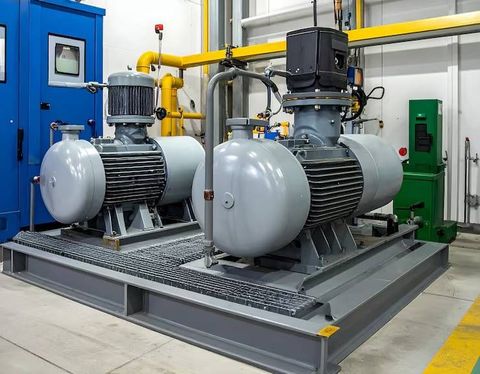
A typical industrial compressed-air system may contain:
Air compressor
Electric motor or other drive system
Intake filter
Air receiver
Aftercooler
Moisture separator
Air dryer
Filtration equipment
Pressure regulators
Distribution piping
Monitoring and control equipment
The complete system is therefore larger than the compressor itself.
Types of Industrial Air Compressors
Reciprocating compressors use pistons that move inside cylinders to compress air. They can be suitable for intermittent operation and applications requiring relatively high pressure from a compact machine.
Rotary screw compressors use rotating male and female screw elements to continuously compress air. They are widely used in industrial environments requiring a steady compressed-air supply.
Rotary vane compressors use a rotor with sliding vanes inside a housing. The changing chamber volume compresses the incoming air.
Centrifugal compressors use high-speed rotating impellers to increase air velocity, followed by diffusion that converts velocity into pressure. They are generally associated with applications requiring substantial continuous airflow.
Scroll compressors use interlocking spiral-shaped elements to progressively compress air. Their operating characteristics make them suitable for selected applications where lower noise and controlled compression are important considerations.
Importance
Industrial air compressors matter because compressed air can operate equipment across many production environments. Pneumatic cylinders, valves, actuators, drills, impact tools, spray equipment, packaging machines, automation systems, and process controls can all use compressed air.
A compressed-air system also affects energy consumption and production reliability. Leaks, unsuitable pressure settings, restricted filters, moisture, and poorly matched equipment can influence system performance.
Industrial Applications
Compressed air is used in many industries and processes. Common applications include:
Manufacturing automation
Packaging equipment
Pneumatic tools
Material handling
Assembly systems
Textile machinery
Food processing equipment
Chemical processing
Metalworking
Automotive production
Construction equipment
Instrumentation and control
The required air quality can vary significantly. Air used for general pneumatic equipment may have different filtration and moisture requirements from air that comes into direct contact with a product or is used in sensitive instrumentation.
Pressure and Airflow
Two important specifications are pressure and airflow. Pressure describes the force available within the compressed-air system and is commonly expressed in bar, psi, or similar units. Airflow describes how much compressed air the system can deliver over a particular period and may be expressed in cubic feet per minute or cubic meters per minute.
A compressor must be considered in relation to both values. A machine with sufficient pressure but inadequate airflow may not support multiple pneumatic devices operating simultaneously.
The required pressure also depends on the equipment connected to the system. Increasing system pressure above the level required by downstream equipment can increase energy demand without necessarily improving the process.
Pressure Ratings
Pressure ratings describe the pressure levels for which components are designed to operate. These ratings can apply to compressors, receivers, valves, filters, hoses, pipes, regulators, and other components.
A simplified comparison is shown below:
| Compressor Category | Common Operating Characteristic | Typical Industrial Role |
|---|---|---|
| Reciprocating | Intermittent or cyclic compression | Workshops and selected production tasks |
| Rotary Screw | Continuous compressed-air generation | Manufacturing and process equipment |
| Rotary Vane | Rotary compression | General industrial applications |
| Centrifugal | High-volume continuous airflow | Large process facilities |
| Scroll | Compact, controlled compression | Selected clean-air applications |
Actual pressure and airflow ranges vary substantially according to machine design and manufacturer specifications. Ratings should therefore be evaluated from equipment documentation rather than inferred only from compressor type.
Air Quality
Compressed air can contain water vapor, oil aerosols, particles, and other contaminants from the intake environment or compression process. Treatment equipment can reduce particular contaminants when required.
Air dryers remove moisture using technologies such as refrigerated or desiccant drying. Filters can capture particles and selected aerosols. Oil-free compressor designs use different compression arrangements to reduce oil contact with the compressed-air stream.
The required air quality depends on the application. Instrumentation, food processing, electronics, pharmaceuticals, and other sensitive environments may have more demanding air-quality specifications than general workshop applications.
Recent Updates
From 2024 through 2026, industrial air compressor development has increasingly focused on energy management, variable-speed operation, digital monitoring, heat recovery, improved controls, and system-level efficiency.
Variable-Speed Compression
Variable-speed drive technology allows compressor motor speed to change according to compressed-air demand in suitable systems. Instead of operating at one fixed speed, the compressor can adjust its output within its designed operating range.
This approach can be particularly relevant where air demand changes throughout the production cycle. Appropriate control settings and system design remain important because variable-speed equipment is not suitable for every operating condition.
Digital Monitoring
Modern compressors may include sensors that measure pressure, temperature, motor conditions, operating hours, and other parameters. Data can be displayed through local control panels or connected monitoring platforms.
Digital monitoring can help operators understand demand patterns and identify certain abnormal conditions. Maintenance teams can also use recorded information alongside physical inspections and established maintenance procedures.
Heat Recovery
Compression generates heat because mechanical energy is converted into compressed air and thermal energy. Some industrial systems can capture a portion of this heat for appropriate facility applications.
Recovered heat may be used for water heating, space heating, or other processes where the temperature and system design are suitable. The practicality of heat recovery depends on compressor configuration and the facility's simultaneous heat demand.
System-Level Efficiency
Recent approaches increasingly consider the complete compressed-air network rather than the compressor alone. Air leakage detection, pressure management, appropriately sized piping, filtration, drying, storage, and compressor sequencing can all affect system performance.
Digital pressure sensors and flow meters can provide information about demand across different production areas. This can help facility operators understand how compressed air is being distributed and consumed.
Laws or Policies
Industrial air compressors can be affected by rules covering pressure equipment, machinery safety, electrical systems, workplace protection, noise, environmental requirements, and energy efficiency. The applicable requirements vary by country, equipment configuration, pressure rating, and installation environment.
Pressure Equipment Requirements
Air receivers and other pressurized components can fall under pressure-equipment regulations. Such rules may address design pressure, material selection, inspection, testing, safety valves, documentation, and periodic examination.
The compressor itself and its associated receiver should not be treated as isolated pieces of equipment when assessing pressure-related requirements. The complete pressurized system may include multiple components with different ratings.
Machinery and Electrical Safety
Compressors contain motors, rotating components, electrical panels, pressure systems, and automatic controls. Safety requirements may address guarding, emergency controls, electrical protection, grounding, isolation procedures, and safe access.
Maintenance activities can involve stored electrical, mechanical, pneumatic, and thermal energy. Appropriate energy-isolation procedures are therefore important when equipment is being inspected or maintained.
Environmental and Workplace Considerations
Noise regulations may apply to industrial compressor installations, particularly in enclosed production areas. Ventilation can also be relevant because compressors generate heat during operation.
Some compressor systems use refrigerants in air dryers or cooling equipment, which can bring additional environmental requirements depending on the refrigerant and jurisdiction.
Tools and Resources
Several tools can help with compressed-air system planning and analysis. Airflow calculators can convert between common flow units, while pressure calculators can assist with unit conversions between bar, psi, and other pressure measurements.
Compressed-air leak detection equipment can help identify escaping air from fittings, hoses, valves, and piping. Flow meters can measure air consumption at specific locations, while pressure data loggers can show variations throughout production cycles.
Useful resources include:
Compressor specification sheets
Airflow and pressure calculators
Pipe-sizing worksheets
Compressed-air leak detection equipment
Pressure data loggers
Flow meters
Dew-point measurement instruments
Air-quality testing equipment
Preventive maintenance schedules
Energy monitoring dashboards
Compressor control software
Equipment inspection checklists
A basic planning table can help distinguish several important parameters:
| Parameter | What It Measures | Planning Relevance |
|---|---|---|
| Pressure | Force within compressed air | Determines equipment compatibility |
| Airflow | Volume delivered over time | Indicates supply capacity |
| Receiver Volume | Stored compressed air | Helps manage demand changes |
| Dew Point | Moisture condition | Important for moisture-sensitive systems |
| Filtration | Contaminant removal | Determines air cleanliness |
| Motor Power | Drive energy requirement | Affects electrical planning |
| Noise Level | Acoustic output | Relevant to workplace conditions |
System calculations should account for peak demand rather than only average consumption. Pressure drops across filters, dryers, valves, and piping should also be considered when evaluating the distribution network.
FAQs
What are industrial air compressors?
Industrial air compressors are machines that convert mechanical energy into compressed air for manufacturing, automation, tools, processing equipment, and other industrial applications. Common types include reciprocating, rotary screw, rotary vane, centrifugal, and scroll compressors.
What pressure ratings are used for industrial air compressors?
Pressure ratings vary according to compressor design and application. Specifications may be provided in bar, psi, or other pressure units. The appropriate rating depends on the requirements of connected equipment and the design limits of the complete compressed-air system.
Which industrial air compressor types are commonly used?
Reciprocating, rotary screw, rotary vane, centrifugal, and scroll compressors are common categories. Their suitability depends on airflow requirements, pressure, operating cycle, air quality, facility conditions, and application.
How is compressed-air quality controlled?
Compressed-air quality can be managed through intake filtration, aftercoolers, moisture separators, air dryers, coalescing filters, particulate filters, and appropriate compressor designs. The treatment arrangement depends on the required air-quality specification.
What factors should be considered when planning an industrial air compressor system?
Important factors include required pressure, peak airflow, operating schedule, air quality, receiver capacity, piping layout, moisture control, electrical requirements, ventilation, noise, maintenance access, and applicable pressure-equipment and workplace rules.
Conclusion
Industrial air compressors provide compressed air for pneumatic equipment, automation, processing, material handling, and numerous manufacturing activities. Reciprocating, rotary screw, rotary vane, centrifugal, and scroll designs use different compression mechanisms and have different operating characteristics. Pressure, airflow, air quality, moisture control, storage, and distribution should be considered as parts of the complete system. Current industrial developments include variable-speed controls, digital monitoring, heat recovery, and system-level energy management.