Explore Factory IoT and Automation Tools for Real-Time Monitoring and Process Control
Factory IoT refers to the use of connected sensors, machines, controllers, software, and communication networks within industrial environments. It connects physical equipment with digital systems so information about production conditions can be collected, processed, and displayed in a usable form.
Traditional factories often depended on operators checking machines manually, recording measurements, and reviewing information after a production cycle. Factory IoT changes this approach by allowing equipment data to move continuously between machines, industrial controllers, monitoring platforms, and business systems.
Factory IoT and automation tools are commonly used for machine monitoring, production tracking, equipment condition analysis, energy measurement, quality monitoring, and process control. The technology can be applied to individual machines or connected across an entire production facility.
How Industrial IoT Developed
Industrial IoT developed from several technologies that had already been used in manufacturing. Programmable logic controllers, supervisory control systems, industrial sensors, robotics, databases, and factory networks created the foundation for connected manufacturing.
The wider adoption of cloud computing, wireless communication, edge computing, and advanced analytics expanded these capabilities. Modern systems can process information closer to the equipment while also transferring selected information to centralized software platforms.
A typical factory IoT environment may include:
- Sensors that measure temperature, pressure, vibration, flow, speed, or electrical conditions
- Programmable logic controllers that manage machine operations
- Industrial gateways that connect different equipment and protocols
- Edge computers that process information near the production equipment
- Monitoring dashboards that display operational information
- Automation software that coordinates production activities
- Data platforms that store historical information for analysis
Real-Time Monitoring and Process Control
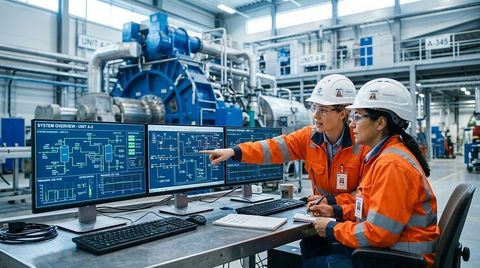
Real-time monitoring means information is collected and displayed with little delay. Operators can observe machine conditions, production values, alarms, and other operational indicators without waiting for manual reports.
Process control goes a step further by using measurements and programmed rules to influence equipment operation. For example, a controller may adjust a motor speed when a sensor detects a change in process conditions.
This combination allows factories to connect observation with automated responses while maintaining defined operating parameters.
Importance
Why Connected Factory Systems Matter
Manufacturing environments contain many processes that can change quickly. A temperature increase, pressure variation, motor vibration, material shortage, or production interruption can affect several stages of a process.
Factory IoT tools provide a structured way to observe these changes. Instead of relying only on periodic inspections, operators can review current information through dashboards, alarms, and machine interfaces.
The technology also creates historical records. These records can help teams understand how equipment behaved over time and identify patterns that may not be visible during a single inspection.
Who Uses Factory IoT Tools
Factory IoT affects different groups within an industrial organization. Operators use monitoring interfaces to observe equipment, while maintenance teams examine machine conditions and historical readings.
Production managers can review production information, and engineering teams can analyze equipment behavior or automation performance. Information technology teams may manage networks, data platforms, user access, and cybersecurity controls.
The technology can also affect workers indirectly because automated monitoring changes how inspections, reporting, maintenance planning, and production coordination are performed.
Problems Addressed by Real-Time Monitoring
Factory IoT can address several common operational challenges:
- Limited visibility into machine conditions
- Manual recording of production information
- Delayed detection of abnormal operating conditions
- Difficulty comparing historical machine performance
- Disconnected equipment from different manufacturers
- Limited access to production information outside control areas
- Difficulty identifying recurring process variations
The following table illustrates common Factory IoT functions and the type of information they can provide.
| Factory IoT Function | Typical Data | Common Purpose |
|---|---|---|
| Machine Monitoring | Runtime, speed, status | Equipment visibility |
| Condition Monitoring | Vibration, temperature | Equipment assessment |
| Energy Monitoring | Voltage, current, power | Energy analysis |
| Production Monitoring | Output, cycle time | Production tracking |
| Quality Monitoring | Measurements, defect data | Process analysis |
| Environmental Monitoring | Humidity, temperature | Facility observation |
| Predictive Analytics | Historical sensor patterns | Maintenance planning |
| Process Control | Setpoints, control values | Automated adjustment |
Relationship Between IoT and Automation
IoT and automation are related but have different roles. Automation focuses on controlling machines and processes according to programmed instructions, while IoT focuses on connecting equipment and making operational information available.
When combined, the two technologies can create a connected control environment. Sensors collect information, controllers respond to defined conditions, gateways transfer data, and software presents information for analysis.
Recent Updates
Growth of Edge Computing
Edge computing has become an important part of modern factory IoT architecture. Instead of transferring every piece of information to a remote platform, some processing can occur close to machines.
This approach can reduce unnecessary data movement and allow certain monitoring functions to continue with limited dependence on external networks. Edge systems are particularly useful when fast responses or continuous equipment observation are required.
More Connected Industrial Equipment
Modern industrial equipment increasingly includes communication capabilities that allow machine information to be integrated with wider factory systems. Industrial Ethernet, wireless technologies, machine protocols, and gateway devices can connect equipment with different communication methods.
This trend is also increasing interest in interoperability. Factories may contain machines from different generations, so communication layers are important for combining older equipment with newer digital systems.
Greater Use of Industrial Analytics
Factory analytics has expanded from simple dashboards toward pattern recognition and condition analysis. Historical machine data can be examined to identify unusual behavior, recurring production changes, and relationships between operating conditions.
Machine learning can also be applied to selected industrial datasets. Its usefulness depends heavily on data quality, sensor reliability, appropriate models, and proper interpretation.
Increased Attention to Cybersecurity
Connected factories create additional digital connections, which increases the importance of cybersecurity. Modern industrial environments may use network segmentation, access controls, authentication, secure communication, system monitoring, and software update procedures.
Cybersecurity is now considered alongside automation architecture rather than being treated only as an information technology concern.
Laws or Policies
Industrial Data and Safety Requirements
Factory IoT systems operate within several types of rules, and requirements vary by country and industrial sector. Workplace safety rules can influence how automated equipment, sensors, robots, control systems, and emergency mechanisms are designed and operated.
Industrial facilities may also need to follow requirements concerning electrical systems, machinery safety, environmental conditions, product quality, and recordkeeping.
Data Protection Considerations
Although factory IoT primarily collects equipment information, some systems can also process information associated with workers, access records, productivity measurements, or facility activity.
Where personal information is involved, applicable data protection rules may influence how information is collected, stored, accessed, transferred, and retained. Organizations generally need to understand which data their connected systems process and which legal requirements apply.
Cybersecurity Policies
Industrial cybersecurity policies increasingly address connected control environments. Depending on the jurisdiction and industry, organizations may need documented controls for access management, incident response, system security, network protection, and risk management.
Factories operating across multiple regions may need to consider several regulatory frameworks simultaneously. The specific requirements depend on the equipment, industry, data, and location.
Tools and Resources
Industrial IoT Platforms
Industrial IoT platforms provide functions for collecting, organizing, visualizing, and analyzing equipment information. They can connect sensors and controllers with dashboards, databases, analytics applications, and enterprise systems.
Common platform capabilities include device management, data visualization, alarm management, historical data storage, user permissions, and integration interfaces.
SCADA Systems
Supervisory Control and Data Acquisition systems are widely used for monitoring and controlling industrial processes. SCADA environments can display equipment status, process values, alarms, and historical trends.
They are commonly connected to programmable logic controllers and remote equipment through industrial communication networks.
PLC Programming Tools
Programmable logic controllers remain central to industrial automation. PLC programming environments allow engineers to create control logic, configure inputs and outputs, monitor machine states, and diagnose certain operating conditions.
Different PLC manufacturers use different programming environments and communication methods, making compatibility an important consideration in connected factories.
Dashboards and Data Visualization
Factory dashboards convert equipment information into charts, indicators, alarms, and trend displays. A well-structured dashboard can help users understand production conditions without reviewing raw sensor records individually.
Common dashboard measurements include machine uptime, cycle duration, temperature, pressure, energy consumption, production quantity, and alarm frequency.
Digital Twins
Digital twin technology creates a digital representation of physical equipment or processes. Depending on the application, a digital twin can combine sensor information, engineering models, historical records, and simulation data.
These systems can be used to study equipment behavior, compare operating scenarios, and understand process relationships without changing the physical production environment.
FAQs
What is Factory IoT?
Factory IoT is the connection of industrial machines, sensors, controllers, software, and networks so equipment information can be collected, communicated, and analyzed. It supports monitoring, automation, and process control.
How does real-time monitoring work in a factory?
Real-time monitoring uses sensors and industrial control systems to collect information from equipment. The information is transferred to monitoring software where operators can view machine status, process measurements, alarms, and trends.
What are Factory IoT and automation tools used for?
Factory IoT and automation tools are used for machine monitoring, production tracking, process control, energy analysis, equipment condition monitoring, quality analysis, and industrial data management.
What role does edge computing play in Factory IoT?
Edge computing processes selected information close to the machines that generate it. This can support faster local analysis and reduce the amount of information that needs to move to centralized platforms.
Are Factory IoT systems affected by cybersecurity rules?
Yes. Connected industrial environments can be subject to cybersecurity policies and sector-specific requirements. Access control, network protection, authentication, monitoring, and incident response are common areas of consideration.
Conclusion
Factory IoT connects industrial equipment, sensors, controllers, networks, and software to improve access to operational information. Real-time monitoring helps users observe machine and process conditions, while automation systems can respond to defined control requirements. Recent developments include greater use of edge computing, industrial analytics, connected equipment, digital twins, and cybersecurity controls. Regulations and technical requirements vary according to industry, location, equipment, and the type of information processed.