Industrial Automation Overview With Modern Manufacturing and Technology Insights
Industrial automation refers to the use of machines, control systems, sensors, software, and robotics to perform manufacturing activities with limited direct manual control. It has developed from basic mechanical equipment into connected systems that can monitor processes, adjust operations, collect information, and coordinate different stages of production.
The foundations of industrial automation can be traced to mechanized manufacturing, electrical controls, and early automatic machines. As electronics and computing developed, programmable logic controllers (PLCs), industrial computers, sensors, and digital control systems became important parts of manufacturing automation.
Today, industrial automation connects physical equipment with digital technologies. A modern production line may include industrial robots, machine vision, motion controllers, programmable logic controllers, industrial sensors, human-machine interfaces, and manufacturing software. These technologies work together to control activities such as assembly, material movement, inspection, packaging, machining, and process monitoring.
Manufacturing automation exists because many industrial processes involve repetitive, precise, or continuously monitored activities. Automation can provide consistent machine operation while allowing people to focus on supervision, maintenance, quality assessment, process planning, and other activities that require judgment.
Main Components of Industrial Automation
An automated manufacturing system usually contains several connected layers. Sensors collect information from equipment and production processes, while controllers interpret that information and determine how machines should respond.
Actuators then perform physical actions, such as moving a robotic arm, opening a valve, positioning a component, or adjusting a motor. Human-machine interfaces allow operators to view machine conditions and interact with control systems.
Common components include:
- PLCs for controlling machine sequences
- Industrial sensors for detecting physical conditions
- Industrial robots for programmed movement and handling
- Machine vision systems for inspection and identification
- Motor drives for controlling speed and movement
- Human-machine interfaces for operator interaction
- Industrial networks for transferring machine information
- Manufacturing software for monitoring and analyzing production data
These components can operate as individual systems or as parts of a larger integrated automation architecture.
Importance
Industrial automation matters because modern manufacturing involves increasingly complex processes. Factories may need to coordinate machines, materials, inspection systems, production schedules, and digital records while maintaining consistent operating conditions.
For everyday consumers, automation can influence the products they use, from household appliances and electronics to packaged goods, vehicles, and industrial equipment. Although most people do not interact directly with factory automation, automated production affects how products are assembled, inspected, packaged, and transported.
Problems Addressed by Automation
Automation is particularly useful for repetitive activities. A machine can repeat a programmed movement many times without experiencing the same physical fatigue associated with repetitive manual activity.
Industrial automation can also support process monitoring. Sensors can continuously measure factors such as temperature, pressure, position, vibration, flow, speed, and electrical conditions. When measurements move outside defined ranges, control systems can record the event or initiate an appropriate machine response.
Automation can address several operational challenges:
- Repetitive production activities
- Consistent machine positioning
- Continuous process monitoring
- Material handling
- Automated inspection
- Production data collection
- Coordination between machines
- Reduction of unnecessary manual exposure to hazardous environments
Automation does not eliminate the need for people. Human knowledge remains important for system design, programming, maintenance, troubleshooting, quality management, and operational decisions.
Industrial Robots and Smart Manufacturing
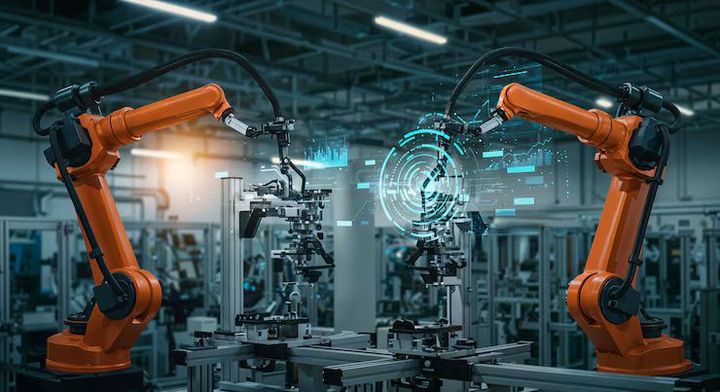
Industrial robots are a major part of modern manufacturing automation. They can be programmed for activities such as welding, assembly, palletizing, machine tending, painting, and material handling.
Collaborative robots, commonly called cobots, are designed for applications where people and robotic equipment may work in closer proximity under appropriate safeguards. Their use depends on the task, workspace design, risk assessment, and applicable safety requirements.
Smart manufacturing expands automation by connecting equipment with information systems. Instead of treating every machine as an isolated unit, connected systems can share information about production conditions, equipment status, and process performance.
Automation and Operational Data
Data has become an important part of industrial automation. A sensor can generate information about equipment conditions, while a control system can record machine states and production events.
Manufacturers can use this information to understand process behavior and identify unusual patterns. For example, a gradual increase in machine vibration may indicate a developing mechanical issue that requires inspection.
The following table shows common automation technologies and their general functions.
| Technology | Main Function | Typical Application |
|---|---|---|
| PLC | Controls machine sequences | Assembly equipment |
| Industrial robot | Performs programmed movement | Welding and handling |
| Sensor | Detects physical conditions | Temperature or position monitoring |
| Machine vision | Processes visual information | Inspection |
| HMI | Displays and controls machine information | Operator interface |
| Motor drive | Controls motor operation | Conveyors and machinery |
| Industrial network | Connects equipment | Data communication |
| Manufacturing software | Organizes production information | Monitoring and analysis |
Recent Updates
Industrial automation has continued moving toward connected, data-driven manufacturing during 2024–2026. One major trend is the integration of artificial intelligence with machine vision, production analytics, predictive monitoring, and process optimization.
Artificial intelligence can analyze large quantities of operational data and identify patterns that may be difficult to recognize manually. In manufacturing environments, this can support activities such as visual inspection, anomaly detection, equipment monitoring, and production analysis.
Industrial IoT and Connected Equipment
The Industrial Internet of Things, or IIoT, connects machines, sensors, controllers, and software through industrial communication networks. Connected equipment can provide information that supports centralized monitoring and analysis.
Edge computing is also becoming more relevant. Instead of sending every piece of information to a distant data center, some processing can take place close to the machines generating the data. This can help reduce communication delays and support applications that require rapid responses.
Digital Twins and Simulation
Digital twins are another developing area in manufacturing technology. A digital twin is a digital representation of a physical machine, production line, or process.
Depending on its design, a digital twin can combine operational information with engineering models and simulation. It can help teams study equipment behavior, evaluate process changes, or understand how a production system may respond under different conditions.
Cybersecurity and Automation
Greater connectivity also increases the importance of industrial cybersecurity. Factory equipment connected to internal networks or external systems can face risks related to unauthorized access, malicious software, configuration errors, and data exposure.
Modern automation planning therefore increasingly considers network segmentation, access controls, software updates, authentication, backups, monitoring, and secure system design.
Laws or Policies
Industrial automation is shaped by workplace safety rules, machinery requirements, electrical regulations, cybersecurity expectations, and environmental policies. The exact legal requirements vary by country, industry, machine type, and application.
Because industrial automation is used globally, manufacturers and facility operators may need to consider national laws alongside recognized international standards. Requirements can cover machine guarding, emergency controls, electrical safety, worker exposure, equipment documentation, and risk assessment.
Safety and Machine Controls
Automated equipment can contain moving mechanisms, electrical systems, heated surfaces, pressure systems, or other hazards. Safety measures may include physical guards, emergency stopping functions, protective sensors, controlled access, warning systems, and documented operating procedures.
Industrial robots also require appropriate risk assessment and protective measures. The safeguards depend on the robot, application, workspace, and interaction between people and machines.
Cybersecurity policies are increasingly relevant where industrial control systems connect to enterprise networks or external infrastructure. Organizations may establish rules covering account permissions, network access, software management, incident response, and data protection.
Environmental policies can also influence automation projects. Energy monitoring, efficient motor control, process optimization, and equipment management can help organizations understand resource use within industrial operations.
Tools and Resources
Several tools help people understand, design, operate, and analyze industrial automation systems. PLC programming environments are used to create machine-control logic, while HMI development platforms create operator interfaces.
Simulation software can model robotic movements, production lines, and manufacturing processes before physical implementation. Industrial network diagnostic tools can help examine communication between controllers, sensors, drives, and other equipment.
Other useful resources include:
- PLC programming references
- Industrial automation training materials
- Robot simulation platforms
- Electrical and control-system diagrams
- Machine safety checklists
- Industrial communication documentation
- Equipment maintenance records
- Production monitoring dashboards
- Digital twin and process simulation tools
- Cybersecurity frameworks for industrial control environments
Standards organizations and technical institutions also publish guidance covering machinery safety, industrial communication, automation architecture, and cybersecurity. These resources can help readers understand the terminology and principles behind industrial automation without requiring an engineering background.
FAQs
What is industrial automation?
Industrial automation is the use of control systems, machines, sensors, software, and robotics to perform manufacturing processes with limited direct manual control. It can include everything from a single automated machine to a connected production facility.
How does manufacturing automation work?
Manufacturing automation uses sensors to collect information, controllers such as PLCs to process programmed instructions, and machines or actuators to perform physical actions. Software and communication networks can connect these components for monitoring and coordination.
What role do industrial robots play in industrial automation?
Industrial robots perform programmed physical activities such as assembly, welding, handling, packaging, and machine tending. Their operation normally depends on application-specific programming, workspace design, and appropriate safety controls.
What are PLCs used for in manufacturing automation?
PLCs are industrial controllers designed to manage machine operations and sequences. They can receive signals from sensors, execute programmed logic, and send commands to equipment such as motors, valves, and actuators.
How is artificial intelligence changing industrial automation?
Artificial intelligence is increasingly used for applications such as visual inspection, anomaly detection, production analysis, and equipment monitoring. Its usefulness depends on data quality, system design, application requirements, and appropriate human oversight.
Conclusion
Industrial automation combines machines, sensors, controllers, robotics, software, and communication technologies to manage manufacturing processes. Its development is increasingly connected with artificial intelligence, industrial IoT, edge computing, digital twins, and cybersecurity. Safety rules and technical standards remain important because automated equipment can involve physical, electrical, and digital risks. Overall, modern manufacturing automation represents an ongoing shift toward more connected, measurable, and digitally managed industrial processes.