Explore Surgical Mask Making Machines With Automated Production and Engineering Insights
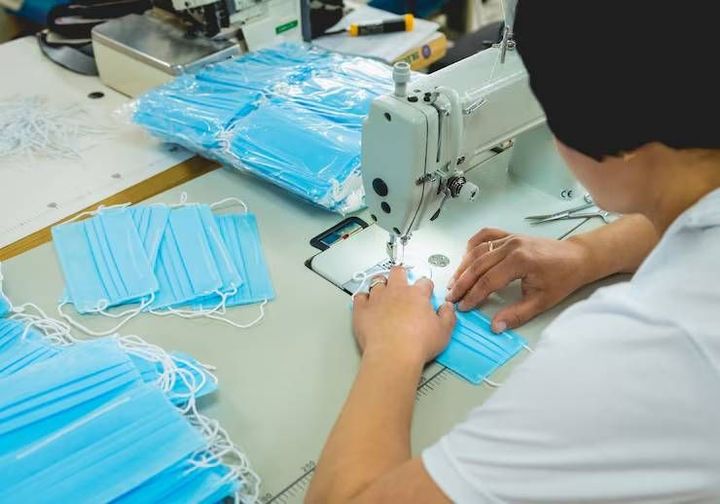
Surgical mask making machines are industrial systems designed to manufacture disposable medical masks through a series of connected production steps. These machines process nonwoven fabrics, form multiple protective layers, attach ear loops, create nose bridges, and seal the edges to produce masks with consistent shapes and dimensions.
Depending on the equipment design, production may be fully automated, partially automated, or supported by manual handling.
The development of surgical mask manufacturing equipment is closely connected to advances in textile processing, ultrasonic welding, automated material handling, and healthcare product manufacturing. As hospitals, clinics, laboratories, and other healthcare facilities require protective face coverings, manufacturers use specialized machinery to produce masks in repeatable batches.
Modern surgical mask production lines typically combine fabric feeding, pleating, cutting, welding, and assembly operations. Their configuration depends on the intended mask design, material specifications, production capacity, and applicable quality requirements. Understanding these systems helps readers learn how industrial automation supports the manufacture of disposable protective equipment.
How surgical mask making machines work
A typical surgical mask making machine converts rolls of nonwoven fabric into finished masks through a sequence of mechanical and automated operations. Several layers of material are aligned, folded, and joined before the nose wire and ear loops are attached.
Common production stages include:
Fabric feeding: Rolls of nonwoven material enter the machine through controlled feeding mechanisms.
Layer alignment: Multiple fabric layers are positioned to maintain consistent dimensions.
Pleating: The fabric is folded to create expandable sections that accommodate different face shapes.
Cutting: Automated blades or cutting mechanisms separate the mask body into individual pieces.
Ultrasonic welding: High-frequency mechanical vibrations generate localized heat that bonds compatible thermoplastic materials without conventional stitching.
Ear-loop attachment: The machine attaches elastic loops using suitable welding or joining methods.
Inspection and collection: Finished masks are checked for visible defects and gathered for subsequent quality assessment and packaging.
Not every production line performs all these operations within one machine. Some facilities use separate mask-body forming and ear-loop attachment equipment, while integrated systems combine several stages.
Main types of manufacturing equipment
Surgical mask production equipment is available in several configurations. The appropriate arrangement depends on the mask design, required output, available floor space, and level of automation.
Mask-body forming machines create the pleated rectangular section of the mask. They generally include fabric-feeding systems, folding mechanisms, cutting assemblies, and ultrasonic bonding units.
Ear-loop welding machines attach elastic loops to prepared mask bodies. Some operate as standalone units, while others form part of an integrated production line.
Fully automated production lines coordinate multiple manufacturing stages through sensors, programmable controllers, and synchronized mechanisms. They can reduce repeated manual handling, although operators remain necessary for monitoring, material replenishment, inspection, and maintenance.
Semi-automatic machines combine mechanical processing with selected manual tasks. These configurations may suit smaller manufacturing facilities or operations that require greater flexibility in handling different product designs.
Importance
Surgical mask making machines matter because consistent manufacturing is essential for producing protective equipment used in healthcare and other environments where appropriate face coverings are required. Automated equipment can help manufacturers maintain repeatable dimensions, reduce handling errors, and organize production processes more systematically.
The equipment also affects production planning, workforce responsibilities, material utilization, and quality management. Hospitals and healthcare distributors depend on suitable products being available through established supply chains, while manufacturers must balance production capacity with product specifications and inspection requirements.
Who uses these machines?
Different organizations participate in surgical mask manufacturing and distribution. Their equipment requirements vary according to production volume, product design, and quality assurance procedures.
Medical textile manufacturers use production lines to convert nonwoven fabrics into finished masks.
Healthcare equipment manufacturers integrate mask production with broader protective equipment operations.
Contract manufacturers produce masks according to agreed product specifications and applicable quality systems.
Industrial production facilities use automation controls to coordinate manufacturing stages and track operational performance.
Quality control teams inspect finished products, document defects, and verify whether production meets defined acceptance criteria.
Factors affecting production performance
The performance of surgical mask manufacturing equipment depends on more than its advertised operating speed. Material characteristics, machine configuration, maintenance practices, and inspection procedures all influence actual production results.
Fabric thickness and layer alignment can affect feeding accuracy and welding quality. Variations in elastic tension, nose-wire placement, or cutting alignment may produce defects that require adjustment or rejection.
Other important factors include changeover time, operator training, compressed-air requirements where applicable, electrical consumption, spare-part availability, and equipment downtime. Evaluating these variables provides a more complete understanding of manufacturing performance than considering nominal output alone.
Production measurements and quality indicators
Manufacturers can use operational measurements to understand machine performance and identify recurring problems. The following indicators are commonly relevant to automated production planning.
Indicator | What it measures | Why it matters |
|---|---|---|
Production rate | Masks produced per unit of time | Helps estimate manufacturing capacity |
Defect rate | Proportion of units that fail inspection | Indicates process consistency |
Machine availability | Time equipment remains ready for production | Helps identify downtime |
Material utilization | Amount of usable product obtained from input materials | Supports waste monitoring |
Changeover time | Time required to switch between approved production configurations | Affects scheduling efficiency |
Welding consistency | Repeatability of bonded areas | Supports structural quality checks |
These measurements should be interpreted together. A machine producing more units per minute may still have lower effective output if it experiences frequent stoppages or generates a high proportion of defective masks.
Recent Updates
Developments in surgical mask manufacturing increasingly focus on automation, process monitoring, energy management, and production traceability. Recent industry trends emphasize improving the consistency of manufacturing operations rather than relying exclusively on higher mechanical speeds.
Automation and intelligent monitoring
Programmable logic controllers, touch-screen interfaces, sensors, and automated fault alerts are widely relevant to modern manufacturing equipment. These technologies help coordinate fabric feeding, cutting, welding, and product transfer while giving operators information about machine status.
Some production systems incorporate cameras or other inspection technologies to identify visible defects, misplaced components, or irregular shapes. Automated inspection can support quality control, but it does not independently establish filtration performance, bacterial filtration efficiency, or compliance with medical-device requirements.
Improvements in ultrasonic welding
Ultrasonic welding remains an important technology for joining compatible nonwoven materials and attaching elastic components. Equipment designs may provide improved control over vibration, pressure, welding duration, and energy delivery.
Consistent process settings can help reduce weak bonds and material damage. However, the appropriate settings depend on the materials, joint design, and machine configuration, so manufacturers must validate the process for the intended product.
Flexible manufacturing and data tracking
Manufacturers increasingly consider equipment that supports controlled changeovers between compatible product configurations. Modular machine layouts can simplify the replacement or adjustment of selected components, although not every machine can accommodate every mask style.
Production monitoring systems can also record output, downtime, rejected units, and maintenance events. These records support troubleshooting, inventory planning, and traceability when linked to suitable batch identification and quality documentation procedures.
Current manufacturing considerations
Recent equipment planning increasingly considers the complete production system rather than the machine alone. This includes fabric supply, compressed air where required, packaging integration, operator safety, maintenance access, and product inspection.
Sustainability considerations also include material waste, electricity consumption, equipment longevity, and the handling of manufacturing scrap. These factors vary with the facility and production design, so comparisons require consistent measurement methods.
Laws or Policies
Surgical mask manufacturing is influenced by medical-device regulations, product standards, workplace safety requirements, and environmental rules. The exact obligations depend on the intended use of the mask, the claims made about its protection, and the jurisdiction where it is manufactured or distributed.
A machine's ability to produce a mask does not automatically mean the finished product qualifies as a compliant medical device. Manufacturers must evaluate the complete product and its intended use against the requirements that apply to their markets.
Medical-device and product requirements
Depending on the jurisdiction, surgical masks may need to meet requirements concerning bacterial filtration efficiency, differential pressure, splash resistance, microbial cleanliness, labeling, and other performance characteristics. Applicable test methods and thresholds vary by product classification and intended use.
Manufacturers should distinguish surgical masks from respirators. These products can have different performance requirements, testing procedures, and regulatory classifications, even when their materials or appearance seem similar.
Rules affecting manufacturing equipment
Production facilities may need to address several operational requirements:
Machine guarding and emergency stops to reduce risks from moving components.
Electrical safety and appropriate installation procedures.
Occupational safety measures for noise, maintenance, and material handling.
Documented production controls and quality inspection procedures.
Environmental management for manufacturing waste and rejected materials.
The equipment manufacturer may provide operating instructions, maintenance schedules, and technical documentation. The facility remains responsible for determining which local workplace, environmental, and product regulations apply to its operations.
Quality documentation and validation
Quality systems can include approved material specifications, machine setup records, inspection results, maintenance logs, and batch traceability. Where required, manufacturers may need to validate production processes and demonstrate that equipment consistently produces output meeting established specifications.
Filtration and other performance characteristics should be evaluated through appropriate testing rather than inferred from machine speed, fabric appearance, or welding strength alone.
Tools and Resources
Several technical resources help manufacturers and readers understand surgical mask making machines, compare equipment configurations, and evaluate production requirements.
Equipment evaluation tools
A structured equipment comparison sheet can record machine capacity, supported mask types, automation level, dimensions, utility requirements, changeover arrangements, and maintenance needs. Recording these details in a common format makes technical comparisons more meaningful.
Production capacity calculators can estimate theoretical output using the machine's rated speed and planned operating hours. Estimates should then account for changeovers, stoppages, inspection, and rejected products.
For example, a machine rated at 100 masks per minute has a theoretical hourly output of 6,000 masks. If it operates effectively for only 80% of the planned production time, its estimated output becomes 4,800 masks per hour, assuming the rated speed is maintained during operating periods and the calculation excludes additional yield losses.
Quality and engineering resources
Manufacturers can use several categories of technical resources:
Machine manuals: Explain operating controls, setup procedures, safety precautions, and maintenance intervals.
Material specification sheets: Describe fabric composition, thickness, and other relevant characteristics.
Inspection templates: Record dimensions, weld integrity, component placement, and visual defects.
Preventive maintenance checklists: Track cleaning, wear, lubrication where applicable, and replacement of consumable parts.
Product testing procedures: Assess relevant filtration, pressure-drop, splash-resistance, and other required performance characteristics.
Comparing machine specifications
The following comparison illustrates how equipment configurations differ in general terms. Actual capabilities depend on the individual machine and production line.
Feature | Semi-automatic system | Fully automated system |
|---|---|---|
Material handling | May require manual assistance | Usually more integrated |
Production coordination | Partial automation | Synchronized operations |
Operator involvement | More frequent handling | Primarily monitoring and intervention |
Changeover flexibility | Depends on machine design | Depends on automation and tooling |
Maintenance requirements | Mechanical and electrical checks | Mechanical, electrical, sensor, and control-system checks |
Quality inspection | May involve manual checks | May integrate automated inspection |
Equipment selection requires a review of actual specifications, product requirements, operator capabilities, and facility conditions rather than assumptions based on the automation category alone.
FAQs
What is a surgical mask making machine?
A surgical mask making machine is industrial equipment that forms mask bodies from nonwoven materials and joins components such as nose wires and ear loops. Depending on its configuration, it may perform individual manufacturing steps or coordinate an integrated production process.
How does an automatic surgical mask making machine work?
An automatic surgical mask making machine feeds fabric layers, forms pleats, cuts the material, and uses suitable joining methods to assemble mask components. Sensors and programmable controls coordinate the operations, while operators oversee production and quality checks.
What materials are used in surgical mask manufacturing?
Surgical masks commonly use nonwoven fabrics, including polypropylene-based materials, along with suitable elastic ear loops and nose-bridge components. Material selection depends on the mask design, intended use, and applicable performance requirements.
How is surgical mask quality tested?
Quality assessment can include dimensional checks, visual inspection, bond-strength evaluation, filtration testing, differential-pressure measurement, and splash-resistance testing where applicable. The required tests depend on the product classification and relevant standards.
What factors affect surgical mask making machine production capacity?
Production capacity depends on rated operating speed, material feeding, welding performance, changeover time, downtime, and the proportion of acceptable finished masks. Actual output may therefore differ from the manufacturer's nominal production rating.
Conclusion
Surgical mask making machines combine material handling, pleating, cutting, welding, and assembly technologies to manufacture disposable masks. Automation can improve process consistency and reduce repeated manual handling, while sensors and production records help operators monitor performance. Product quality still depends on suitable materials, validated manufacturing processes, inspection, and compliance with applicable requirements. Understanding machine configurations and production measurements provides a useful foundation for evaluating surgical mask manufacturing systems.