Explore Sheet Metal Bending Machines With Automated Bending Systems and Technical Details
Sheet metal bending machines are industrial machines designed to shape flat metal sheets into specific angles, curves, channels, and other forms. They apply controlled force to change the shape of metal without cutting it completely apart.
These machines are widely used in manufacturing, construction, automotive production, electrical equipment, furniture fabrication, and industrial enclosure manufacturing.
The development of sheet metal bending technology is closely connected to the growth of metalworking and industrial production. Traditional bending methods relied on manual tools, mechanical presses, and operator experience. As manufacturing requirements became more complex, hydraulic systems, programmable controls, and computer-assisted bending technologies emerged to improve consistency and reduce repetitive manual work.
Modern sheet metal bending machines include manual, mechanical, hydraulic, electric, and computer numerical control (CNC) models. Each type is designed for different material thicknesses, production volumes, component shapes, and accuracy requirements. Automated bending systems combine machine controls, positioning equipment, sensors, and sometimes robotic handling to coordinate the bending process.
Understanding these machines helps readers recognize how metal components are manufactured and why different bending technologies are selected for different applications. Their operation involves several technical factors, including material properties, bending force, tooling geometry, machine capacity, and production requirements.
How sheet metal bending works
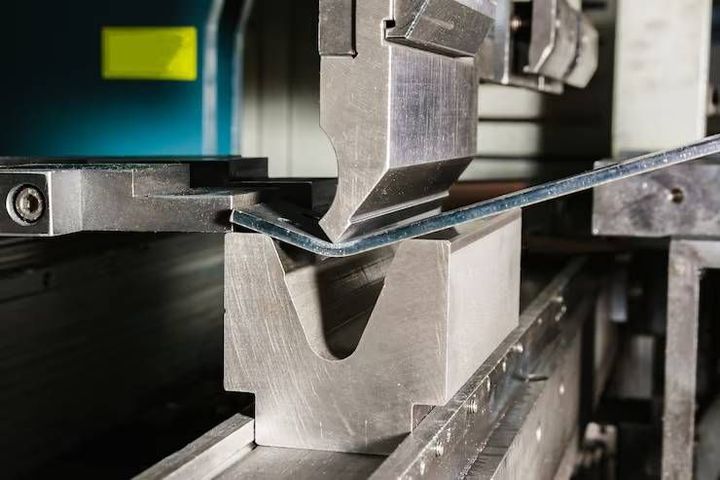
The bending process begins with a flat sheet placed against a machine's supporting surface or positioning system. A punch, bending beam, or other forming mechanism applies force to create the required shape, while a die or supporting tool helps control the deformation.
The final angle depends on several factors, including sheet thickness, metal strength, tooling dimensions, and the depth of the bend. Manufacturers must also account for springback, which occurs when metal partially returns toward its original shape after the applied force is removed.
Main types of sheet metal bending machines
Different machine designs support different manufacturing needs.
Manual bending machines use hand-operated mechanisms and are generally suited to simpler components and smaller production volumes.
Mechanical bending machines use mechanical drive systems to produce controlled forming movements.
Hydraulic press brakes use hydraulic pressure to generate bending force and accommodate a wide range of industrial applications.
Electric press brakes use electric drive mechanisms to control machine movement and can support precise positioning.
CNC sheet metal bending machines use programmable controls to coordinate bending angles, backgauges, and production sequences.
Robotic bending systems combine bending equipment with robotic arms or automated handling devices to move parts through repeated operations.
Importance
Sheet metal bending machines play an important role in producing the metal components found in everyday products. Electrical cabinets, ventilation ducts, vehicle body components, industrial panels, storage enclosures, and building elements often require accurately bent sheet metal.
Without controlled bending processes, manufacturers may experience inconsistent angles, uneven dimensions, surface damage, material waste, and difficulties assembling finished components. These problems can affect product fit, structural performance, manufacturing schedules, and the reliability of downstream production.
Who uses sheet metal bending equipment?
Several industries depend on these machines for regular production activities.
Construction manufacturers use bending equipment to form metal roofing components, flashing, brackets, and structural accessories.
Automotive manufacturers shape panels, brackets, reinforcement components, and selected body parts.
Electrical equipment manufacturers produce control cabinets, equipment housings, mounting panels, and protective enclosures.
HVAC manufacturers bend sheet metal for ventilation ducts, fittings, and air distribution components.
Furniture manufacturers create metal frames, supports, shelves, and decorative components.
Industrial equipment manufacturers use formed sheet metal for machine covers, protective guards, and fabricated assemblies.
The equipment selected by each industry depends on the material, required geometry, expected production volume, and acceptable dimensional variation.
Common manufacturing challenges
One challenge is maintaining consistent bend angles across multiple components. Differences in sheet thickness, material hardness, tooling condition, and machine calibration can produce variations between parts.
Another challenge is managing springback. Metals behave differently after bending, so operators may need to adjust the programmed angle or forming depth to achieve the intended final shape.
Other important considerations include:
Preventing scratches, dents, and surface marks.
Selecting suitable punch and die geometries.
Managing complex parts with several bends.
Maintaining safe distances between operators and moving machine components.
Coordinating material handling with the bending sequence.
Reducing unnecessary setup changes between production batches.
These challenges explain why modern bending systems increasingly rely on digital programming, measurement tools, and automated positioning.
Technical factors that affect bending results
Bending quality depends on the interaction between material characteristics and machine settings. Sheet thickness, tensile strength, bend radius, tooling opening, and bending method all influence the final result.
Air bending, bottoming, and coining are three common press-brake methods. Air bending forms the sheet through contact with the punch and die without forcing it completely against the bottom of the die. Bottoming pushes the material more firmly into the die profile, while coining applies higher pressure to produce a more closely defined shape.
Technical factor | Meaning | Effect on production |
|---|---|---|
Bending force | Force applied to deform the sheet | Determines the machine capacity required |
Sheet thickness | Thickness of the metal material | Influences force, tooling, and bend radius |
Bend angle | Intended angle after forming | Affects component fit and assembly |
Bend radius | Curvature at the inside of the bend | Influences material strain and cracking risk |
Backgauge position | Reference position used to locate the sheet | Helps control flange dimensions |
Springback compensation | Adjustment for elastic recovery | Improves final angle consistency |
CNC control | Programmable management of machine movements | Supports repeatable bending sequences |
Recent Updates
Current developments in sheet metal bending focus on automation, digital controls, connected manufacturing systems, and improved monitoring. These developments are helping manufacturers coordinate complex bending operations while managing material variation and production requirements.
Growth of automated bending systems
Automated bending systems increasingly combine CNC press brakes with robotic arms, automatic tool changers, sheet loading equipment, and part unloading mechanisms. Depending on the configuration, these systems can handle repeated bending sequences with less direct manual intervention.
Robotic handling is particularly useful when components are heavy, repetitive, or difficult to position consistently. However, automation requires suitable programming, equipment integration, safety planning, and maintenance.
Improved CNC controls and digital programming
Modern CNC controls allow operators to enter component dimensions, define bending sequences, and configure machine movements through digital interfaces. Some systems include graphical part programming, three-dimensional simulation, and automatic bend-sequence calculations.
Simulation can help identify collisions between the workpiece, tooling, and machine structure before physical production begins. It can also help operators evaluate whether a proposed sequence is practical for the selected machine.
Sensors and process monitoring
Sensors and measurement systems can monitor machine position, bending force, material alignment, and other operating conditions. Some advanced systems use angle measurement or adaptive control to compensate for variations in material behavior.
These technologies do not eliminate every production error. Their effectiveness depends on sensor capability, calibration, material conditions, programming quality, and the specific machine configuration.
Energy efficiency and connected manufacturing
Electric and hybrid press brakes are part of a broader shift toward managing energy consumption in industrial equipment. Their actual energy use depends on the machine design, workload, operating cycle, and production conditions.
Connected manufacturing systems can also record production information, machine status, and maintenance indicators. This data may help production teams identify recurring issues and coordinate machine availability with other manufacturing operations.
Laws or Policies
Sheet metal bending machines are affected by workplace safety requirements, machinery design standards, electrical safety rules, and environmental obligations. The applicable requirements depend on the country where the machine is manufactured, installed, or operated.
Because the intended country has not been specified, the following overview describes common regulatory areas rather than the legal requirements of one jurisdiction.
Machinery and operator safety
Industrial machinery regulations commonly address the prevention of injuries caused by moving components, crushing points, electrical hazards, unexpected machine movement, and flying material.
Relevant safety measures may include:
Physical guards and protective barriers around hazardous areas.
Light curtains or other presence-sensing protective devices where appropriate.
Emergency stop controls and clearly identified operating controls.
Safe procedures for changing tools and maintaining equipment.
Training for operators, technicians, and maintenance personnel.
Procedures for isolating energy sources before maintenance.
A machine's safety requirements depend on its design, intended use, automation level, and installation environment. A robotic bending cell may require additional protective measures because the robot and press brake create a combined work area.
Standards and regulatory frameworks
Manufacturers and industrial operators may need to consider machinery safety standards, electrical equipment standards, and risk-assessment procedures. Examples include the ISO 12100 framework for machinery risk assessment and risk reduction, along with relevant press-brake safety standards and applicable national machinery regulations.
Where equipment is imported or installed across different markets, documentation, conformity assessments, and local workplace requirements may also apply. Requirements should be evaluated for the actual machine configuration and operating location rather than assumed to be identical worldwide.
Environmental and workplace considerations
Industrial facilities may also need to manage electrical consumption, hydraulic fluid handling, metal scrap, noise, and other workplace impacts. Proper storage of fluids, routine inspection, and organized waste handling can help reduce environmental and operational risks.
Tools and Resources
Several technical tools help manufacturers plan bending operations, select equipment, and check component dimensions. The usefulness of each tool depends on the complexity of the part and the information available about the material and machine.
Sheet metal bending calculators
Bend allowance and bend deduction calculators help estimate the flat pattern dimensions required before a sheet is formed. These calculations depend on material thickness, inside bend radius, bend angle, and the material's bend characteristics.
A K-factor calculator estimates the location of the neutral axis within the material during bending. The appropriate value varies with material, tooling, and bending conditions, so calculated dimensions may require verification through testing or established production data.
CNC programming and simulation software
Bending software helps create component models, plan bending sequences, and evaluate machine movements. Some applications simulate potential collisions and calculate backgauge positions, helping reduce setup uncertainty.
Compatibility matters because software features vary by manufacturer, machine model, controller, and available tooling library. A program developed for one machine may require adjustments before it can run on another.
Machine specification comparison
A technical specification sheet helps readers compare different sheet metal bending machines using measurable characteristics.
Specification | What to examine |
|---|---|
Bending length | Maximum workpiece length supported |
Pressing capacity | Maximum rated bending force |
Maximum material thickness | Supported thickness for a defined material and bend |
Backgauge axes | Available positioning directions |
Control system | Programming, simulation, and measurement functions |
Tool compatibility | Supported punches, dies, and tool-changing arrangements |
Automation options | Robotic handling and automatic loading capabilities |
Safety equipment | Guards, protective devices, and control features |
Rated capacity alone does not establish whether a machine can form a particular component. Material strength, bend length, die opening, and tooling configuration must also be considered.
FAQs
What are sheet metal bending machines used for?
Sheet metal bending machines form flat metal sheets into angles, channels, flanges, enclosures, brackets, and other shapes. They are used in construction, automotive manufacturing, HVAC production, electrical equipment, and general metal fabrication.
How do automated sheet metal bending systems work?
Automated sheet metal bending systems combine programmable bending equipment with positioning devices, sensors, or robotic handling. The system follows programmed instructions to position parts and complete a sequence of bends, depending on its configuration.
What is the difference between a CNC press brake and a hydraulic press brake?
A hydraulic press brake uses hydraulic pressure to generate bending force. A CNC press brake uses computerized controls to manage movements and bending sequences; many CNC press brakes are hydraulic, although electric and hybrid models are also available.
Which factors affect sheet metal bending accuracy?
Accuracy depends on material thickness, material strength, tooling geometry, bend radius, machine calibration, backgauge positioning, and springback. Consistent setup and suitable measurement procedures help control dimensional variation.
What safety measures are important when operating sheet metal bending machines?
Important measures include suitable machine guarding, functioning protective devices, operator training, safe tool-changing procedures, and proper energy isolation during maintenance. Safety controls must match the machine design and applicable workplace requirements.
Conclusion
Sheet metal bending machines transform flat metal sheets into components used across construction, transportation, equipment manufacturing, and many other industries. Modern CNC controls, sensors, and robotic handling systems support more coordinated and repeatable bending operations. Machine selection and production quality depend on material properties, bending capacity, tooling, programming, and workplace safety. Understanding these technical factors provides a foundation for evaluating manual, hydraulic, electric, and automated bending technologies.